What is ROAS and what is a good ROAS for your business
What is ROAS: the revenue each unit of ad spend generates. A good ROAS depends on your margin: with a 35% margin, you need at least 2.86x to break even.
· 2 min read
If you run digital ads, knowing what is ROAS is key to telling whether your campaigns work. ROAS (return on ad spend) measures how much comes back in sales for every unit you spend on ads. Google Ads explains it with an example: if you sell €5 for every €1 spent, your ROAS is 500%, or 5x. You can calculate yours with our ROAS calculator.
CLP 500,000
Ad spend
in the month
CLP 1,800,000
Sales generated
attributed to the campaign
3.6x
ROAS
CLP 3.6 in sales per CLP 1
Source: InfoByData calculation with a sample campaign
View the data as a table
| Ad spend | CLP 500,000 | in the month |
| Sales generated | CLP 1,800,000 | attributed to the campaign |
| ROAS | 3.6x | CLP 3.6 in sales per CLP 1 |
What is ROAS and how is it calculated
The formula is simple:
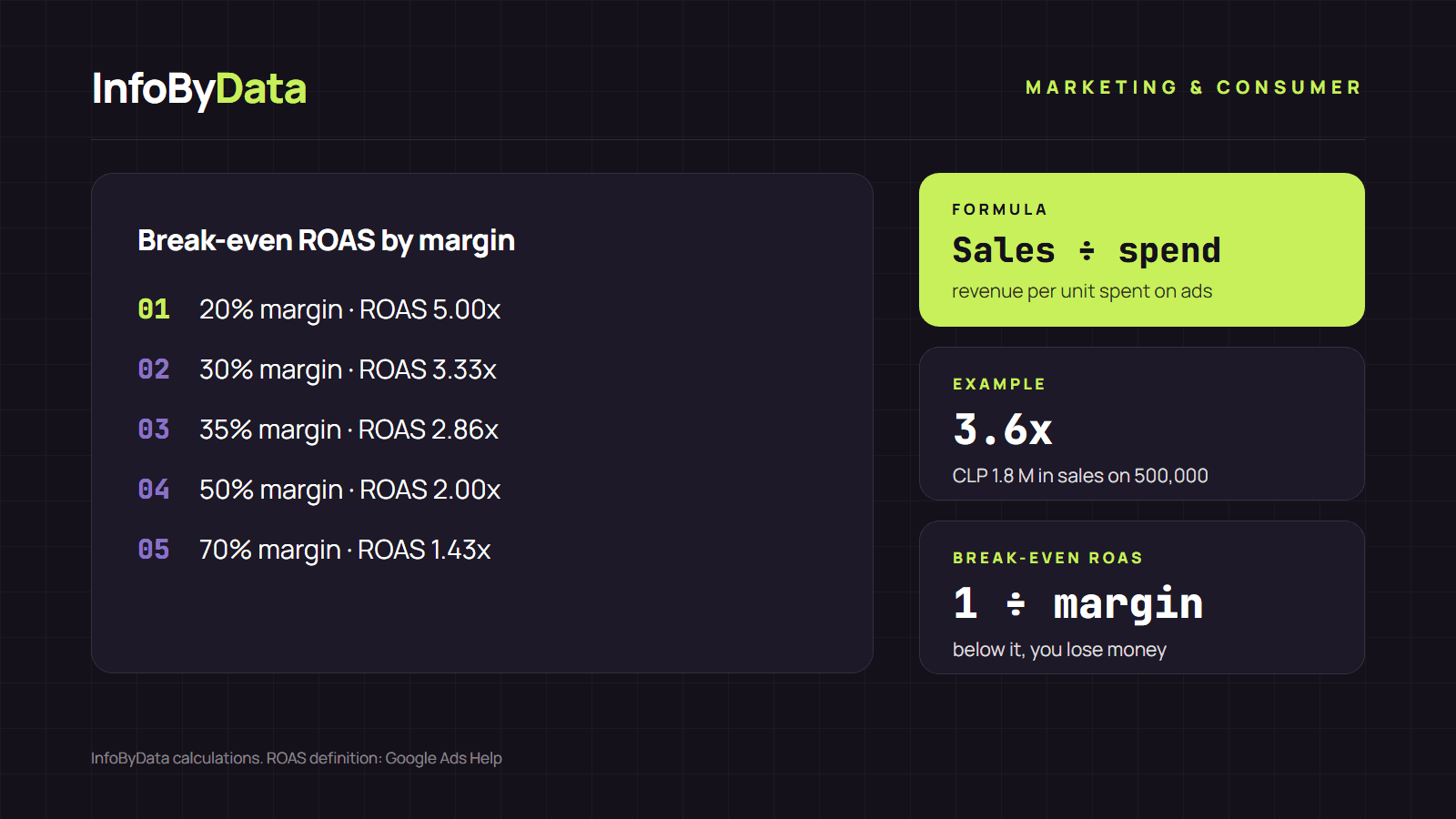
ROAS = revenue generated by the campaign ÷ ad spend
If you spent CLP 500,000 on Google or Meta and that campaign generated CLP 1,800,000 in sales, your ROAS is 3.6x. Google Ads also expresses it as a percentage: multiply by 100, so a 3.6x ROAS equals 360%.
What is a good ROAS: it depends on your margin
There is no single "good" ROAS for everyone. A 3x ROAS can be excellent for one company and a loss for another, because ROAS measures sales, not profit. What matters is whether sales cover the cost of the products and the ads.
The break-even ROAS is calculated like this:
Break-even ROAS = 1 ÷ margin
| Your business margin | Break-even ROAS |
|---|---|
| 20% | 5.00x |
| 30% | 3.33x |
| 35% | 2.86x |
| 50% | 2.00x |
| 70% | 1.43x |
InfoByData calculation. Margin is the share of the price that is profit after product cost.
With a 35% margin, the sample campaign (3.6x ROAS) is profitable, because it beats the 2.86x minimum. If you don't know your margin, work it out with our margin calculator or read how to calculate the selling price.
ROAS, CPA and CPC: the metrics that go with it
Knowing what is ROAS isn't enough: it's best read alongside other metrics.
| Metric | Formula | What it tells you |
|---|---|---|
| CPC | Spend ÷ clicks | How much you pay per visit |
| CTR | Clicks ÷ impressions | How appealing your ad is |
| Conversion rate | Sales ÷ clicks | How well your site converts |
| CPA | Spend ÷ sales | How much each sale costs you |
| ROAS | Revenue ÷ spend | How much comes back per unit spent |
If ROAS is low, these metrics show where the problem is: a low CTR points to the ad; a low conversion rate, to your site or offer. We explain more metrics in our article on marketing KPIs.
How to measure ROAS properly
To know what is ROAS for each campaign, you need to attribute sales correctly. Tag your ad links with our UTM link builder so Google Analytics records which campaign each sale comes from.
What it means for you
- Calculate your break-even ROAS before spending. Divide 1 by your margin: below that floor, every sale loses you money.
- Don't compare your ROAS with other businesses'. A 2x ROAS is profitable with a 60% margin and a loss with 30%.
- Read ROAS together with CPA and conversion rate. They help you find which part of the campaign to improve. The calculations in this article are for reference.
Sources
- Google Ads Help, target ROAS
- InfoByData calculations using the standard ROAS, CPA, CPC and CTR formulas.
- what is ROAS
- ROAS
- CPA
- digital advertising
- Google Ads
- ROAS calculator