Chile's REP Law: what companies must do with their packaging and what the recycling targets are
Chile's REP Law requires companies that sell packaged products to fund their recycling. In 2026 they must recycle 65% of non-household paper and cardboard.
· 2 min read
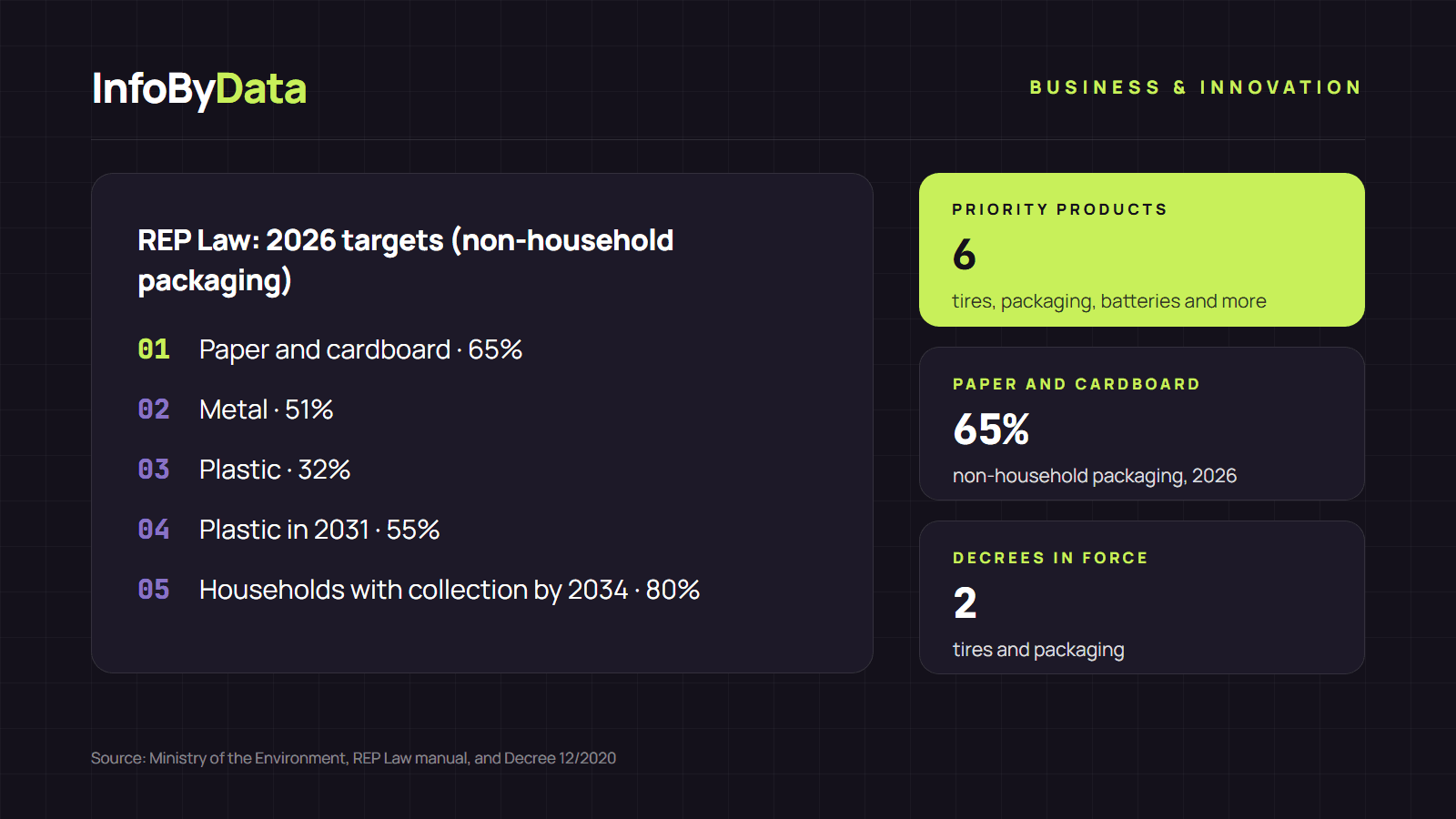
Chile's REP Law changed how companies handle their waste. According to the Ministry of the Environment, Law 20,920, published in 2016, requires companies that put certain products on the market to fund and organize their recycling at the end of their useful life. In 2026, producers of non-household packaging must recycle 65% of paper and cardboard, 51% of metal and 32% of plastic they sell.
6
Priority products
defined in the law
65%
2026 paper and cardboard target
non-household packaging
80%
Household recycling coverage
target for 2034
Source: Ministry of the Environment, REP Law manual and Decree 12/2020
View the data as a table
| Priority products | 6 | defined in the law |
| 2026 paper and cardboard target | 65% | non-household packaging |
| Household recycling coverage | 80% | target for 2034 |
What the REP Law is
REP stands for Extended Producer Responsibility (Responsabilidad Extendida del Productor). The idea is simple: whoever sells a product that becomes waste must collect and recycle it. The law defines six priority products, chosen for the volume of waste they generate, their hazard or the resources that can be recovered:
- Tires
- Lubricating oils
- Portable batteries (pilas)
- Electrical and electronic equipment
- Batteries (baterías)
- Packaging
Each product has its own decree with targets. According to the Ministry, two decrees are fully in force today: tires (Decree 8/2019) and packaging (Decree 12/2020), whose targets have applied since October 2023. The lubricating oils decree (Decree 47/2023) will have targets from January 1, 2027.
What companies must do under the REP Law
Producers (companies that manufacture, import or first sell these products in Chile) must meet their targets through management systems: organizations that contract collection and recycling. They can be individual, with a single company, or collective, with several. Collective ones cannot distribute profits.
Compliance is overseen by the Superintendency of the Environment, which can impose fines. Targets apply per calendar year, and recovery targets only count if waste is recycled as material.
The packaging recycling targets
These are the targets for non-household packaging, such as packaging used by companies and retailers:
- Paper and cardboard
- Metal
- Plastic
Source: Ministry of the Environment, Decree 12/2020
View the data as a table
| Paper and cardboard | Metal | Plastic | |
|---|---|---|---|
| 2023 | 48% | 23% | 13% |
| 2024 | 54% | 32% | 19% |
| 2025 | 60% | 42% | 25% |
| 2026 | 65% | 51% | 32% |
| 2027 | 71% | 61% | 38% |
| 2028 | 74% | 64% | 42% |
| 2029 | 78% | 66% | 46% |
| 2030 | 81% | 69% | 51% |
| 2031 | 85% | 70% | 55% |
For household packaging, the kind we use at home, the decree also requires large management systems to expand collection to cover 80% of Chilean households by 2034, and to install drop-off points in the largest municipalities.
During the first four years (2023 to 2026), companies can offset part of a target with tonnes of another material: up to 100% for non-household packaging and up to 50% for household packaging, excluding glass.
What it means for you
- If your company sells packaged products, check whether you are a producer. REP Law obligations apply to whoever puts the product on the Chilean market, including importers.
- Targets rise every year. For non-household plastic, the target goes from 32% in 2026 to 55% in 2031: plan ahead.
- As a consumer, sorting at home does count. The goal of covering 80% of households depends on packaging arriving clean and sorted. This article is for information only: check your company's obligations on the Ministry of the Environment's website.
Sources
- REP Law
- recycling
- packaging
- circular economy
- sustainability
- Ministry of the Environment