Data-driven culture: how to get your team to make decisions based on data (2026)
56% of adults in Chile have low numeracy skills, according to the OECD. What a data-driven culture is and 6 practical steps to build one in your team at work.
By Paulina · SEO and digital strategy specialist
· 4 min read
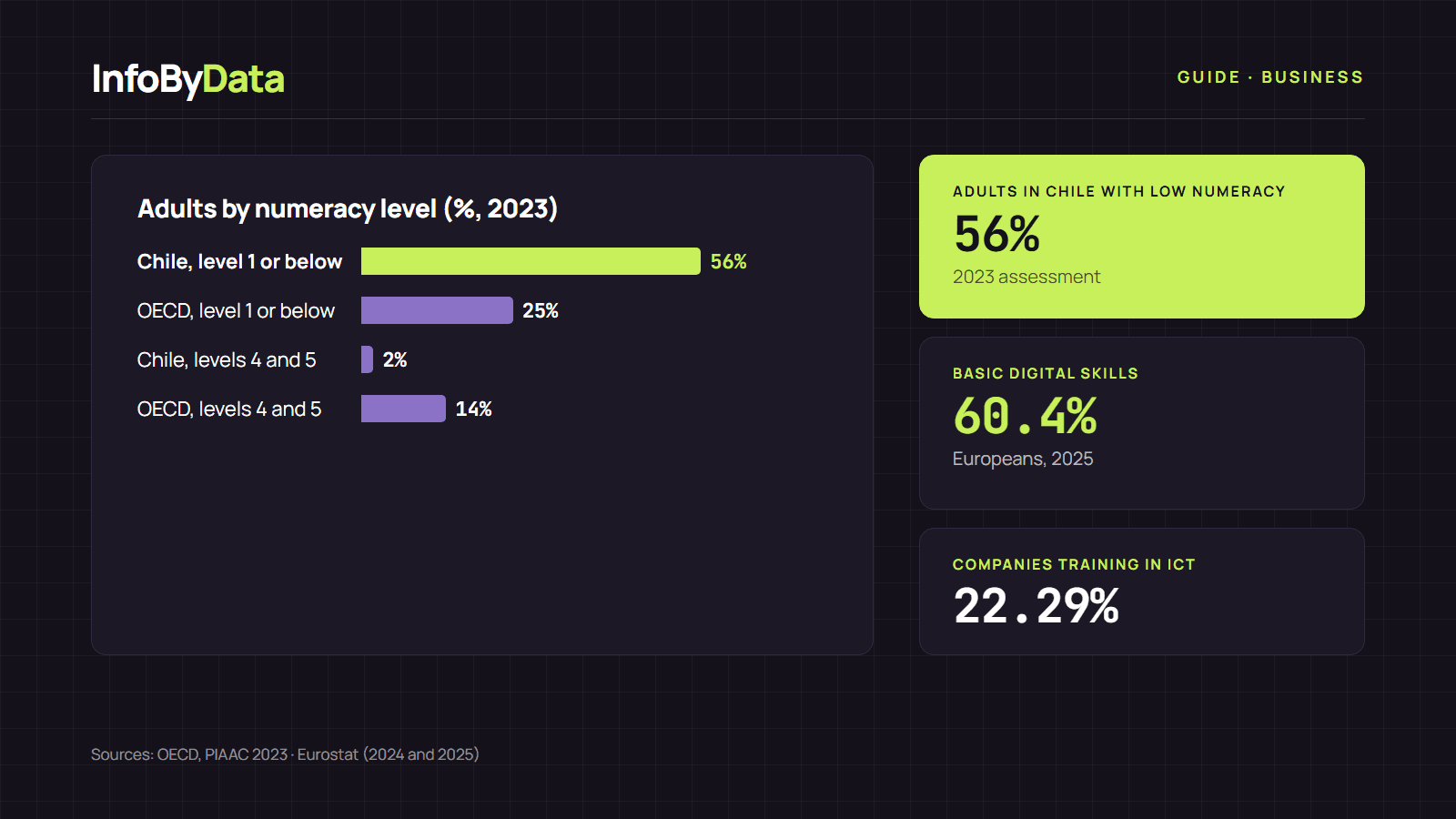
56% of adults in Chile score at or below level 1 in numeracy, compared with an OECD average of 25%, according to the OECD Survey of Adult Skills 2023. That is the starting point for any company that wants to be data-driven: tools are of little use if the team can't read a percentage, compare two figures or spot a number that doesn't add up.
In this guide we explain what a data-driven culture is, what skills a team needs to decide with data and how to build that culture step by step, with or without specialists.
56%
Adults in Chile with low numeracy
level 1 or below; OECD: 25%
2%
Adults in Chile with high numeracy
levels 4 or 5; OECD: 14%
60.4%
Europeans with basic digital skills
or above, 2025
22.29%
EU companies that provide ICT training
10 or more employees, 2024
Source: OECD, PIAAC 2023; Eurostat, 2024 and 2025
View the data as a table
| Adults in Chile with low numeracy | 56% | level 1 or below; OECD: 25% |
| Adults in Chile with high numeracy | 2% | levels 4 or 5; OECD: 14% |
| Europeans with basic digital skills | 60.4% | or above, 2025 |
| EU companies that provide ICT training | 22.29% | 10 or more employees, 2024 |
What a data-driven culture is
A data-driven culture is a way of working in which people, not just analysts, use data to propose, discuss and evaluate decisions. In a company with a data culture, the question "what do the numbers say?" comes up before approving a campaign, changing a price or hiring someone.
It doesn't depend on having a large data science team. It depends on three things: accessible data, people who know how to interpret it and leaders who ask for evidence and use it. If the concept is still unclear, first read what data-driven means and how to apply it in your company.
The starting point in Chile: numeracy skills
The OECD's PIAAC assessment measures the skills of people aged 16 to 65. In the 2023 edition, Chile was far from the average in numeracy, the skill closest to working with data.
- Chile
- OECD average
Source: OECD, Survey of Adult Skills 2023, Chile country note
View the data as a table
| Chile | OECD average | |
|---|---|---|
| Level 1 or below | 56% | 25% |
| Levels 4 or 5 | 2% | 14% |
For a Chilean company, this means it is unwise to assume the whole team reads a chart or a conversion rate correctly. A data-driven culture starts by training people in the basics.
Data literacy: the foundation of a data-driven culture
Data literacy is the ability to search, filter, evaluate and manage data and information. Eurostat measures it as part of the digital skills of the European population. Most people master the basics in each area, but only 60.4% reach a basic or above-basic level in all five at once.
Train or hire: what companies do
To move toward a data-driven culture, companies have two paths: train their team or hire specialists. Eurostat data shows that training is more common, and that hiring is hard.
Of the companies that sought ICT specialists in 2024, 57.5% had hard-to-fill vacancies. The most cited reasons were a lack of applicants (43.24%), salary expectations (41.86%) and a lack of relevant training (41.73%).
Research also points to people. In the US Census Bureau study, Brynjolfsson and McElheran found that the benefit of data-driven decision making is greater in plants that already have skilled workers. And at Google, Project Oxygen used more than 10,000 data points to identify the behaviors of good managers, according to its re:Work site: leadership can also be measured and improved.
How to build a data-driven culture in your team: 6 steps
- Leaders set the example. If management asks for data before approving something and uses it, the rest of the team follows.
- Train in the basics before the tools. Percentages, averages, rates and how to read a chart. This is the gap the OECD shows in Chile.
- Define a few shared indicators. A dashboard with five KPIs everyone understands beats fifty nobody checks. See our marketing KPI guide.
- Make data easy to find. A single source of truth, with access for whoever needs it and clear rules on who maintains it.
- Turn meetings into evidence reviews. Every proposal comes with its data point, its source and the metric that will be used to evaluate it.
- Celebrate learning, not just wins. A test that fails and is measured well is also useful information.
To apply it in a specific area, see data-driven marketing. To see how many companies already analyze data, read our 2026 data-driven study. If your company is small, the guide to artificial intelligence for small businesses in Chile may also help.
What it means for you
- Start with people, not software: 56% of adults in Chile have low numeracy skills. Training in the basics is the foundation of a data-driven culture.
- Training is often more feasible than hiring: 57.5% of European companies that sought specialists had hard-to-fill vacancies.
- Culture shows in meetings: when every proposal comes with its data point and a way to measure it, the team is already deciding with data.
Sources
- OECD: Survey of Adult Skills 2023, Chile country note
- Eurostat: "Individuals' level of digital skills" (isoc_sk_dskl_i21), 2025 data
- Eurostat: "Enterprises that provided training to develop ICT skills" (isoc_ske_ittn2), 2024 data
- Eurostat: "Enterprises that recruited or tried to recruit ICT specialists" (isoc_ske_itrcrn2), 2024 data
- Brynjolfsson, E. and McElheran, K. (2016): "Data in Action: Data-Driven Decision Making in U.S. Manufacturing", Census Bureau, CES 16-06
- Google re:Work: "Following the data: the research behind great managers"
- data-driven
- data-driven culture
- data culture
- data literacy
- data-driven decision making