Data-driven marketing: how to use your customer data to make better decisions (2026)
Only 17.62% of European companies analyze customer data. What data-driven marketing uses, how to attribute sales and what Chile's new data law requires.
By Paulina · SEO and digital strategy specialist
· 4 min read
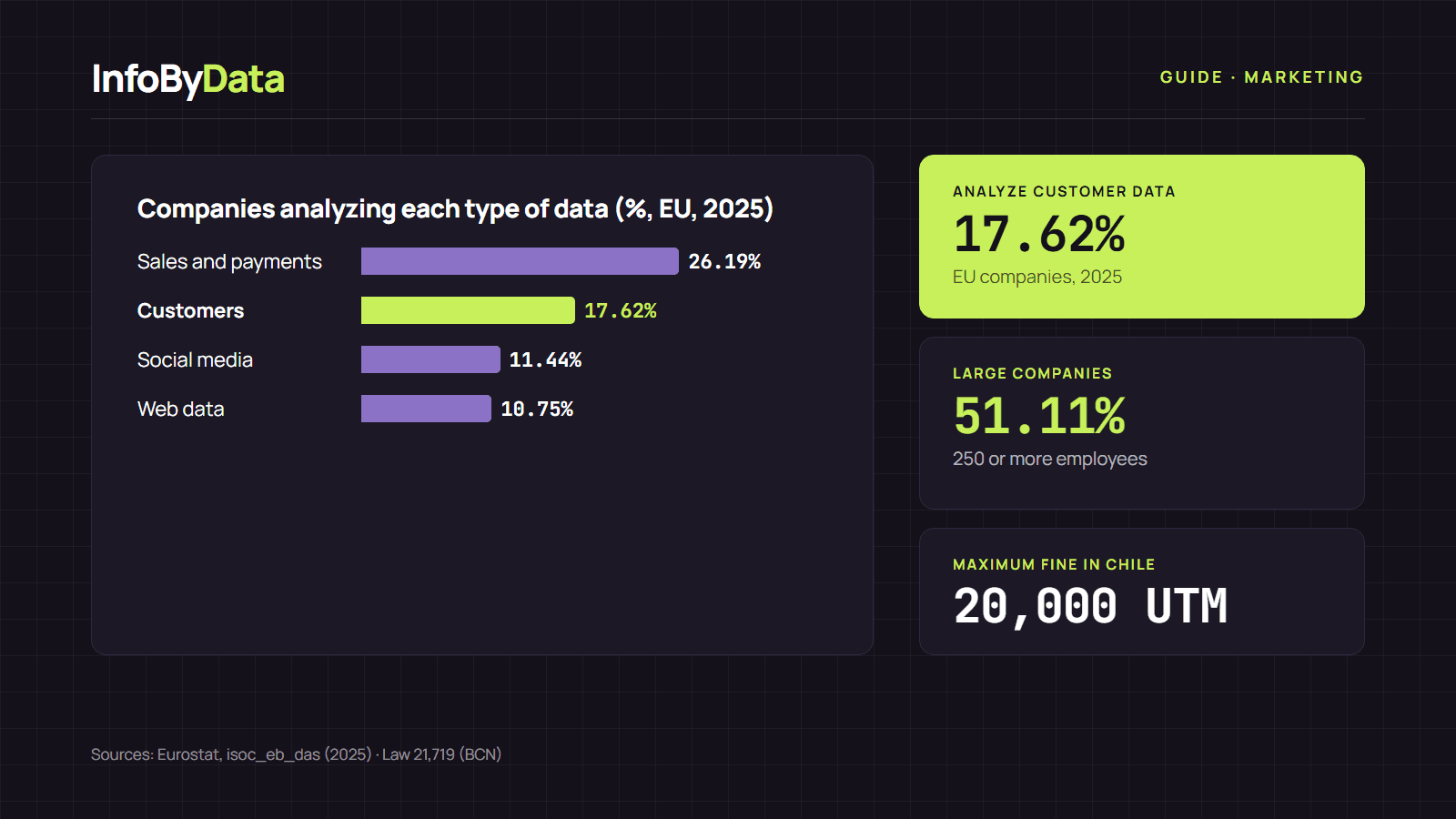
Only 17.62% of companies in the European Union with 10 or more employees analyzed data about their customers in 2025, such as purchases, preferences, location or reviews, according to Eurostat. Among large companies, the figure rises to 51.11%. That gap sums up the challenge of data-driven marketing: the data exists, but most companies still don't use it to decide.
In this guide we explain what data-driven marketing is, what data it uses, how to know which channel generates sales and what changes with Chile's new Personal Data Protection Law.
17.62%
Analyze customer data
EU companies, 2025
51.11%
Large companies
250 or more employees
11.44%
Analyze social media data
2025
20,000 UTM
Maximum fine in Chile
very serious infringements, Law 21,719
Source: Eurostat, 2025; Law 21,719, BCN
View the data as a table
| Analyze customer data | 17.62% | EU companies, 2025 |
| Large companies | 51.11% | 250 or more employees |
| Analyze social media data | 11.44% | 2025 |
| Maximum fine in Chile | 20,000 UTM | very serious infringements, Law 21,719 |
What data-driven marketing is
Data-driven marketing is the practice of deciding campaigns, budgets, messages and channels based on measured data about customers and results, rather than only on intuition or habit.
In practice, it answers questions such as: which channel brings the customers who buy the most? Which message converts best? How much does it cost to acquire a customer, and how much do they bring in over time? To do that, it relies on indicators like the ones we explain in our marketing KPI guide. If you want to start with the basics, first read what data-driven means and how to apply it in your company.
What data data-driven marketing uses
Companies mainly analyze what they record in their daily operations: sales and customers. Social media and web data, which are key for digital marketing, still appear in a smaller share.
Customer data that your company collects directly (purchases, sign-ups, email responses, site visits) is called first-party data. It is the most valuable for a data-driven approach, because it is accurate, it is yours and it doesn't depend on third parties.
The size gap: small businesses analyze less
Across the three types of marketing data, large companies are three or more times ahead of small ones.
- Small
- Medium
- Large
Source: Eurostat, isoc_eb_das
View the data as a table
| Small | Medium | Large | |
|---|---|---|---|
| Customers | 14.25% | 30.89% | 51.11% |
| Social media | 9.37% | 19.47% | 32.48% |
| Web data | 8.81% | 18.03% | 31.75% |
For a small business, that is an opportunity: free tools such as Google Analytics or Search Console make it possible to measure a website without a large team. Even so, 42.8% of websites use no analytics tool at all, as we showed in web analytics in numbers.
Data-driven attribution: how to know which channel drives sales
A customer may see an ad on social media, search for the brand on Google days later and buy after opening an email. Which channel gets the credit? That is the question of attribution.
Google Analytics offers a data-driven attribution model that, according to its official documentation, uses machine learning to compare paths that end in a conversion with those that don't, and gives more credit to the touchpoints most likely to generate the sale. It takes into account factors such as time to conversion, device type and the number of ad interactions.
| Model in Google Analytics | How it splits the credit |
|---|---|
| Data-driven | Across all channels, according to their estimated contribution |
| Last click (paid and organic) | All to the last channel the person clicked, excluding direct traffic |
| Google paid channels last click | All to the last Google Ads click |
In November 2023, Google removed the first-click, linear, time-decay and position-based models. If your store sells online, this measurement is the basis for budget decisions; complement it with our guide to integrating AI into your online store.
Data-driven marketing and Chile's new personal data law
Using customer data requires protecting it. Law 21,719, which regulates the protection and processing of personal data and creates the Personal Data Protection Agency, takes effect on December 1, 2026. On October 20, 2026, the Senate Constitution Committee approved in general a bill that seeks to postpone it until December 2027; until it is passed, the date in force remains December 2026.
Three points of the law that affect marketing:
- Consent: the law defines it as an expression of will that is "free, specific, unequivocal and informed", given through a statement or a clear affirmative action.
- Fines: up to 5,000 UTM for minor infringements, 10,000 UTM for serious ones and 20,000 UTM for very serious ones.
- Large companies: the fine can reach 2% or 4% of annual revenue, depending on severity, if that amount is higher.
This summary is for information only and does not replace legal advice.
How to implement data-driven marketing in 5 steps
- Set a goal and its KPI. For example, reduce customer acquisition cost by 10% in six months.
- Organize your first-party data. Bring sales, customers and web traffic together in one place, with each person's consent.
- Set up conversion tracking in Google Analytics and review the attribution report before moving budget.
- Test before scaling. Compare two versions of an ad, an email or a page, and keep the one that converts best.
- Review results every month and record which decision you made with each piece of data.
To see how online commerce is growing, see e-commerce in numbers. And to make your team work this way permanently, read our guide to data-driven culture.
What it means for you
- Your customer data is an advantage: only 17.62% of European companies analyze it. Using it systematically still sets you apart from your competitors.
- Measure before moving your budget: data-driven attribution shows which channels contribute to a sale, not just which one got the last click.
- Get ready for the new law: data-driven marketing in Chile needs clear consent to use personal data, with fines of up to 20,000 UTM.
Sources
- Eurostat: "Data analytics by size class of enterprise" (isoc_eb_das), 2025 data
- Google Analytics Help: get started with attribution
- Library of the National Congress of Chile: Law 21,719, which regulates the protection and processing of personal data
- Senate of Chile: bill to postpone the law's entry into force moves forward (October 20, 2026)
- data-driven
- data-driven marketing
- customer data
- data-driven attribution
- first-party data