Data-driven study 2026: 4 in 10 companies now analyze data, but the gap by company size is widening
In the European Union, 39.85% of companies analyzed data in 2025, compared with 82.03% of large firms. We combined data from Eurostat, the US Census Bureau and Stanford's AI Index to measure who makes decisions with data and what they gain.
By Paulina · SEO and digital strategy specialist
· 5 min read
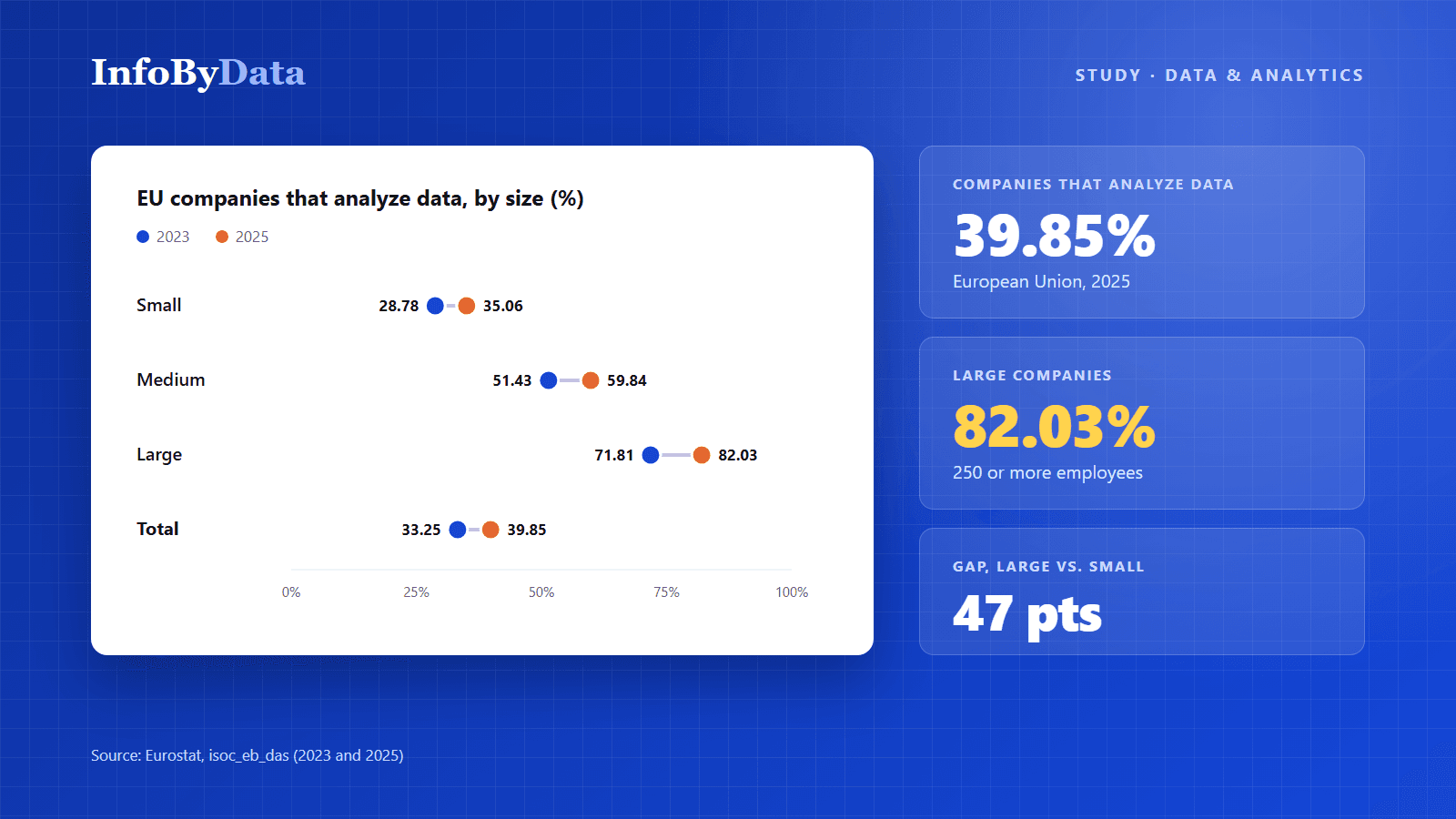
39.85% of companies in the European Union with 10 or more employees analyzed data in 2025, either with their own staff or through an external provider, according to Eurostat. Two years earlier, the figure was 33.25%. The progress is real but uneven: among large companies it reaches 82.03%, and among small ones, 35.06%.
Being a data-driven company means making decisions based on measured evidence, not just intuition or experience. In this study we look at how many companies do it, what data they use, who does the analysis and what research says about the results.
39.85%
EU companies that analyze data
with 10 or more employees, 2025
82.03%
Large companies that analyze data
250 or more employees, 2025
47 points
Gap between large and small firms
it was 43 points in 2023
30%
Data-driven US plants in 2010
up from 11% in 2005
Source: Eurostat, 2025; Brynjolfsson and McElheran, 2016
View the data as a table
| EU companies that analyze data | 39.85% | with 10 or more employees, 2025 |
| Large companies that analyze data | 82.03% | 250 or more employees, 2025 |
| Gap between large and small firms | 47 points | it was 43 points in 2023 |
| Data-driven US plants in 2010 | 30% | up from 11% in 2005 |
Methodology
This study combines three public sources, each with its own definition of "data-driven":
| Source | What it measures | Coverage | Period |
|---|---|---|---|
| Eurostat, survey on ICT usage in enterprises | Companies that perform data analytics (in-house or external) and which data they analyze | EU companies with 10 or more employees, excluding the financial sector | 2023 and 2025 |
| Brynjolfsson and McElheran, US Census Bureau | Plants that make data-driven decisions, under a strict definition | Representative sample of US manufacturing plants | 2005 and 2010 |
| Stanford HAI, AI Index 2026 | Organizations that use artificial intelligence | Organizations surveyed worldwide | 2023 to 2025 |
The figures are not directly comparable: they show the same phenomenon from different angles. Differences and gaps were calculated by InfoByData from the published data.
Finding 1: data analytics is growing, especially in large companies
Companies of every size advanced between 2023 and 2025, but large ones started higher and kept rising faster. The gap between large and small companies went from 43.03 to 46.97 percentage points.
- 2023
- 2025
Source: Eurostat, isoc_eb_das
View the data as a table
| 2023 | 2025 | |
|---|---|---|
| Small (10 to 49) | 28.78% | 35.06% |
| Medium (50 to 249) | 51.43% | 59.84% |
| Large (250 or more) | 71.81% | 82.03% |
| Total | 33.25% | 39.85% |
It's the same pattern we saw in our study on AI in business: in Latin America, a large company is four times more likely to use AI than a small one. Data and AI advance together, and small businesses fall behind on both.
Finding 2: sales and customer data are the most analyzed
Companies mainly analyze what they already record in their daily operations: transactions and customer information. External sources, such as government open data or satellite data, are still a minority.
For a marketing team, that translates into metrics such as customer acquisition cost, conversion rate or customer lifetime value, which we explain in our guide to marketing KPIs. For an SEO team, web data is what makes it possible to measure the real effect of changes such as Google's AI Overviews, which cut clicks from 15% to 8% of visits, according to Pew Research Center.
Finding 3: most companies analyze data in-house
At every size, more companies analyze data with their own staff than with external providers. The difference is largest among large companies, which have more resources to hire specialized talent.
- Own staff
- External provider
Source: Eurostat, 2025
View the data as a table
| Own staff | External provider | |
|---|---|---|
| Small | 27.86% | 12.68% |
| Medium | 54.47% | 17.64% |
| Large | 78.84% | 29.17% |
A company can use both options, so the percentages don't add up to the total.
Finding 4: data-driven decisions are linked to higher productivity
The most cited evidence on impact comes from the US Census Bureau. Economists Erik Brynjolfsson and Kristina McElheran analyzed a representative sample of manufacturing plants and found that data-driven decision making nearly tripled, from 11% to 30%, between 2005 and 2010, according to their article in the American Economic Review.
In a companion Census study covering more than 18,000 plants, the same authors found that value added was about 3% higher in plants that adopted these practices than in those that didn't. The improvement appears after adoption and not before, which the authors consider consistent with a causal effect.
Their definition of "data-driven" is demanding: a plant had to have data available, use it to make decisions, track 10 or more key indicators and set both short- and long-term targets. The study also found that the benefit is greater when the company already has technology and skilled workers.
Finding 5: AI raises the bar
Artificial intelligence depends on well-organized data to work. Stanford's AI Index 2026 reports that 88% of surveyed organizations used AI in 2025, up from 55% in 2023. By contrast, only 19.95% of European companies used AI that year, according to Eurostat. That distance shows that trying AI is one thing and building it into business decisions is another.
Public data is also raw material. In our article on crypto in numbers, every price comes from CoinGecko's open API: an example of how an analysis can be built entirely from public sources.
Limitations of the study
- There is no comparable statistic for Chile or Latin America. Eurostat only covers the European Union, and we did not find a regional survey that measures data analytics with the same methodology.
- Definitions vary by source. For Eurostat, it's enough for a company to analyze data; the Census study requires systematic use in decision making.
- The productivity study covers US manufacturing from 2005 to 2010. Its results are a reference, not a prediction for other sectors or countries.
How to move toward a data-driven company
- Start with the data you already have: sales, payments and customers are the sources companies use most, and they don't require buying external information.
- Define a few indicators and a target for each. The Census study required 10 or more KPIs with short- and long-term targets; a small business can start with five, like the ones in our marketing KPI guide.
- Decide who will do the analysis: in-house staff is the most common option, but an external provider can help you get started.
- Measure before and after every change. It's the same logic as our on-page SEO best practices: each change is evaluated with click and ranking data.
- Organize your data before adding AI: without clean, accessible data, AI tools deliver less.
What it means for you
- The gap is an opportunity for small businesses: only 35.06% of small European companies analyze data, compared with 82.03% of large ones. Starting today still sets a small business apart from its competitors.
- You don't need a big investment to start: the most analyzed data is sales and customer data, which most companies already generate.
- Being data-driven is a process, not a tool: the benefit appears when data is used systematically to make decisions, with clear indicators and targets.
Sources
- Eurostat: "Data analytics by size class of enterprise" (isoc_eb_das), 2023 and 2025 data
- Brynjolfsson, E. and McElheran, K. (2016): "The Rapid Adoption of Data-Driven Decision-Making", American Economic Review 106(5)
- Brynjolfsson, E. and McElheran, K. (2016): "Data in Action: Data-Driven Decision Making in U.S. Manufacturing", Census Bureau, CES 16-06
- Stanford HAI: AI Index 2026, economy chapter
- Eurostat: "Use of artificial intelligence in enterprises" (2025 data)
- Pew Research Center: Google users and AI summaries (2025)
- data-driven
- data analytics
- data-driven companies
- data-driven decision making
- business analytics