How to implement a data-driven strategy in a small business? A 7-step guide (2026)
91.8% of companies in Chile are micro or small businesses. How to implement a data-driven strategy in a small business, with 7 steps and free tools to start.
By Paulina · SEO and digital strategy specialist
· 4 min read
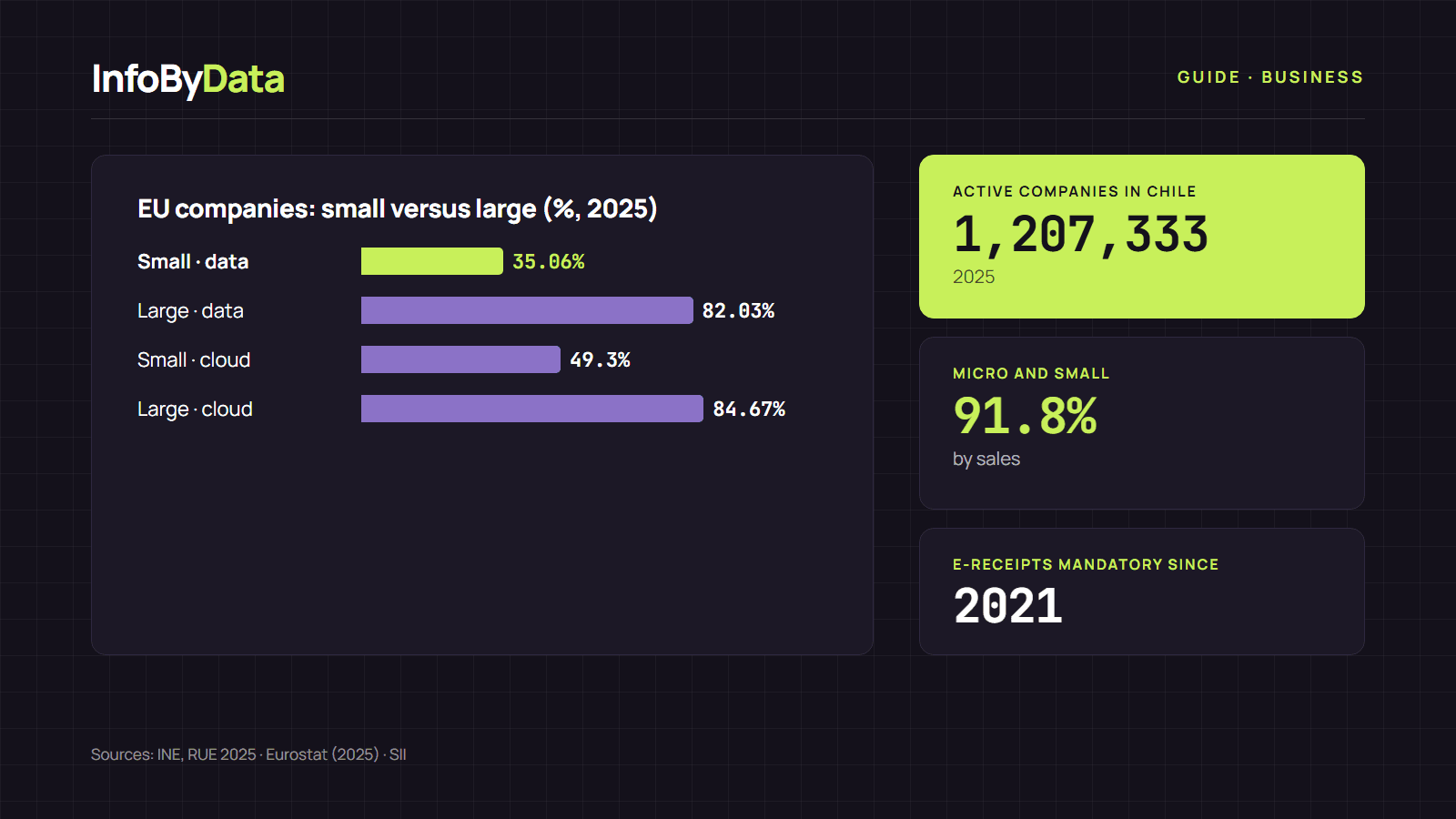
In 2025 there were 1,207,333 active companies in Chile, and 91.8% were micro or small businesses by sales, according to the National Statistics Institute's Unified Business Register (INE). For the vast majority of businesses in the country, the question is not whether they can afford a data team, but how to make better use of the data they already have. That is the basis of a data-driven strategy in a small business.
In this guide we explain what a data-driven strategy is for a small business, where small companies stand, and how to implement it in 7 steps with free or low-cost tools.
1,207,333
Active companies in Chile
2025, +3.9% in one year
91.8%
Micro and small
by sales
35.06%
Small EU companies that analyze data
10 to 49 employees
82.03%
Large companies that analyze data
250 or more employees
Source: INE, RUE 2025; Eurostat, 2025
View the data as a table
| Active companies in Chile | 1,207,333 | 2025, +3.9% in one year |
| Micro and small | 91.8% | by sales |
| Small EU companies that analyze data | 35.06% | 10 to 49 employees |
| Large companies that analyze data | 82.03% | 250 or more employees |
What a data-driven strategy is for a small business
A data-driven strategy is a plan to make the business's important decisions (what to sell, at what price, where to invest in advertising, how much stock to buy) with measured data. In a small business it doesn't require expensive software or specialists: it requires choosing a few questions, measuring what you need to answer them and reviewing the results with discipline.
If you want to understand the concept first, see what data-driven means and how to apply it in your company and what data-driven decision making is.
The starting point: small companies use their data less
In the European Union, one of the few regions with comparable statistics, small companies lag far behind large ones in the use of data and cloud tools.
- Small (10 to 49)
- Large (250 or more)
Source: Eurostat, isoc_eb_das and isoc_cicce_use
View the data as a table
| Small (10 to 49) | Large (250 or more) | |
|---|---|---|
| Analyze data | 35.06% | 82.03% |
| Pay for cloud services | 49.3% | 84.67% |
| Have their database in the cloud | 21.63% | 49.77% |
| Use a cloud CRM | 12.19% | 42% |
The gap is also an opportunity: a small business that adopts a data-driven strategy stands out from most of its direct competitors.
How to implement a data-driven strategy in a small business: 7 steps
- Choose three business questions. For example: which products earn the highest margin? Where do the customers who buy come from? Which day do I sell the most?
- Gather the data you already have. In Chile, all taxpayers who issued paper receipts have been required to issue them electronically since 2021, according to the Internal Revenue Service (SII). That means your sales are already digitized, as is the data from your payment system, online store or social media.
- Put it all in one place. A well-structured spreadsheet (one row per sale, with date, product, amount and channel) is enough to start.
- Define five indicators and a target for each. Sales by channel, margin by product, average ticket, returning customers and acquisition cost. Follow our marketing KPI guide.
- Measure your website and campaigns. With free tools such as Google Analytics and Search Console. We compare them in the best data-driven tools for digital marketing.
- Review the data every week and decide. A short meeting, with the dashboard in view, to decide on one concrete action.
- Test before changing everything. Change one thing (a price, an ad, a page) and compare before and after.
Free tools for a data-driven strategy in a small business
| Need | Tool | Cost |
|---|---|---|
| Measure your website | Google Analytics | Free |
| Measure Google search | Google Search Console | Free |
| See how users browse | Microsoft Clarity | Free, with no traffic limits |
| Build dashboards | Google's Data Studio | No charge |
| Store and organize data | Spreadsheet or PostgreSQL | Free or included in your office suite |
As you grow, you can add a CRM or artificial intelligence tools; see our guide to artificial intelligence for small businesses in Chile.
Common mistakes when implementing a data-driven strategy
- Measuring everything and deciding nothing: fifty indicators without a clear target don't change any decision.
- Starting with the tool: buying software before the questions are clear usually ends in unused licenses.
- Neglecting personal data: if you store customer data, check what Law 21,719 requires, which we explain in data-driven marketing.
- Doing it alone: if the team doesn't understand the data, they won't use it. See how to build a data-driven culture.
What it means for you
- You already have data to start with: your electronic receipts and invoices, your website and your social media are the raw material of a data-driven strategy.
- The gap with large companies is an opportunity: only 35.06% of small European companies analyze data, compared with 82.03% of large ones.
- Start small and with discipline: three questions, five indicators and a weekly review are worth more than any expensive software.
Sources
- INE Chile: Unified Business Register, business structure and demography 2025
- Eurostat: "Data analytics by size class of enterprise" (isoc_eb_das), 2025 data
- Eurostat: "Cloud computing services by size class of enterprise" (isoc_cicce_use), 2025 data
- SII Chile: who must issue electronic receipts
- Microsoft Clarity
- Google Cloud: Data Studio
- data-driven
- data-driven strategy
- small business
- SMEs
- data analysis for small businesses