What data-driven means and how to apply it in your company: definition, examples and figures (2026)
Data-driven means deciding with measured evidence. Only 15.86% of European companies analyze data from three or more sources. Definition, examples and 6 steps.
By Paulina · SEO and digital strategy specialist
· 4 min read
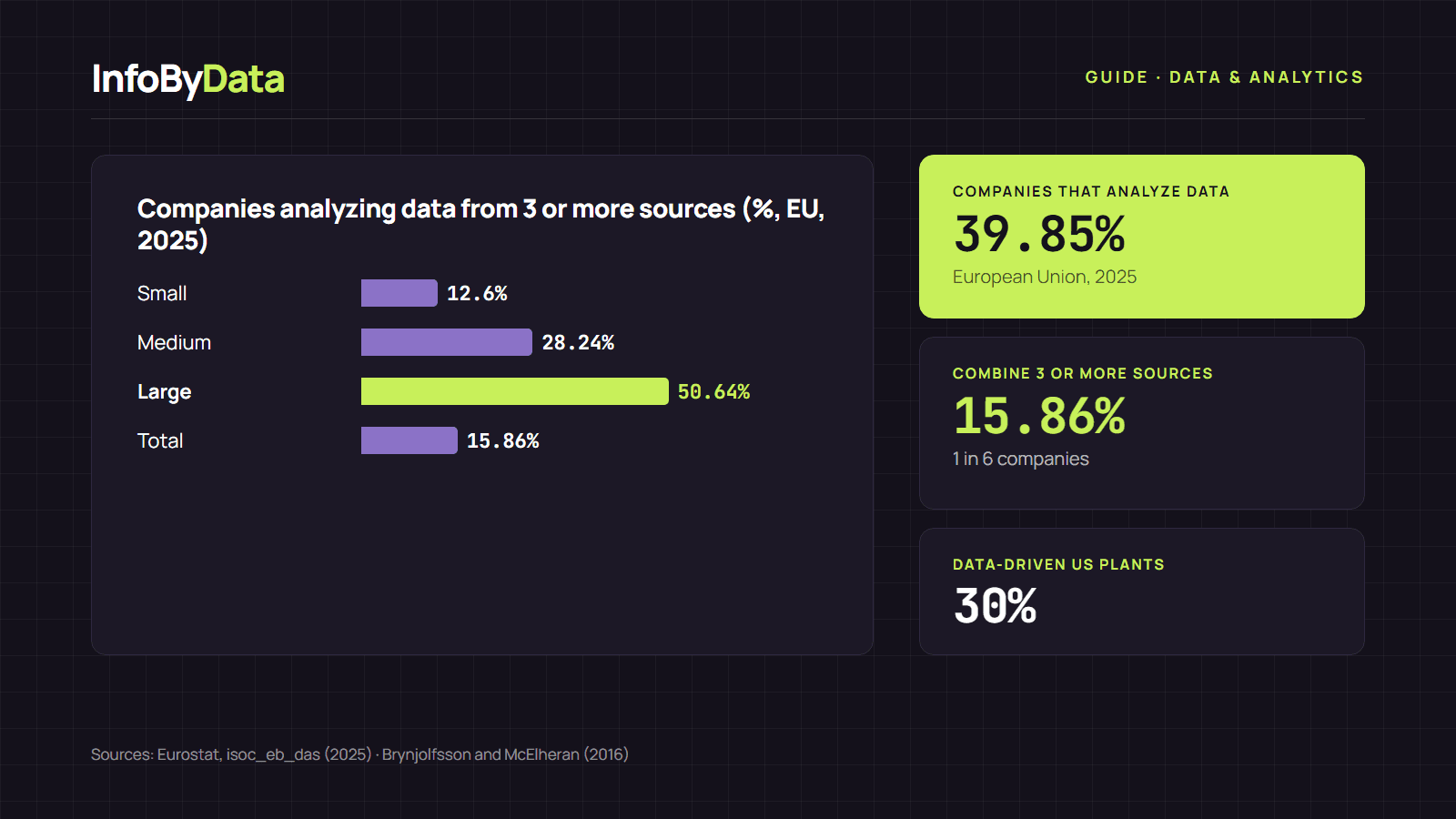
Only 15.86% of companies in the European Union with 10 or more employees analyzed data from three or more different sources in 2025, according to Eurostat. Analyzing data is already common: 39.85% of companies do it. What is still rare is combining data and using it systematically to make decisions, which is what defines a data-driven organization.
In this guide we explain what data-driven means, how it differs from deciding by intuition or being "data-informed", what real examples exist and how to apply it in a company step by step.
39.85%
EU companies that analyze data
10 or more employees, 2025
15.86%
Analyze data from 3 or more sources
2025
50.64%
Large companies with 3 or more sources
250 or more employees
30%
Data-driven US plants in 2010
up from 11% in 2005
Source: Eurostat, 2025; Brynjolfsson and McElheran, 2016
View the data as a table
| EU companies that analyze data | 39.85% | 10 or more employees, 2025 |
| Analyze data from 3 or more sources | 15.86% | 2025 |
| Large companies with 3 or more sources | 50.64% | 250 or more employees |
| Data-driven US plants in 2010 | 30% | up from 11% in 2005 |
What data-driven means: definition
Data-driven means "guided by data". A data-driven company makes its decisions based on measured evidence (sales, customer behavior, costs, test results) and not only on intuition, hierarchy or habit.
The strictest definition comes from academic research. In their study for the American Economic Review, economists Erik Brynjolfsson and Kristina McElheran considered a plant data-driven only if it met four conditions:
- It had data available to make decisions.
- It actually used that data when deciding.
- It tracked 10 or more key performance indicators (KPIs).
- It had short- and long-term targets.
By that standard, data-driven decision making almost tripled between 2005 and 2010, from 11% to 30% of US manufacturing plants.
Data-driven, data-informed and intuition: the differences
In practice, companies move between three ways of deciding. None fully removes human judgment; what changes is the weight of the data.
| Approach | How decisions are made | Main risk |
|---|---|---|
| Intuition | Experience, hierarchy or habit | Repeating mistakes without noticing |
| Data-informed | Data is one input, alongside the team's judgment | Using data only to confirm what was already believed |
| Data-driven | Systematically measured data determines the decision | Measuring badly or tracking indicators that don't matter |
A data-driven approach doesn't mean deciding without people. It means defining in advance what will be measured, with which indicator, and which result would change the decision.
How many companies are data-driven: the figures
Eurostat measures two levels: whether a company analyzes data and whether it combines data from several sources (sales, customers, web, social media, sensors, public data, among others). The second figure is the closest to a mature data-driven practice.
- Analyze data
- 3 or more sources
Source: Eurostat, isoc_eb_das
View the data as a table
| Analyze data | 3 or more sources | |
|---|---|---|
| Small (10 to 49) | 35.06% | 12.6% |
| Medium (50 to 249) | 59.84% | 28.24% |
| Large (250 or more) | 82.03% | 50.64% |
| Total | 39.85% | 15.86% |
The gap between the two bars is large at every size: many companies analyze some source, but few combine several. Among small companies, only one in eight does. We track how these figures have changed in our 2026 data-driven study.
Examples of data-driven decisions
Google and its managers. Google started from a provocative hypothesis: that managers didn't matter. To test it, its Project Oxygen analyzed more than 10,000 data points from performance reviews and surveys, plus interviews, according to its official re:Work site. The result contradicted the hypothesis: teams with more effective managers had better results, higher satisfaction and lower turnover. With that data, Google identified 10 behaviors of a good manager and uses them to train and evaluate its leaders.
US manufacturing plants. In a US Census Bureau study of more than 18,000 plants, Brynjolfsson and McElheran found that value added was about 3% higher in plants that adopted data-driven decision making.
Digital marketing. Google Analytics offers a data-driven attribution model, which uses machine learning to split the credit for each sale across channels according to how much each one contributed. We explain it in detail in our data-driven marketing guide.
How to apply a data-driven approach in your company in 6 steps
- Start with a specific decision, not with the data. For example: "Which channel should get next quarter's budget?"
- Choose a few indicators. Five well-defined KPIs are more useful than fifty. You can start with the ones in our marketing KPI guide.
- Use the data you already have. Sales and payments are the most analyzed source: 26.19% of European companies work with them, according to Eurostat.
- Combine at least three sources. Sales, customers and web is an affordable combination for a small business. To measure your website, see web analytics in numbers.
- Set targets and measure before and after every change. Without a baseline, there is no way to know whether a decision worked.
- Train your team. Data is useless if nobody knows how to read it. We go deeper in data-driven culture.
If you are adding tools, compare options in our article on the best AI platforms for business data analysis.
What it means for you
- Analyzing data is not enough: 39.85% of European companies analyze data, but only 15.86% combine three or more sources. The difference lies in systematic use.
- A small business can start small: sales, customers and web traffic are data most companies already generate, and they enable a first data-driven approach.
- Human judgment still matters: being data-driven means defining in advance what you measure and which result would change a decision, not handing everything over to a spreadsheet.
Sources
- Eurostat: "Data analytics by size class of enterprise" (isoc_eb_das), 2025 data
- Brynjolfsson, E. and McElheran, K. (2016): "The Rapid Adoption of Data-Driven Decision-Making", American Economic Review 106(5)
- Brynjolfsson, E. and McElheran, K. (2016): "Data in Action: Data-Driven Decision Making in U.S. Manufacturing", Census Bureau, CES 16-06
- Google re:Work: "Following the data: the research behind great managers"
- Google Analytics Help: get started with attribution
- data-driven
- what is data-driven
- data-driven decision making
- data-informed
- data analysis