Unemployment rate in Chile reaches 9.6%: what INE data show before the new figure
The unemployment rate in Chile reached 9.6% in June-August, 1 point higher than a year earlier. We analyze INE data ahead of the July-September figure.
· 2 min read
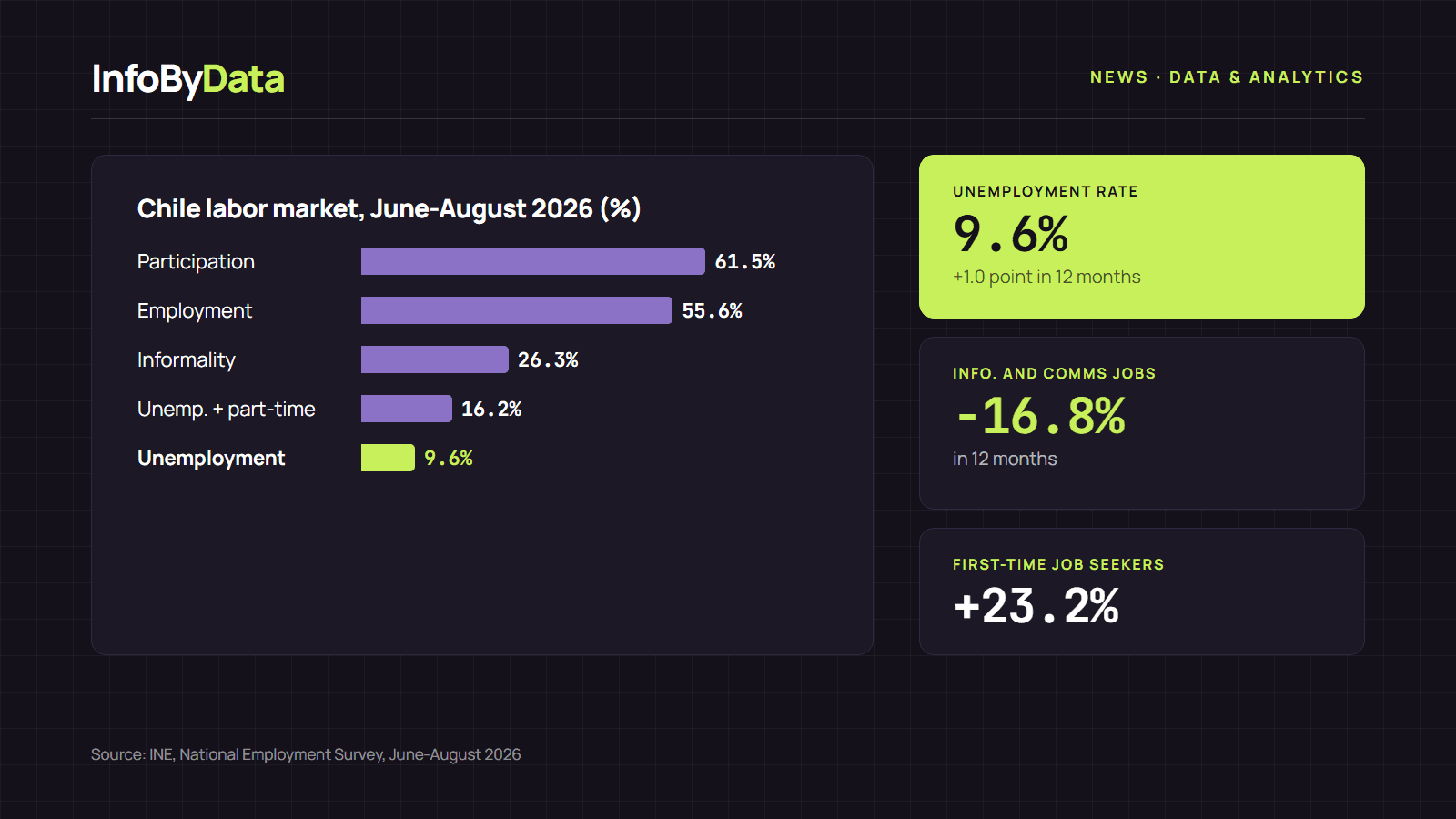
The unemployment rate in Chile was 9.6% in the June-August 2026 quarter, according to the National Employment Survey (ENE) of the National Statistics Institute (INE). That is 1.0 percentage point higher than a year earlier. The July-September figure will be released this week, and analysts consulted by Cooperativa expect it to stay close to that level.
9.6%
Unemployment rate
+1.0 point in twelve months
+13.0%
Unemployed people
versus June-August 2025
−0.9%
Employed people
in twelve months
Source: INE, National Employment Survey, June-August 2026
View the data as a table
| Unemployment rate | 9.6% | +1.0 point in twelve months |
| Unemployed people | +13.0% | versus June-August 2025 |
| Employed people | −0.9% | in twelve months |
Why the unemployment rate in Chile rose
The rise is not explained by more people looking for work, but by fewer people working. The labor force grew 0.3%, while employment fell 0.9%. The number of unemployed people rose 13.0%, led by first-time job seekers, who increased 23.2%.
A version that strips out seasonal effects, the seasonally adjusted rate, reached 9.4%, 0.1 point higher than the previous rolling quarter. In other words, the deterioration is not only seasonal.
- 2025
- 2026
Source: INE, ENE June-August 2026
View the data as a table
| 2025 | 2026 | |
|---|---|---|
| Women | 9.3% | 10.3% |
| Men | 8% | 9.1% |
| Total | 8.6% | 9.6% |
The 2025 rate is obtained by subtracting the twelve-month change reported by the INE (1.0 point for women, 1.1 for men and 1.0 overall).
Where the jobs were lost
The drop in employment was concentrated among men (−1.7%), while employed women increased 0.2%. By sector, the INE identifies three that weighed the most:
| Sector | Change in employment over 12 months |
|---|---|
| Information and communications | −16.8% |
| Manufacturing | −7.6% |
| Retail trade | −1.1% |
Formal salaried workers also fell (−2.9%). Meanwhile, the informal employment rate rose to 26.3%, 0.3 points higher than a year earlier.
Beyond the unemployment rate in Chile
Looking only at the unemployment rate in Chile leaves out people who work fewer hours than they would like. That is why the INE publishes a combined indicator of unemployment and involuntary part-time work, which reached 16.2%. In addition:
The participation (61.5%) and employment (55.6%) rates fell 0.3 and 0.9 points over twelve months. The population outside the labor force grew 1.8%.
If you want to learn how to read these kinds of figures to make decisions, see what data-based decision-making is and why it matters.
What it means for you
- If you are looking for work: competition is greater than a year ago, especially for first-time job seekers, whose number grew 23.2%.
- If you work in tech or manufacturing: these are the sectors where employment fell most over twelve months (−16.8% and −7.6%), so it pays to update your skills and keep your network active.
- If you run a business: with more people available, hiring may be easier, but the fall in formal employment also means more cautious consumers.
Sources
- unemployment rate in Chile
- INE
- National Employment Survey
- labor market
- informality