Crypto in numbers 2026: Bitcoin is 37% below its peak as Latin America grows on stablecoins
The crypto market is worth US$2.68 trillion, far from its 2025 peak, but the region moved US$593.8 billion in a year and grew 9.8%. We review data from CoinGecko and Chainalysis, and what Chile's Fintec Law requires.
· 3 min read
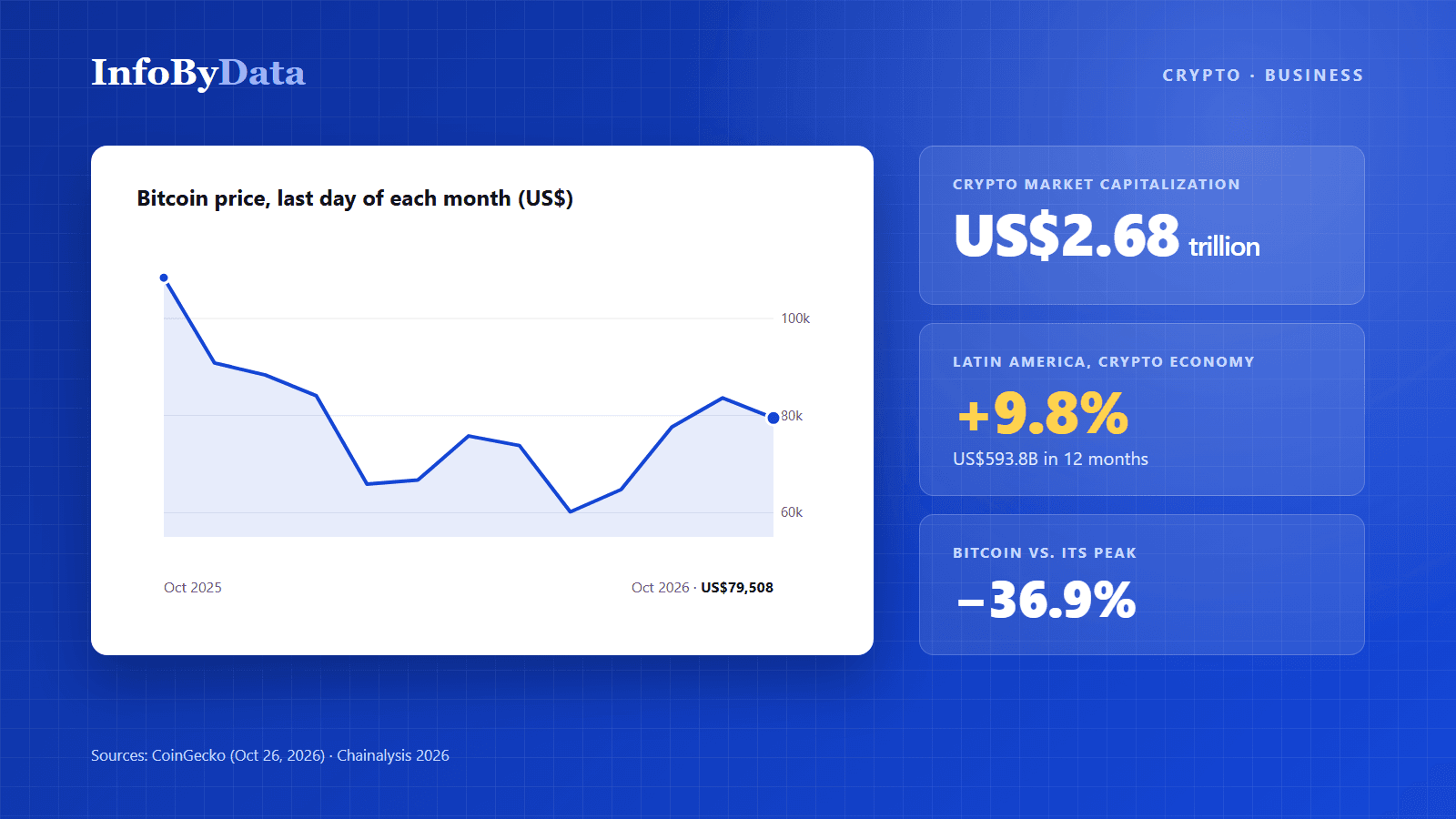
The cryptocurrency market has a total capitalization of US$2.68 trillion, and Bitcoin trades at US$79,610, 36.9% below its all-time high of US$126,080 set on October 6, 2025, according to CoinGecko data from October 26, 2026. Even so, Latin America moved US$593.8 billion in crypto assets between July 2025 and June 2026, 9.8% more than the previous year, according to Chainalysis.
US$2.68T
Total market capitalization
trillion dollars, October 26, 2026
US$79,610
Bitcoin price
36.9% below its October 2025 high
59.4%
Bitcoin's share
of the total market value
US$593.8B
Latin America's crypto economy
July 2025 to June 2026, +9.8%
Source: CoinGecko, October 26, 2026; Chainalysis, 2026
View the data as a table
| Total market capitalization | US$2.68T | trillion dollars, October 26, 2026 |
| Bitcoin price | US$79,610 | 36.9% below its October 2025 high |
| Bitcoin's share | 59.4% | of the total market value |
| Latin America's crypto economy | US$593.8B | July 2025 to June 2026, +9.8% |
A down year for Bitcoin
A year ago, on October 27, 2025, Bitcoin was worth US$114,419. Today it is worth 30.5% less. Its lowest point in the past twelve months was July 1, 2026, at US$58,566.
Source: CoinGecko, daily Bitcoin price
View the data as a table
| Oct 25 | US$108,409 |
| Nov 25 | US$90,832 |
| Dec 25 | US$88,364 |
| Jan 26 | US$84,092 |
| Feb 26 | US$65,891 |
| Mar 26 | US$66,691 |
| Apr 26 | US$75,785 |
| May 26 | US$73,820 |
| Jun 26 | US$60,152 |
| Jul 26 | US$64,743 |
| Aug 26 | US$77,658 |
| Sep 26 | US$83,640 |
| Oct 26 | US$79,508 |
The drop wasn't limited to Bitcoin. According to Chainalysis's global adoption index, total market capitalization fell about 50% over that period, a contraction of US$2.1 trillion.
Who carries weight in the market
Bitcoin accounts for almost six of every ten dollars in the market. It is followed by Ethereum and Tether (USDT), the largest stablecoin: a cryptocurrency designed to keep a stable value, in this case pegged to the dollar.
Source: CoinGecko. "Others" is the remainder up to 100%, calculated by InfoByData
View the data as a table
| Bitcoin | 59.37% |
| Ethereum | 10.43% |
| Tether (USDT) | 6.77% |
| BNB | 3.6% |
| XRP | 3.02% |
| USDC | 2.65% |
| Solana | 2.21% |
| Others | 11.95% |
The two largest stablecoins, Tether and USDC, add up to US$253.77 billion, according to CoinGecko.
Latin America grows against the tide
While global activity fell, Latin America's crypto economy grew 9.8% and ranked as the sixth largest in the world. Brazil leads the region with US$252.5 billion and is first in Chainalysis's 2026 global adoption index. Mexico is 11th.
- Brazil252.5
- Argentina88.5
- Mexico77.6
- Venezuela39.1
- Colombia29.1
Source: Chainalysis, Geography of Cryptocurrency 2026
View the data as a table
| Brazil | 252.5 |
| Argentina | 88.5 |
| Mexico | 77.6 |
| Venezuela | 39.1 |
| Colombia | 29.1 |
The fastest growth among the large markets was in Venezuela, which doubled its activity:
Chainalysis attributes the region's progress to protection against local currency volatility and everyday use, rather than speculation. Stablecoins are at the center of that shift:
Chile: slower growth and a regulated market
Chainalysis doesn't publish the size of Chile's crypto economy, but it does report one indicator: Chilean wallets holding at least US$10,000 in stablecoins grew 47% since July 2024. That is less than in the region's other large markets:
In Chile, the Fintec Law (Law 21,521), published on January 4, 2023, defines crypto assets as a "digital representation of units of value, goods or services, except money" that can be transferred, stored or exchanged digitally. The law includes them among financial instruments. As a result, anyone who professionally provides services such as custody, brokerage or alternative trading systems for crypto assets must be registered in the Registry of Financial Service Providers of the Financial Market Commission (CMF).
This article is for information only and is not investment advice. Prices are as of October 26, 2026, and change daily.
What it means for you
- Volatility comes with the asset: Bitcoin lost 36.9% from its peak in a year. Any decision about cryptocurrencies should take into account that prices can swing sharply within a few months.
- Check the platform before using it: in Chile, companies that hold or broker crypto assets must be registered with the CMF. Checking that is the first filter.
- Stablecoins are already a business tool: they make up a third of cross-border crypto transfers in the region. For companies with suppliers or clients abroad, their evolution and regulation are worth following.
Sources
- CoinGecko: global crypto market capitalization (data as of October 26, 2026)
- CoinGecko: Bitcoin price history
- Chainalysis: "Latin America: Brazil Leads World in Adoption as Region's Crypto Economy Grows" (September 23, 2026)
- Chainalysis: 2026 Global Crypto Adoption Index (September 23, 2026)
- Library of the National Congress of Chile: Law 21,521 (Fintec Law)
- Financial Market Commission (CMF)
- cryptocurrency
- bitcoin
- stablecoins
- crypto in Chile
- Fintec Law