AI virtual assistants: a 2026 comparison of ChatGPT, Gemini, Claude and Copilot for personal and professional use
ChatGPT has over 1.2 billion weekly users and Gemini 950 million a month. We compare AI virtual assistants for personal and professional use, with data.
By Paulina · SEO and digital strategy specialist
· 5 min read
More than 1.2 billion people use ChatGPT every week, according to OpenAI, and the Gemini app has 950 million monthly users, according to Google. AI virtual assistants are now part of daily life, but they don't all do the same job: some stand out for personal use and others fit better into work.
In this comparison we look at ChatGPT, Gemini, Claude and Microsoft Copilot using data from the companies themselves, Eurostat and the Stack Overflow survey. We have no commercial relationship with any of them.
1.2B+
ChatGPT weekly users
OpenAI, October 2026
950M
Gemini app monthly users
Google, July 2026
25.49%
Europeans using generative AI personally
2025
15.36%
Europeans using it for work
2025
Source: OpenAI, Oct. 2026; Google, Jul. 2026; Eurostat, 2025
View the data as a table
| ChatGPT weekly users | 1.2B+ | OpenAI, October 2026 |
| Gemini app monthly users | 950M | Google, July 2026 |
| Europeans using generative AI personally | 25.49% | 2025 |
| Europeans using it for work | 15.36% | 2025 |
What AI virtual assistants are
They are generative artificial intelligence apps you talk to in writing or by voice. They answer questions, write texts, summarize documents, analyze data and create images. Unlike the voice assistants of a few years ago, they understand complex instructions and keep the context of a conversation.
We explain what generative AI is and who uses it in our study generative AI in numbers.
The most used AI virtual assistants in 2026
Each company reports its users with a different measure, so the figures can't be compared directly:
- ChatGPT (OpenAI): more than 1.2 billion people a week, according to its GPT-6 announcement in October 2026. In March 2026 it had more than 900 million.
- Gemini (Google): 950 million monthly users of the app, with daily users tripling in a year, according to Alphabet's results of July 22, 2026.
- Claude (Anthropic) and Copilot (Microsoft): their companies don't publish a comparable user figure.
Among developers, however, there is a common measurement. The 2026 Stack Overflow survey asked which AI models they use:
Comparing AI virtual assistants: ChatGPT, Gemini, Claude and Copilot
| Assistant | Company | Stands out for | Integrates with | Available in Chile |
|---|---|---|---|---|
| ChatGPT | OpenAI | General use, file analysis, tables and charts | Uploaded files and connected sources | Yes |
| Gemini | Integration with Google's ecosystem | Google Sheets and Google Workspace | Yes | |
| Claude | Anthropic | Long texts, analysis and file creation | Google Workspace, Microsoft 365 and business tools | Yes |
| Copilot | Microsoft | Working inside Office | Word, Excel, PowerPoint and Outlook | Check the local plan |
Availability in Chile for ChatGPT, Gemini and Claude is confirmed in the official lists of OpenAI, Google and Anthropic. Features and plans change often: check the current terms before paying.
ChatGPT: the most used assistant
It's the assistant with the most users in the world. According to OpenAI's help pages, it can analyze uploaded files, answer questions about the data and create tables or charts.
Best for: anyone looking for a general-purpose assistant for personal and work tasks.
Gemini: for people who live in Google
Its advantage is integration with Google. According to Google's help pages, Gemini in Google Sheets lets you create tables and work with data inside the spreadsheet.
Best for: people and companies that already use Google Workspace.
Claude: for long texts and working with files
According to Anthropic's help pages, Claude analyzes spreadsheets and creates files such as Excel workbooks with formulas and charts. In May 2026, Anthropic launched Claude for Small Business, which connects to tools such as QuickBooks, PayPal, HubSpot, Canva, Google Workspace and Microsoft 365.
Best for: professionals who write, review long documents or automate tasks for a small business.
Microsoft Copilot: the assistant inside Office
According to Microsoft, Copilot drafts documents in Word, turns data into insights in Excel, builds presentations in PowerPoint and summarizes your inbox in Outlook. In the United States, the Microsoft 365 Personal plan costs US$9.99 a month; prices may vary in other countries.
Best for: people who work in Word, Excel and Outlook all day.
AI virtual assistants for personal use
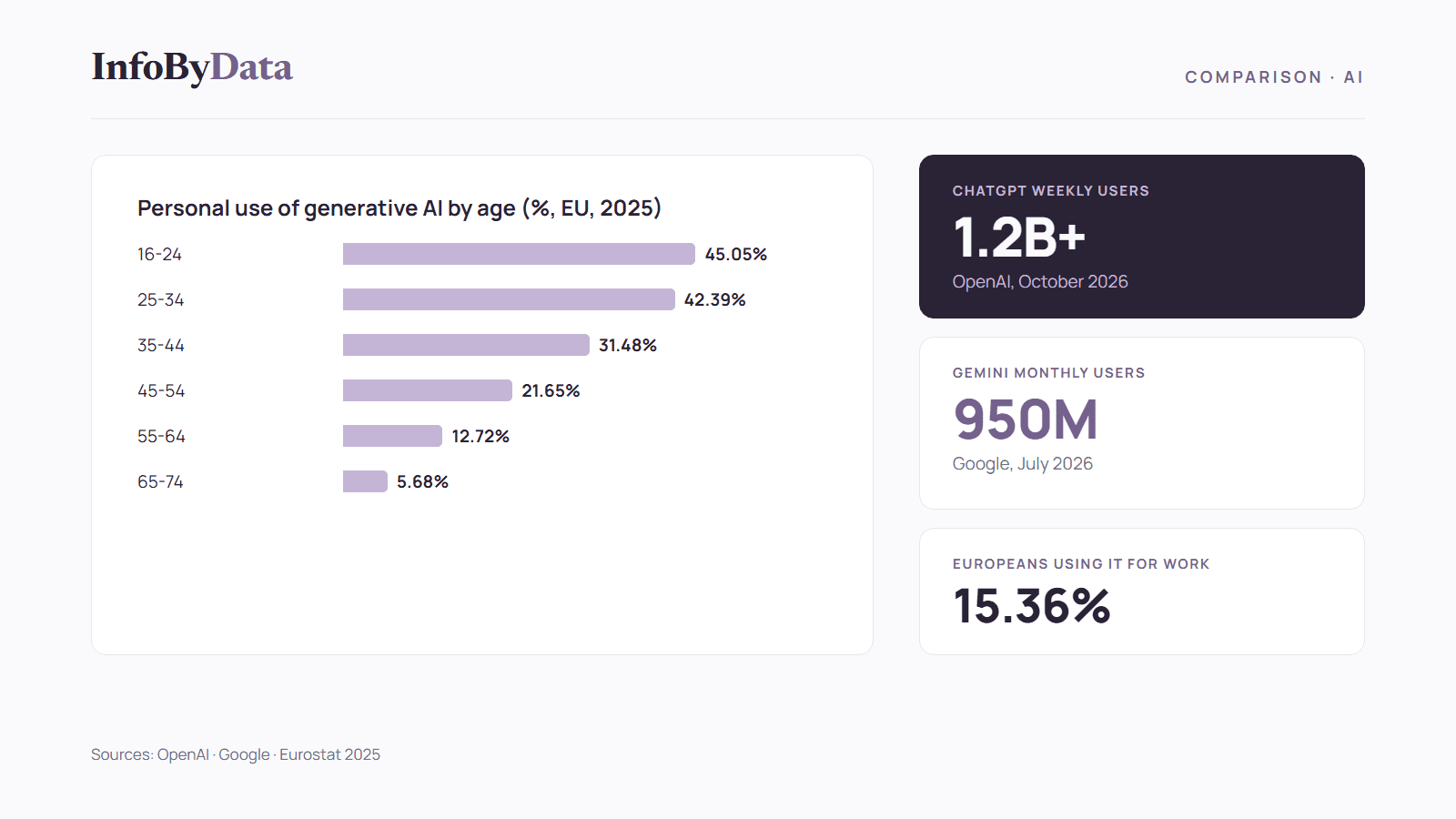
Personal use is the most widespread. In the European Union, 25.49% of people used generative AI for private purposes in 2025, compared with 15.36% who used it for work, according to Eurostat:
- Personal use
- Work use
Source: Eurostat, isoc_ai_iaiu
View the data as a table
| Personal use | Work use | |
|---|---|---|
| 16 to 24 | 45.05% | 16.28% |
| 25 to 34 | 42.39% | 27.44% |
| 35 to 44 | 31.48% | 22.07% |
| 45 to 54 | 21.65% | 16.38% |
| 55 to 64 | 12.72% | 8.75% |
| 65 to 74 | 5.68% | 1.5% |
Most common personal uses: looking up information, planning trips or meals, writing messages, learning a new topic or translating. They are also changing how we search: when Google shows an AI summary, clicks on results fall, as we explain in AI Overviews in numbers.
AI virtual assistants for professional use
At work, use peaks between ages 25 and 34: 27.44% of that group uses generative AI for work. The most useful professional uses are:
- Writing and summarizing: emails, reports, meeting minutes and proposals.
- Analyzing data: uploading a spreadsheet and asking for a summary or a chart. We compare options in best AI platforms for business data analysis.
- Automating small business tasks: quotes, customer replies or social media posts. See our guide to artificial intelligence for SMEs in Chile.
How to choose among AI virtual assistants
- Look at your ecosystem. If you work in Google, Gemini; if you work in Office, Copilot; if you have no preference, ChatGPT or Claude.
- Try the free or trial version with a real task before paying for a subscription.
- Compare with the same question. Ask two assistants the same thing and keep the one that answers best for your case.
- Check privacy. Anthropic, for example, says it doesn't train its models on data from its Team and Enterprise plans by default. Review each company's policy before uploading sensitive information.
- Don't rely on just one. Many people use two assistants depending on the task.
What it means for you
- There's no single best assistant for everything: ChatGPT is the most used, Gemini integrates with Google, Claude stands out with texts and files, and Copilot lives inside Office.
- Personal use leads, but professional use is growing: one in four Europeans uses it personally and almost one in six for work.
- Choose based on your work tools, not the advertising: the assistant that connects with what you already use will save you the most time.
Sources
- OpenAI: "GPT-6 and Intelligent UI for everyone" (October 2026)
- OpenAI: "OpenAI raises $122 billion to accelerate the next phase of AI" (March 2026)
- Google: CEO remarks on Alphabet's Q2 2026 results (July 22, 2026)
- Anthropic: "Introducing Claude for Small Business" (May 13, 2026)
- Microsoft: Copilot for individuals
- Eurostat: "Individuals - use of generative AI tools" (isoc_ai_iaiu), 2025 data
- Stack Overflow Developer Survey 2026: technology
- OpenAI: ChatGPT supported countries
- Google: where Gemini is available
- Anthropic: supported countries for Claude
- AI virtual assistants
- ChatGPT
- Gemini
- Claude
- Microsoft Copilot