How to optimize SEO for online stores to increase sales: a 2026 guide with data
Only 35% of WooCommerce stores pass Core Web Vitals on mobile, compared with 76% of Shopify stores. Here's how to optimize SEO for online stores.
By Paulina · SEO and digital strategy specialist
· 4 min read
About 19% of websites are online stores, according to the e-commerce chapter of the Web Almanac 2025 by HTTP Archive, and in Chile online sales neared US$10 billion in 2025, according to the Santiago Chamber of Commerce. With so much competition, SEO for online stores is one of the most cost-effective ways to attract shoppers and increase sales without relying only on paid advertising.
In this guide we review what the data says about e-commerce platforms and what Google recommends so your products show up better in search results.
19.2%
Mobile sites that are online stores
2025
44.4%
Mobile stores built with WooCommerce
the most used platform
76%
Shopify stores passing Core Web Vitals
on mobile
US$10B
Online sales in Chile in 2025
according to the CCS
Source: HTTP Archive, Web Almanac 2025; CCS, 2026
View the data as a table
| Mobile sites that are online stores | 19.2% | 2025 |
| Mobile stores built with WooCommerce | 44.4% | the most used platform |
| Shopify stores passing Core Web Vitals | 76% | on mobile |
| Online sales in Chile in 2025 | US$10B | according to the CCS |
Why SEO for online stores helps increase sales
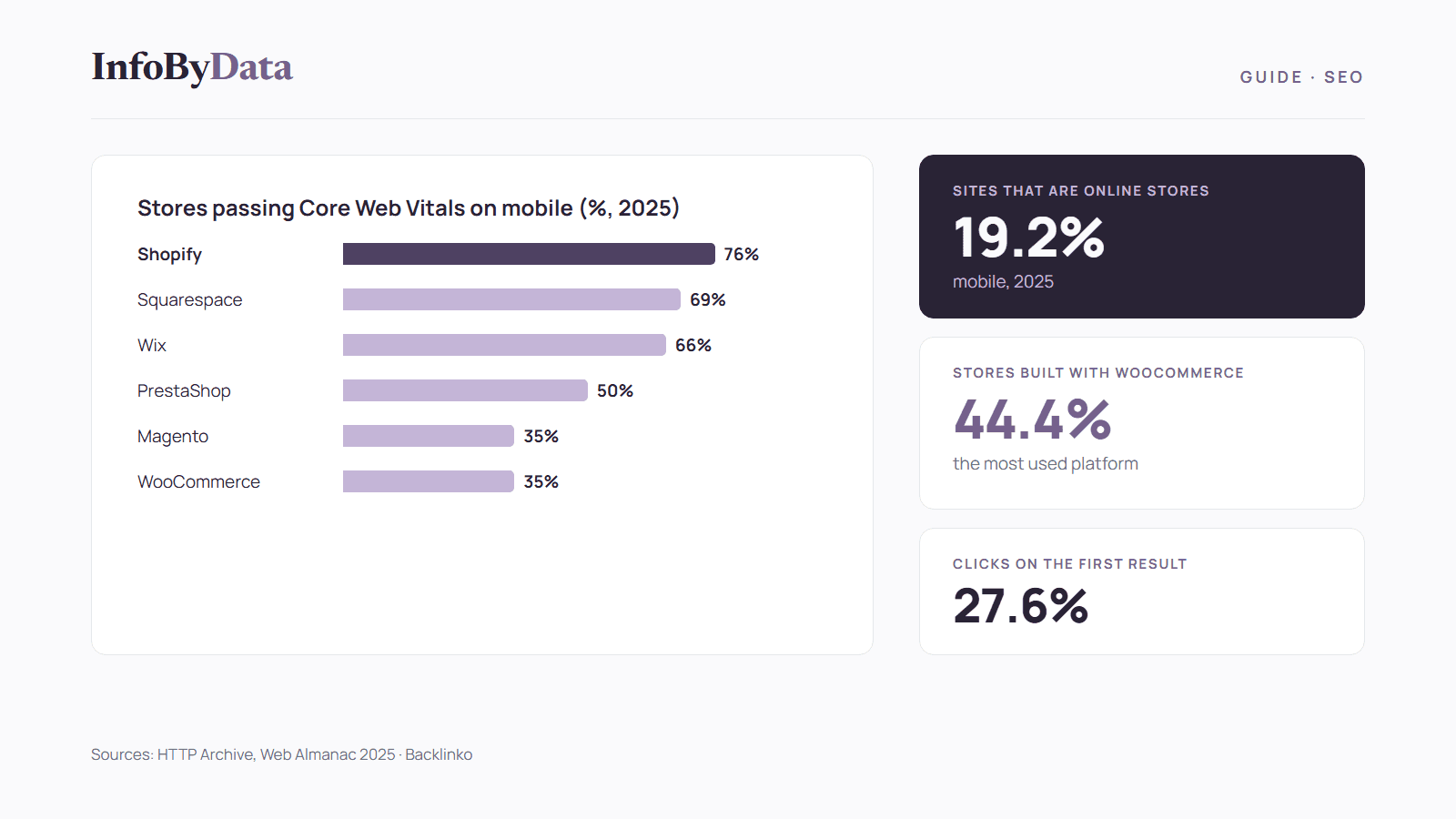
People who search for a product on Google are often ready to buy. Ranking at the top makes the difference: the first organic result gets 27.6% of clicks on average, according to an analysis by Backlinko, which we explain in our on-page SEO guide. Google can also show your products' price, availability and reviews directly in the results, which attracts more qualified clicks.
Which platform your store uses and how it affects SEO
WooCommerce and Shopify account for almost seven in ten online stores on mobile, according to the Web Almanac 2025:
The platform has a big influence on speed, one of the signals Google uses to measure page experience. The difference in Core Web Vitals is large:
- Mobile
- Desktop
Source: HTTP Archive, Web Almanac 2025
View the data as a table
| Mobile | Desktop | |
|---|---|---|
| Shopify | 76% | 76% |
| Wix eCommerce | 66% | 70% |
| Squarespace Commerce | 69% | 69% |
| PrestaShop | 50% | 54% |
| Magento | 35% | 36% |
| WooCommerce | 35% | 33% |
If your store runs on WooCommerce or Magento, speed is your first SEO task: only one in three stores on those platforms passes Core Web Vitals. The Web Almanac also measures Tiendanube, widely used in Latin America: 51% of its stores pass on mobile.
7 steps to optimize SEO for online stores
1. Add product structured data
Structured data tells Google what you sell. According to Google's documentation, it lets results show price, availability, ratings, shipping costs and return policies. For pages where people can buy, Google recommends the merchant listings type.
2. Connect your store to Google Merchant Center
Google recommends using both structured data on your pages and a product feed in Merchant Center: "providing both structured data on web pages and a Merchant Center feed maximizes your eligibility" to appear in more Google experiences, according to its documentation.
3. Use clear URLs for products and variants
According to Google's URL guide for e-commerce:
- Use descriptive words:
/product/black-t-shirt-with-a-white-collaris better than/product/3243. - Give each variant (color or size) its own URL, and point the canonical tag to the main product page.
- Avoid internally linking to URLs with temporary parameters, such as tracking codes or session IDs.
4. Improve your store's speed
Check Core Web Vitals in Google Search Console and optimize images, themes and apps. We explain each metric in our study technical SEO in numbers.
5. Write unique product pages
Avoid copying the manufacturer's description. Explain what the product is for, its dimensions, materials and how it differs from other options. AI can help you write a first draft, as we explain in how to integrate AI into your online store, but always review the result.
6. Organize your category structure and internal links
Google recommends helping it understand what's most important on your store through navigation and internal links, according to its e-commerce guide. Link from your homepage to your main categories and from each category to its products.
7. Handle category pagination carefully
Give each page of a paginated category its own URL. According to Google, pagination is where most URL mistakes happen on online stores.
How to measure whether SEO is increasing your sales
- Connect Google Search Console to see which searches find you and which products appear.
- Use a web analytics tool to measure sales that come from organic search.
- Track key indicators, such as conversion rate and acquisition cost, which we explain in our marketing KPIs guide.
- Compare before and after each major change, such as adding structured data or improving speed.
Keep Google's AI summaries in mind too: when they appear, clicks on traditional results fall, as we show in AI Overviews in numbers. Structured data and complete product pages help your products stay visible.
What it means for you
- The platform matters: Shopify stores pass Core Web Vitals at more than twice the rate of WooCommerce stores. If you use WooCommerce, prioritize speed.
- Structured data is the foundation of SEO for online stores: it lets Google show price, stock and reviews directly in the results.
- Measure in sales, not just visits: the goal of store SEO is to increase sales, so connect Search Console to your analytics and track conversion.
For more e-commerce data, see our study e-commerce in numbers.
Sources
- HTTP Archive: Web Almanac 2025, e-commerce chapter
- Google Search Central: product structured data
- Google Search Central: e-commerce SEO guide
- Google Search Central: designing a URL structure for e-commerce sites
- CCS: "E-commerce neared US$10 billion in 2025" (March 26, 2026, in Spanish)
- Backlinko: Google CTR statistics
- SEO for online stores
- e-commerce SEO
- increase sales
- structured data
- Core Web Vitals