AI Overviews by the numbers: how many clicks sites lose when Google answers with AI
When Google shows an AI summary, users click a result half as often, and the top position loses up to 58% of its CTR. We reviewed the Pew, Ahrefs and Seer Interactive studies to understand what is changing in SEO.
By Paulina · SEO and digital strategy specialist
· 3 min read
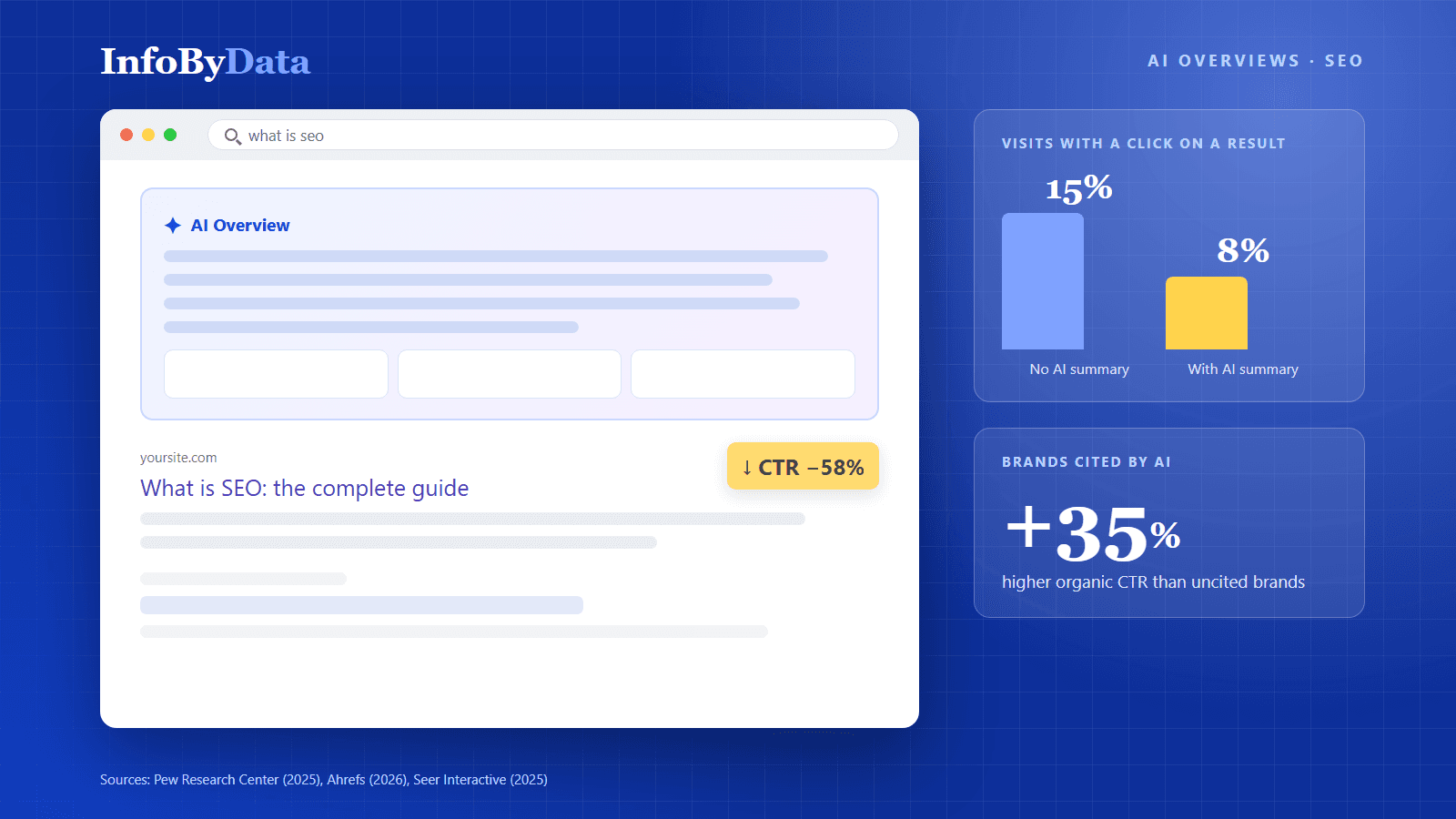
When Google shows an AI-generated summary (AI Overview), users click a traditional result in 8% of visits, compared with 15% when there is no summary. That is what the Pew Research Center measured using real browsing data from 900 U.S. adults and 68,879 Google searches.
For years, the goal of SEO was simple to explain: show up in the top results. Today, for part of all searches Google answers before the links, and that changes the rules.
Fewer clicks when the summary appears
The Pew study shows three effects:
- Clicks on traditional results fall by almost half, from 15% to 8% of visits.
- Only 1% of visits end in a click on one of the links cited inside the summary.
- 26% of searches with a summary end the session: the user stops browsing. Without a summary, the figure is 16%.
In March 2025, 18% of the searches analyzed showed an AI summary.
Source: Pew Research Center, March 2025 data
View the data as a table
| No AI summary, click on a result | 15% |
| With AI summary, click on a result | 8% |
| With AI summary, click on a link in the summary | 1% |
The top position loses the most
Ahrefs analyzed 300,000 keywords, half with an AI Overview and half without, between December 2023 and December 2025. When the summary appears, the CTR of the top result is on average 58% lower than it would have been without it. In an earlier study from April 2025, the drop was 34.5%.
The loss is smaller further down the page:
Source: Ahrefs, 300,000 keywords, December 2023 to December 2025 (desktop data)
View the data as a table
| Position 1 | 58% |
| Position 2 | 50.8% |
| Position 10 | 19.4% |
Ahrefs notes that this is a correlation: the summaries coincide with the drop, but they can't be said to be the only cause.
The drop also happens without summaries
Seer Interactive tracked 3,119 informational searches from 42 companies between June 2024 and September 2025, with 25.1 million organic impressions.
| Search type | Organic CTR June 2024 | Organic CTR September 2025 | Change |
|---|---|---|---|
| With AI Overview | 1.76% | 0.61% | -61% |
| Without AI Overview | 2.74% | 1.62% | -41% |
CTR fell even on searches without a summary. Seer attributes this to users also looking for answers elsewhere, such as ChatGPT, Perplexity, social media or brands they already know.
Being cited does make a difference
The same Seer study found that brands cited inside the AI Overview have a 35% higher organic CTR than those that aren't: 0.70% versus 0.52% in the third quarter of 2025. Seer cautions that it can't prove the citation is the cause.
That is why SEO now has two new goals, known as GEO (generative engine optimization) and AEO (answer engine optimization): getting the AI to choose your page as a source.
What kind of sources AI cites
According to Pew, Wikipedia, YouTube and Reddit are the most-linked sites in both summaries and standard results: together they account for 15% of summary sources. Government sites (.gov) appear more often in summaries (6% of sources) than in standard results (2%).
The common thread is authority: AI prefers recognized sources with verifiable information and clear answers. SEO basics still matter, as we explain in our article on on-page SEO best practices.
What it means for you
- Measure CTR by search type, not just in total: check in Search Console which queries show AI Overviews and compare their trend with those that don't.
- Write to be cited: answer specific questions in the first lines, add your own data and cite sources; that is the kind of content AI picks as a reference.
- Don't rely on Google alone: if sessions end before the click, your brand, email and social media matter more for bringing in direct visits.
Sources
- AI Overviews
- GEO
- AEO
- CTR
- organic traffic