How to integrate AI into your online store to improve the customer experience: a 2026 guide with data from Chile
Chile's e-commerce neared US$10 billion in 2025, and CyberDay already uses an AI assistant. Here's how to integrate AI into your online store, step by step.
By Paulina · SEO and digital strategy specialist
· 5 min read
E-commerce in Chile neared US$10 billion in 2025, with real growth of just over 9%, and it now accounts for 12.6% of retail, according to the Santiago Chamber of Commerce (CCS). For 2026, the CCS projects a record close to US$10.6 billion and notes that more than half of young consumers already use AI to compare prices.
Integrating AI into your online store is no longer just for big brands: today there are tools any small business can use to improve the customer experience, from search to after-sales support.
US$10B
Online sales in Chile in 2025
real growth of just over 9%
US$10.6B
Projected online sales for 2026
a record, according to the CCS
64%
Internet users in Chile who shop online
on a regular basis
6.92%
European companies using AI in marketing or sales
2025
Source: CCS, 2026; CCS, CyberDay 2026; Eurostat, 2025
View the data as a table
| Online sales in Chile in 2025 | US$10B | real growth of just over 9% |
| Projected online sales for 2026 | US$10.6B | a record, according to the CCS |
| Internet users in Chile who shop online | 64% | on a regular basis |
| European companies using AI in marketing or sales | 6.92% | 2025 |
Why integrate AI into your online store now
Online sales are growing faster than the rest of retail: the CCS projects real growth of around 10% for 2026. At the same time, customers are changing how they search and compare. CyberDay 2026, one of the country's main online shopping events, added a new generative AI assistant to guide shoppers, according to the CCS.
For more e-commerce data, see our study e-commerce in numbers.
6 ways to integrate AI into your online store to improve the customer experience
1. A conversational assistant available around the clock
CyberDay 2026's "Cyber AI" assistant is one example: a generative AI conversational agent that worked as an expert advisor 24 hours a day. For an online store, an assistant like this answers questions about products, sizes, shipping or returns without making the customer wait.
2. Natural language search
The same CyberDay assistant let people search "using natural language," according to the CCS. Instead of using filters, the customer types something like "trail running shoes under $50" and the store shows matching options.
3. Personalized recommendations
AI can suggest products based on what the customer searches for or has bought before. At CyberDay, Cyber AI offered personalized suggestions that matched the user's needs with offers from participating brands.
4. Better product pages and images
E-commerce platforms now include AI to write product descriptions and edit photos. Shopify, for example, includes an assistant called Sidekick and tools to generate product copy and replace image backgrounds, according to its Help Center. To create graphics, see also our comparison of AI tools for graphic design.
5. Faster customer service
AI tools can suggest replies to customer questions so your team can answer faster. Shopify, for example, offers reply suggestions in its Shopify Inbox messaging tool. Human review is still key: Shopify itself warns that AI outputs "can contain errors."
6. Analyzing your customer data
AI helps you understand what customers buy, when and why they abandon their carts. Only 17.62% of European companies analyze their customer data, as we saw in our 2026 data-driven study. To get started, connect your store to a web analytics tool.
How many companies already use AI in marketing and sales
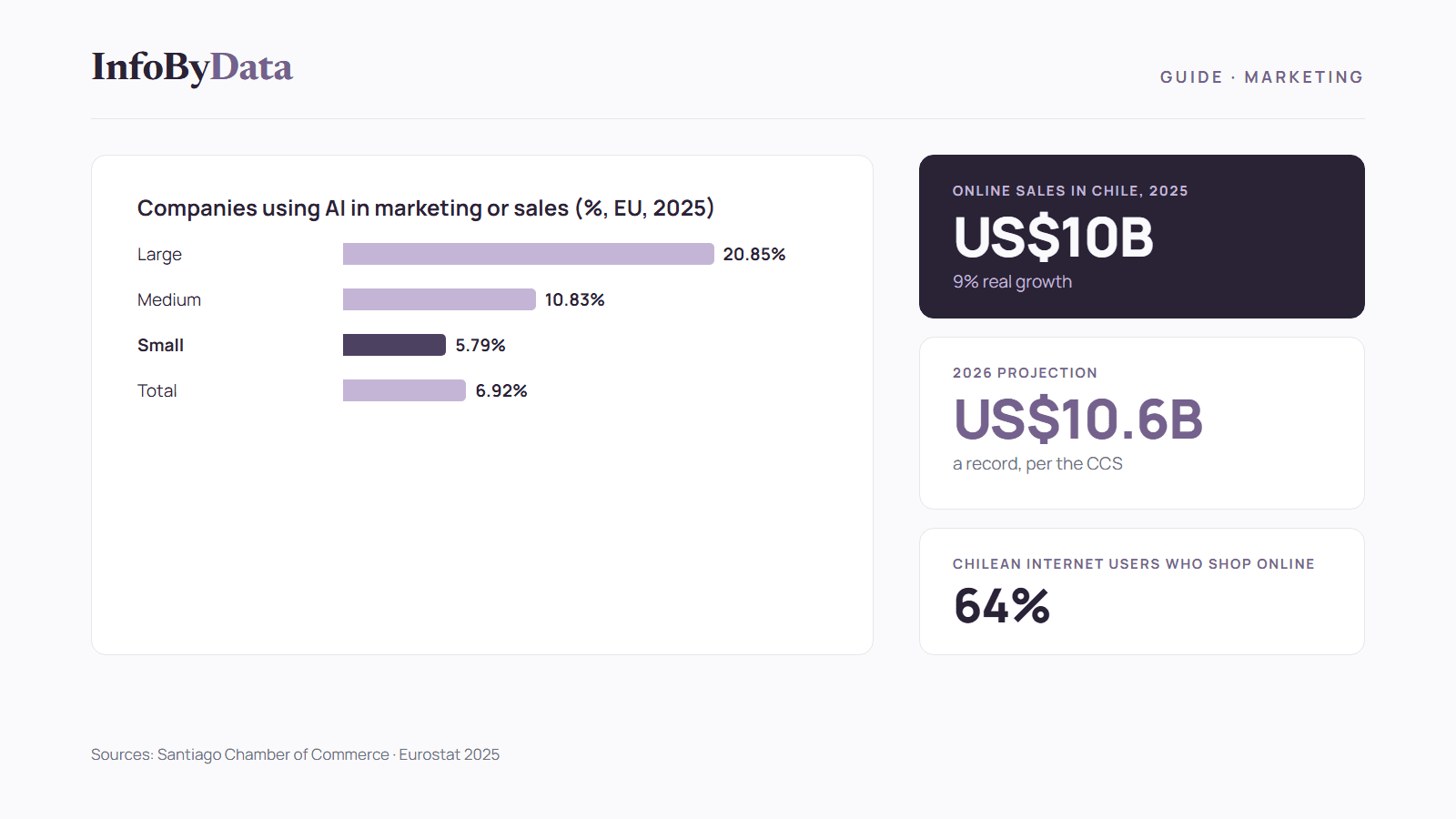
Since there's no official measurement in Chile, we use European companies as a reference. Use of AI in marketing or sales rises sharply with company size, according to Eurostat:
With only 5.79% of small companies using AI in marketing or sales, integrating AI into your online store is still a way to stand out.
Tools to integrate AI into your online store
| Need | What the AI does | Example tool |
|---|---|---|
| Product pages | Writes descriptions and store copy | Shopify's text generator and Sidekick |
| Images | Replaces backgrounds and edits product photos | Shopify's file editor, Canva or Adobe Firefly |
| Customer service | Suggests replies to questions | Shopify Inbox |
| Advice and content | Writes, summarizes and answers questions | ChatGPT, Claude or Gemini |
| Analysis | Summarizes sales and customer behavior | Analytics and BI platforms |
Shopify also lets you connect external assistants such as ChatGPT, Claude, Gemini or Microsoft Copilot, and control what data each one can access, according to its Help Center. To choose an assistant, see our comparison of AI virtual assistants.
Customer experience: trust and clear rules
AI improves the customer experience only if it builds trust. In April 2026, the CCS announced it was about to present a self-regulation code for the responsible development of AI. In the meantime, these basic rules help:
- Tell customers when they're talking to an AI and always offer the option to talk to a person.
- Review what the AI writes before publishing it: prices, shipping terms and warranties must be accurate.
- Protect your customers' personal data and share only what's needed with each tool.
How to integrate AI into your online store, step by step
Step 1: find where your customers get stuck
Review frequent questions, abandoned carts and searches with no results. That's where your first opportunity is.
Step 2: start with what your platform already offers
Many e-commerce platforms include AI tools at no additional cost. Turn them on before buying something new.
Step 3: improve your product pages
Use AI to write clear descriptions and improve photos, and review every text before publishing it.
Step 4: add an assistant or reply suggestions
Start with frequent questions and always leave a way to talk to a person.
Step 5: measure the impact
Compare conversion rate, response time and sales before and after, as we explain in our guide to marketing KPIs.
What it means for you
- Your customers already shop and compare with AI: Chilean e-commerce is growing at a record pace, and more than half of young consumers use AI to compare prices.
- Integrating AI into your online store doesn't require a big investment: many platforms already include assistants and text and image tools.
- Customer experience comes first: use AI to answer faster and better, but with human review and clear data rules.
Sources
- CCS: "E-commerce neared US$10 billion in 2025" (March 26, 2026, in Spanish)
- CCS: "CCS projects online sales will reach US$10.6 billion this year" (October 15, 2026, in Spanish)
- CCS: "CyberDay 2026 will incorporate artificial intelligence to make online shopping easier" (May 26, 2026, in Spanish)
- CCS: "CCS projects double-digit growth in online sales and announces its AI self-regulation code" (April 9, 2026, in Spanish)
- Shopify: AI-powered tools
- Eurostat: "Artificial intelligence by size class of enterprise" (isoc_eb_ai), 2025 data
- integrate AI into your online store
- customer experience
- e-commerce
- artificial intelligence
- Chile