AI code generation tools: a 2026 comparison of Claude Code, GitHub Copilot, Codex and Cursor
90% of developers use AI agents every week, and Claude Code rose from 18% to 39% in 2026. We compare the leading AI code generation tools, with data.
By Paulina · SEO and digital strategy specialist
· 4 min read
90% of professional developers were using AI agents to code at least once a week between May and July 2026, and 68% were using them every day, according to a JetBrains survey of professional developers worldwide. In just a few months, the landscape of AI code generation tools changed completely: Claude Code went from 18% to 39% usage at work, and GitHub Copilot lost first place.
In this comparison we review the main tools using data from JetBrains, Stack Overflow and the companies themselves. We have no commercial relationship with any of them.
90%
Developers using AI agents every week
May to July 2026
68%
Use them every day
according to JetBrains
39%
Developers using Claude Code at work
up from 18% in January 2026
73%
Use coding assistants and agents daily
according to Stack Overflow
Source: JetBrains, 2026; Stack Overflow, 2026
View the data as a table
| Developers using AI agents every week | 90% | May to July 2026 |
| Use them every day | 68% | according to JetBrains |
| Developers using Claude Code at work | 39% | up from 18% in January 2026 |
| Use coding assistants and agents daily | 73% | according to Stack Overflow |
What AI code generation tools are
They are assistants and agents that write, review and fix code from natural language instructions. The first ones completed lines as you typed; today's agents can read an entire project, propose changes across several files, run tests and fix errors.
To understand how these tools differ from general-purpose assistants, see our comparison of AI virtual assistants.
The most used AI code generation tools in 2026
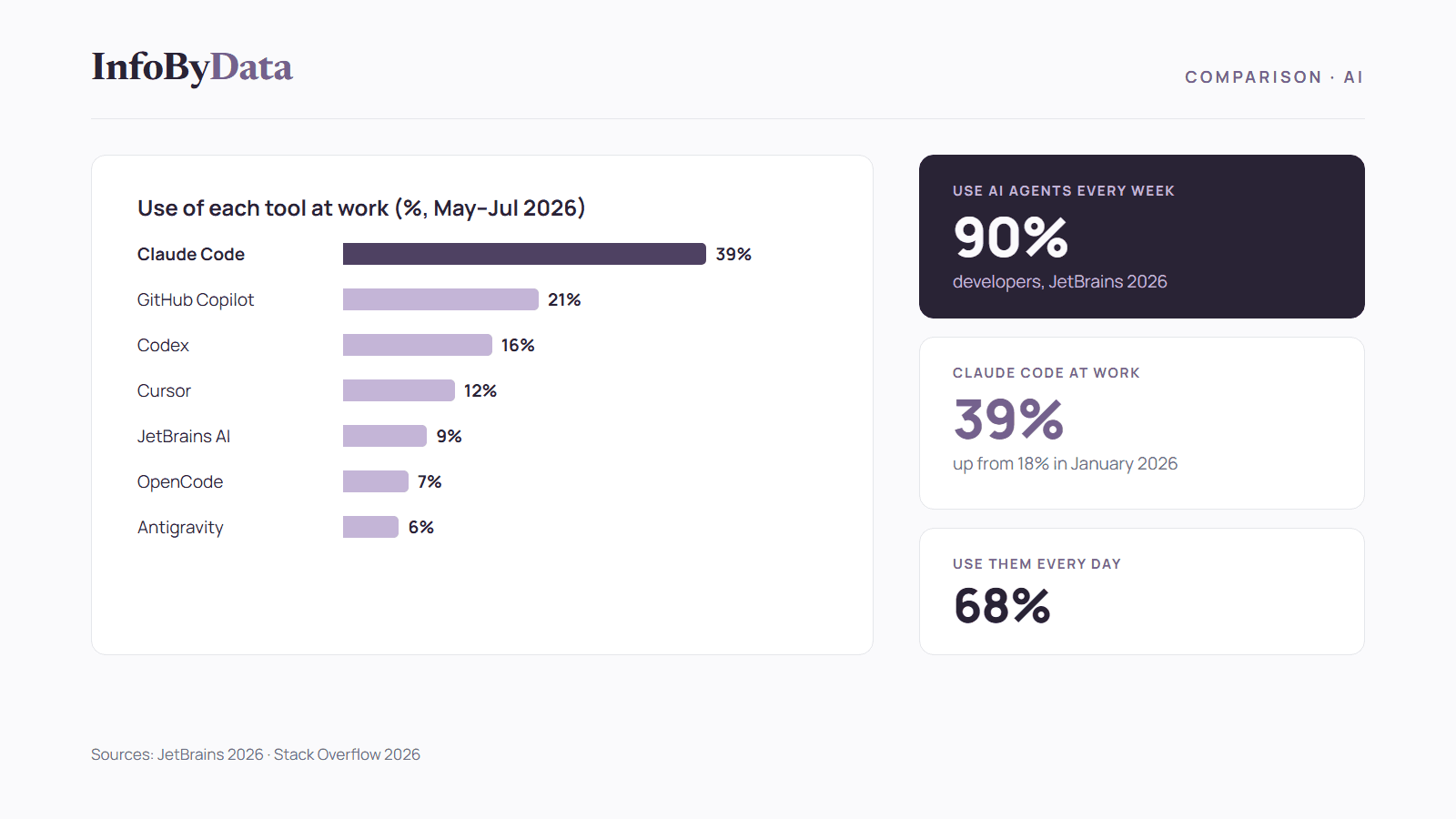
The JetBrains survey measures which tools developers use at work:
The shift in just a few months was large:
- January 2026
- May to July 2026
Source: JetBrains, 2026
View the data as a table
| January 2026 | May to July 2026 | |
|---|---|---|
| Claude Code | 18% | 39% |
| Codex | 3% | 16% |
| Cursor | 18% | 12% |
Comparing AI code generation tools
Claude Code (Anthropic): the most used in 2026
It's the most used tool at work: 39% of developers worldwide and 47% in the United States, according to JetBrains. It's also the main tool for 31% of developers. According to Anthropic, its annualized revenue exceeded US$2.5 billion in February 2026, and a SemiAnalysis estimate put its share of GitHub public commits at 4%.
GitHub Copilot (GitHub and Microsoft): the best known
Its use fell from 29% a year earlier to 21%, according to JetBrains, but it's still one of the best-known tools: 79% of developers know it. It integrates with the main code editors and with GitHub.
Codex (OpenAI): the fastest growing
Its use at work grew fivefold: from 3% in January to 16% between May and July 2026, according to JetBrains. In March 2026, OpenAI reported that Codex had more than 2 million weekly users, five times more than three months earlier.
Cursor: the editor with built-in AI
Cursor is a code editor with built-in AI. Its use fell from 18% in January to 12% between May and July 2026, although more developers know it: 75%, up from 69% in January, according to JetBrains.
Other options: JetBrains AI, OpenCode and Google Antigravity
JetBrains AI reaches 9% of developers, OpenCode, an open-source agent, 7%, and Google Antigravity 6%, according to the same survey. Antigravity is one of the AI tools used by Chile's financial regulator, the CMF, as we report in our article on AI providers in Chile's financial industry.
| Tool | Company | Use at work (May–Jul 2026) | Trend in 2026 |
|---|---|---|---|
| Claude Code | Anthropic | 39% | Up from 18% in January |
| GitHub Copilot | GitHub and Microsoft | 21% | Down from 29% a year earlier |
| Codex | OpenAI | 16% | Up from 3% in January |
| Cursor | Anysphere | 12% | Down from 18% in January |
| JetBrains AI | JetBrains | 9% | No published comparison |
| OpenCode | Open source | 7% | No published comparison |
| Google Antigravity | 6% | Stable |
How reliable are AI code generation tools
Use is widespread, but trust is selective. According to the 2026 Stack Overflow survey, 48% of developers trust AI when they can easily validate its answers, and only 16% extend that trust to most tasks that aren't important work decisions. Favorable views outnumber unfavorable ones by almost 3 to 1.
In companies, the impact is already being measured: in June 2026, 40% of the Santander group's code was developed with AI, and 17,000 people were using AI for software development, according to Santander.
How to choose an AI code generation tool
- Check which editor your team uses. Some tools work inside your current editor, while others are full editors or terminal agents.
- Test with a real task. Compare two tools solving the same problem in your project.
- Review everything the AI writes. Developers' trust depends on being able to validate the code: keep code reviews and automated tests.
- Protect sensitive code and data. Check what information is sent to each tool and the privacy terms of your plan.
- Measure the result. Compare development time and the number of bugs before and after, as in any data-driven project.
What it means for you
- Coding with AI is now the norm: nine in ten developers use AI agents every week. If you lead a technical team, it's worth defining usage rules.
- The market is changing fast: in a few months Claude Code moved into first place and Codex grew fivefold. Re-evaluate tools at least once a year.
- Human review is still key: trust depends on being able to validate the code. The tools speed up work, but they don't replace testing and review.
Sources
- JetBrains: "AI Coding Agents: Adoption Trends" (August 2026)
- Stack Overflow Developer Survey 2026: AI
- Anthropic: "Anthropic raises $30B Series G" (February 12, 2026)
- OpenAI: "OpenAI raises $122 billion to accelerate the next phase of AI" (March 2026)
- Santander: "Santander turns its AI-first strategy into measurable impact" (June 22, 2026)
- AI code generation tools
- Claude Code
- GitHub Copilot
- Codex
- Cursor