What is data-driven decision making and why is it important? Evidence and method (2026)
Deciding with data is linked to 5% to 6% higher productivity (MIT). What data-driven decision making is, why it matters and how to apply it in your company.
By Paulina · SEO and digital strategy specialist
· 3 min read
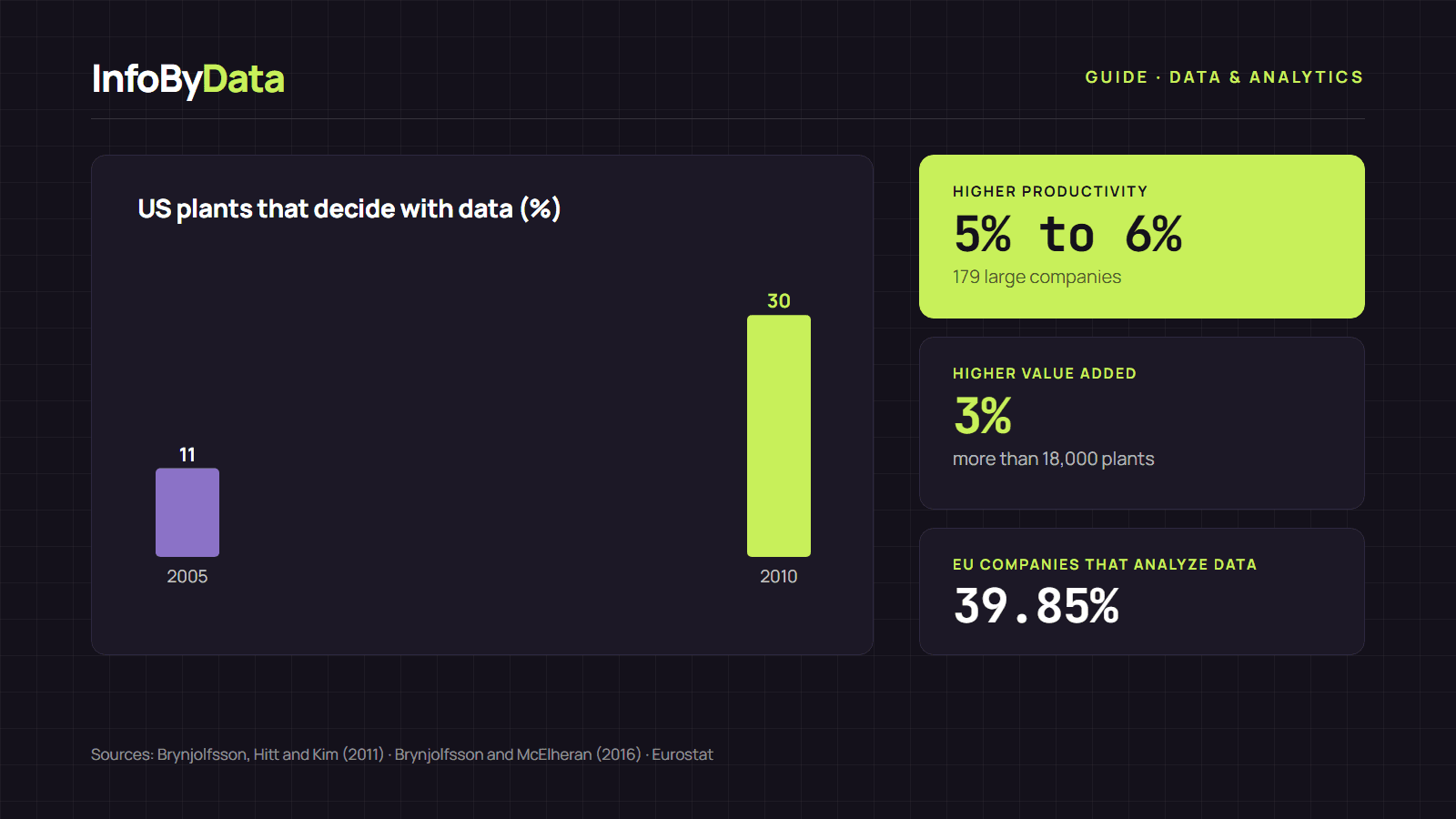
Companies that adopt data-driven decision making have output and productivity 5% to 6% higher than would be expected from their other inputs. That is the conclusion of the "Strength in Numbers" study by Erik Brynjolfsson (MIT), Lorin Hitt and Heekyung Kim, which analyzed 179 large publicly traded companies.
In this article we explain what data-driven decision making is, why it matters according to the evidence, which mistakes it helps avoid and a five-step method to apply it.
5% to 6%
Higher productivity
179 large companies
3%
Higher value added
more than 18,000 US plants
30%
Plants deciding with data in 2010
up from 11% in 2005
39.85%
EU companies that analyze data
2025
Source: Brynjolfsson, Hitt and Kim, 2011; Brynjolfsson and McElheran, 2016; Eurostat, 2025
View the data as a table
| Higher productivity | 5% to 6% | 179 large companies |
| Higher value added | 3% | more than 18,000 US plants |
| Plants deciding with data in 2010 | 30% | up from 11% in 2005 |
| EU companies that analyze data | 39.85% | 2025 |
What data-driven decision making is
Data-driven decision making (DDDM) is a process in which decisions rest mainly on data and analysis, not only on experience or intuition. It is the core practice of a data-driven company.
It doesn't mean data decides on its own. It means that, before deciding, you define what evidence you need, measure it and use it to choose between options. For the full definition of the concept, see what data-driven means and how to apply it in your company.
Why data-driven decision making is important: the evidence
There are three key studies, all based on data from real companies:
- Higher productivity. In the study by Brynjolfsson, Hitt and Kim, companies that decide with data have 5% to 6% higher output and productivity. The relationship also shows up in other indicators, such as asset utilization, return on equity and market value.
- Higher value added. Using US Census data on more than 18,000 plants, Brynjolfsson and McElheran found value added about 3% higher in plants that adopted the practice. The improvement appears after adoption, not before.
- Fast adoption. In the same research program, the share of plants deciding with data almost tripled in five years.
The authors themselves note a limitation: the first study shows an association and does not prove on its own that data causes the improvement. The second, with more plants and before-and-after data, strengthens the case for a real effect.
The mistakes data-driven decision making helps avoid
Deciding by intuition alone exposes you to systematic errors of judgment. Psychologist Daniel Kahneman received the 2002 Nobel Prize in Economic Sciences for integrating psychological research into economics, especially regarding how we judge and decide under uncertainty. Three common biases in companies:
| Bias | What happens | How data helps |
|---|---|---|
| Confirmation | We look for information that confirms what we already believe | Define in advance which result would change the decision |
| Anchoring | The first figure we hear shapes the decision | Compare with historical or market data |
| Availability | We overvalue what we remember easily, like the latest complaint | Look at all cases, not the anecdote |
How to apply data-driven decision making in 5 steps
- Frame the question. For example: "Should we raise the price of this product by 5%?"
- Define what data you need and which result would change your decision. For example: "If sales drop more than 10%, we roll back."
- Gather and check the data. Verify where it comes from and whether it is complete. To choose tools, see the most used data-driven platforms in data analysis.
- Decide and document. Write down what you decided, based on which data, and what you expect to happen.
- Measure the result and learn. Compare what happened with what you expected and adjust.
To get the whole team working this way, read our guide to data-driven culture.
The limits: when data is not enough
- Poor-quality data: if data is incomplete or badly recorded, the decision inherits the error.
- Correlation is not causation: two figures rising together doesn't mean one causes the other. Controlled tests (for example, comparing two versions of a page) help separate cause and effect.
- Too few sources: only 15.86% of European companies analyze data from three or more sources, according to Eurostat. A single source gives a partial view.
What it means for you
- Deciding with data has a measurable return: the evidence on data-driven decision making shows 5% to 6% higher productivity in companies that practice it.
- The method matters more than the tool: defining in advance which data would change your decision is the step that prevents the most mistakes.
- Data doesn't replace judgment: it helps correct biases, but you need to check its quality and not confuse correlation with cause.
Sources
- Brynjolfsson, E., Hitt, L. and Kim, H. (2011): "Strength in Numbers: How Does Data-Driven Decisionmaking Affect Firm Performance?", SSRN
- Brynjolfsson, E. and McElheran, K. (2016): "Data in Action: Data-Driven Decision Making in U.S. Manufacturing", Census Bureau, CES 16-06
- Brynjolfsson, E. and McElheran, K. (2016): "The Rapid Adoption of Data-Driven Decision-Making", American Economic Review 106(5)
- The Nobel Prize: Daniel Kahneman, Prize in Economic Sciences 2002
- Eurostat: "Data analytics by size class of enterprise" (isoc_eb_das), 2025 data
- data-driven decision making
- data-driven
- decisions with data
- cognitive biases
- productivity