Guide to developing a data-driven digital marketing strategy (2026)
94.5% of people in Chile use the internet. A 6-step guide to developing a data-driven digital marketing strategy, with audience figures and KPIs to track.
By Paulina · SEO and digital strategy specialist
· 3 min read
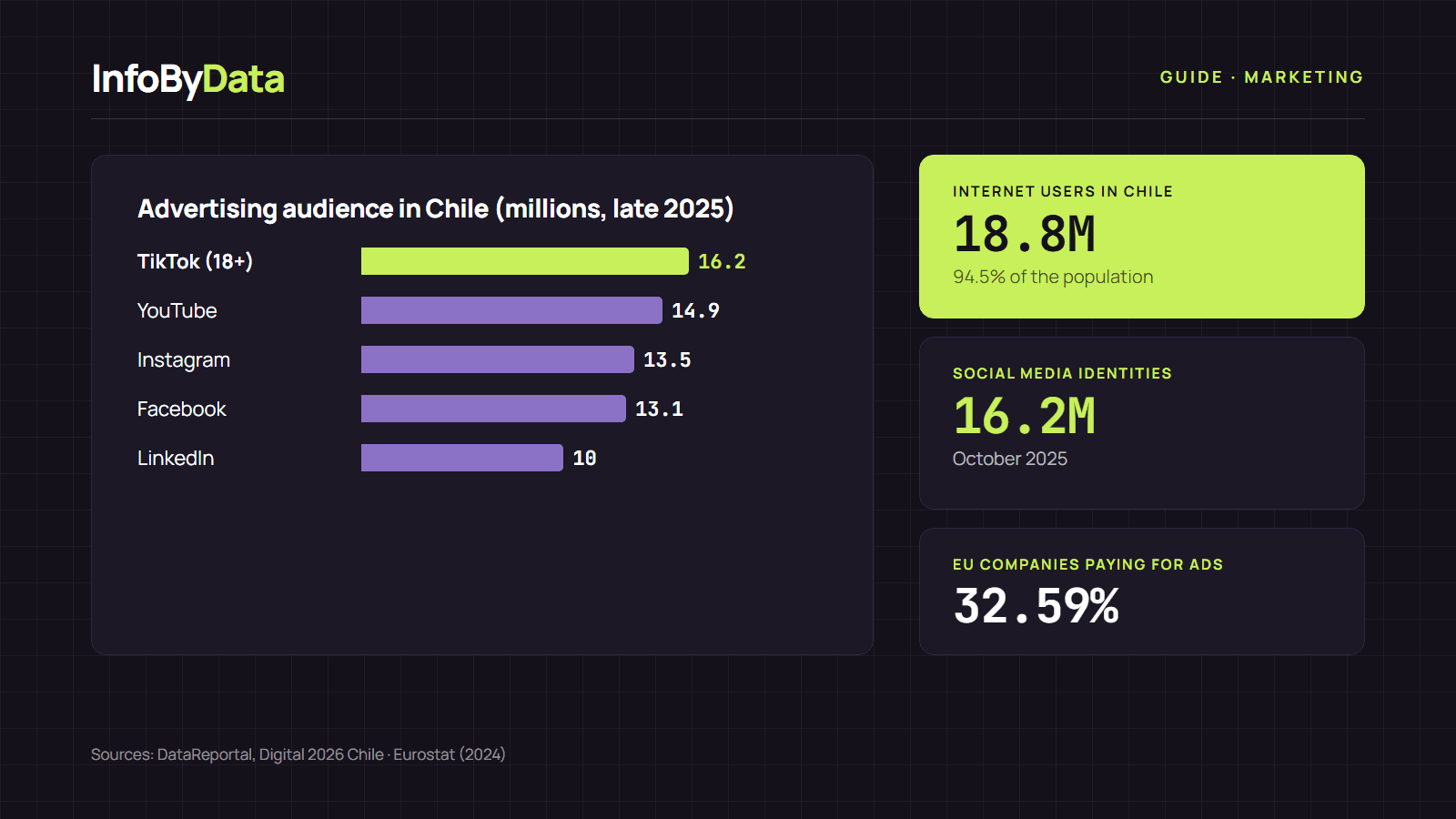
There were 18.8 million internet users in Chile in October 2025, 94.5% of the population, according to DataReportal's Digital 2026 Chile report. Almost a brand's entire audience is online, and almost everything it does online can be measured. That is why a data-driven digital marketing strategy is no longer a luxury for large companies: it is the safest way to decide what to invest in. It is the data-driven approach applied to the whole marketing plan.
This guide explains, in 6 steps, how to develop a data-driven digital marketing strategy: from the diagnosis to the review calendar.
18.8M
Internet users in Chile
94.5% of the population
16.2M
Social media user identities
October 2025
14.9M
YouTube advertising audience
late 2025
32.59%
EU companies paying for online ads
2024
Source: DataReportal, Digital 2026 Chile; Eurostat, 2024
View the data as a table
| Internet users in Chile | 18.8M | 94.5% of the population |
| Social media user identities | 16.2M | October 2025 |
| YouTube advertising audience | 14.9M | late 2025 |
| EU companies paying for online ads | 32.59% | 2024 |
What a data-driven digital marketing strategy is
A data-driven digital marketing strategy is a plan in which every decision (who to speak to, on which channel, with what budget and with what message) rests on measured data, and in which every action has an indicator to evaluate it. It differs from a traditional plan in that it is reviewed and adjusted continuously based on results.
If you want to first understand how customer data is used in marketing, see our data-driven marketing guide.
Step 1: run a data-based diagnosis
Before planning, measure where you stand. Check in Google Analytics where your visits come from and which ones buy, and in Search Console which searches bring you traffic. If you don't measure your site yet, you're not alone: 42.8% of websites use no analytics tool, according to W3Techs. We help you choose in the best data-driven tools for digital marketing.
Step 2: define your audience with market data
Your data-driven digital marketing strategy should start from where your audience is. These are the advertising audiences of the main platforms in Chile:
Advertising audience figures are not the same as unique individuals: one person can have more than one account. Use them to compare platforms, and combine them with your own customer data.
Step 3: set goals and KPIs
Every goal in the strategy needs an indicator and a time-bound target. For example: "increase online sales by 15% in six months, with an acquisition cost below CLP 10,000 per customer". Use the indicators from our marketing KPI guide: acquisition cost, conversion rate, customer lifetime value, return on ad spend and retention rate.
Step 4: choose channels and allocate the budget
Allocate the budget based on the data from the diagnosis and the audience, not on habit. In the European Union, large companies pay for internet advertising more often than small ones:
- Any advertising
- Behavior-targeted
Source: Eurostat, isoc_cismt
View the data as a table
| Any advertising | Behavior-targeted | |
|---|---|---|
| Small (10 to 49) | 30.56% | 12.44% |
| Large (250 or more) | 50.48% | 27.42% |
| Total | 32.59% | 13.93% |
Don't forget organic channels: SEO generates traffic without paying for each click. See how to optimize SEO in online stores.
Step 5: measure and attribute the results
Set up conversions in Google Analytics and review the data-driven attribution model, which splits the credit for each sale across the channels involved. That way you'll know which part of the budget performs and which should be moved.
If you use customers' personal data, remember that Chile's Law 21,719 requires consent that is free, specific, unequivocal and informed. We explain it in data-driven marketing.
Step 6: review your data-driven digital marketing strategy on a fixed calendar
| Frequency | What to review | Typical decision |
|---|---|---|
| Weekly | Spend, clicks and conversions by campaign | Pause ads that don't convert |
| Monthly | KPIs against targets, attribution by channel | Move budget between channels |
| Quarterly | Audience, competitors and goals | Adjust goals and messages |
To get the whole team on this rhythm, read how to build a data-driven culture.
What it means for you
- Your audience is already online: 94.5% of people in Chile use the internet, so almost every marketing action can be measured.
- Data organizes the budget: with goals, KPIs and attribution, every peso is allocated according to what it returns, not according to habit.
- A data-driven digital marketing strategy is always under review: a weekly, monthly and quarterly calendar is what keeps it alive.
Sources
- data-driven digital marketing strategy
- data-driven
- digital marketing
- marketing plan
- digital audience Chile