Which data-driven platforms are the most used in data analysis? 2026 ranking with figures
SQL and Python lead among developers and PostgreSQL is the top database. A ranking of the most used data-driven platforms in data analysis, with 2026 data.
By Paulina · SEO and digital strategy specialist
· 3 min read
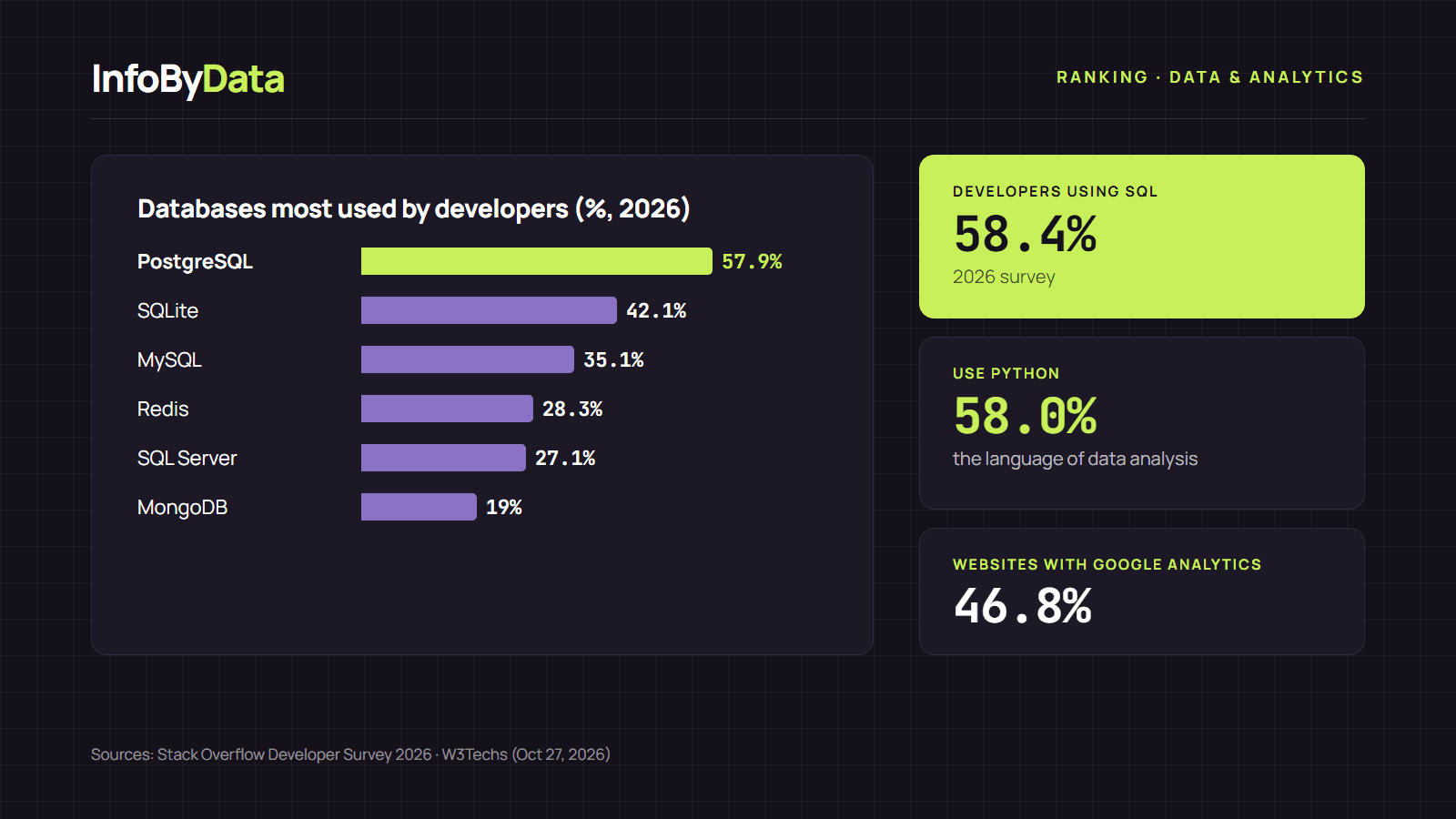
58.4% of developers used SQL and 58.0% used Python over the past year, according to the Stack Overflow 2026 survey. They are the two languages of data analysis, and both rank among the four most used languages in the world. Among databases, PostgreSQL leads with 57.9%. These are the platforms on which a data-driven company is built today.
In this article we review which data-driven platforms are the most used at each stage of data analysis: languages, databases, cloud, business intelligence (BI) and web analytics.
58.4%
Developers using SQL
2026 survey
58.0%
Developers using Python
2026 survey
57.9%
Use PostgreSQL
the most used database
46.8%
Websites with Google Analytics
October 2026
Source: Stack Overflow, 2026; W3Techs, October 27, 2026
View the data as a table
| Developers using SQL | 58.4% | 2026 survey |
| Developers using Python | 58.0% | 2026 survey |
| Use PostgreSQL | 57.9% | the most used database |
| Websites with Google Analytics | 46.8% | October 2026 |
What a data-driven platform is
A data-driven platform is any tool that makes it possible to collect, store, analyze or visualize data to make decisions. In practice, a company combines several:
| Stage | What it is for | Most used examples |
|---|---|---|
| Languages | Querying and processing data | SQL, Python |
| Databases | Storing and organizing data | PostgreSQL, SQLite, MySQL |
| Cloud | Hosting and processing data without your own servers | Cloud databases |
| Business intelligence (BI) | Building dashboards and reports | Power BI, Qlik, Data Studio |
| Web analytics | Measuring visits and conversions | Google Analytics, Microsoft Clarity |
Languages: SQL and Python, the foundation of data analysis
SQL is the language for querying databases, and Python is the most used for cleaning data, running statistics and training artificial intelligence models. In the Stack Overflow 2026 survey, SQL ranked second among the most used languages, behind JavaScript (62.0%), and Python ranked fourth.
For anyone starting out in data analysis, learning SQL is the investment with the highest return: it works with almost any database and is the gateway to the most advanced data-driven platforms.
Databases: the most used data-driven platforms for storing data
PostgreSQL is free and open source, as are SQLite and MySQL. That partly explains their lead: a small business can use the same technology as a large company without paying for licenses.
Cloud: where data is hosted
More and more companies store their data in the cloud instead of on their own servers. In the European Union, 24.01% of companies with 10 or more employees paid to host their database in the cloud in 2025, according to Eurostat. The gap by size is large.
- Any cloud service
- Cloud database
Source: Eurostat, isoc_cicce_use
View the data as a table
| Any cloud service | Cloud database | |
|---|---|---|
| Small (10 to 49) | 49.3% | 21.63% |
| Medium (50 to 249) | 66.78% | 32.95% |
| Large (250 or more) | 84.67% | 49.77% |
| Total | 52.74% | 24.01% |
Business intelligence: data-driven platforms for building dashboards
BI tools turn data into dashboards that anyone on the team can read. In Gartner's 2026 evaluation, Microsoft (Power BI), Google and Qlik were recognized as Leaders, as they confirmed on their official sites. We cover this in our comparison of the best AI platforms for business data analysis.
To start at no cost, Google's Data Studio (formerly Looker Studio) is available at no charge for report creators and viewers, and connects through more than 1,300 Community Connectors.
Web analytics: the most widespread data-driven platform
Google Analytics is on 46.8% of all websites and holds 81.9% of the analytics tools market, according to W3Techs as of October 27, 2026. By contrast, 42.8% of websites use none at all. We compare the options for marketing in our guide to the best data-driven tools for digital marketing.
How to choose your data-driven platforms
- Start with the business question, not the tool. See what data-driven decision making is.
- Prefer open standards: SQL and PostgreSQL work with almost everything and don't lock you into one vendor.
- Start with free versions (Google Analytics, Data Studio, PostgreSQL) and pay only when volume justifies it.
- Think about who will use it: a BI dashboard serves the sales team; Python serves the analyst.
If your company is small, follow our guide to implementing a data-driven strategy in a small business.
What it means for you
- SQL is the most transferable skill: 58.4% of developers use it, and it works on almost any data-driven platform.
- You don't need expensive licenses to start: the most used databases, such as PostgreSQL, SQLite and MySQL, are free.
- Measuring your website is the first step: 42.8% of websites use no analytics tool, so doing it already puts you ahead.
Sources
- data-driven
- data-driven platforms
- data analysis
- most used databases
- BI tools