Artificial intelligence law in Chile: what stage the bill is at and what obligations companies would face
Chile's artificial intelligence law passed its first Senate vote. It would ban 7 uses of AI and set fines of up to 20,000 UTM, about CLP 1.449 billion.
· 5 min read
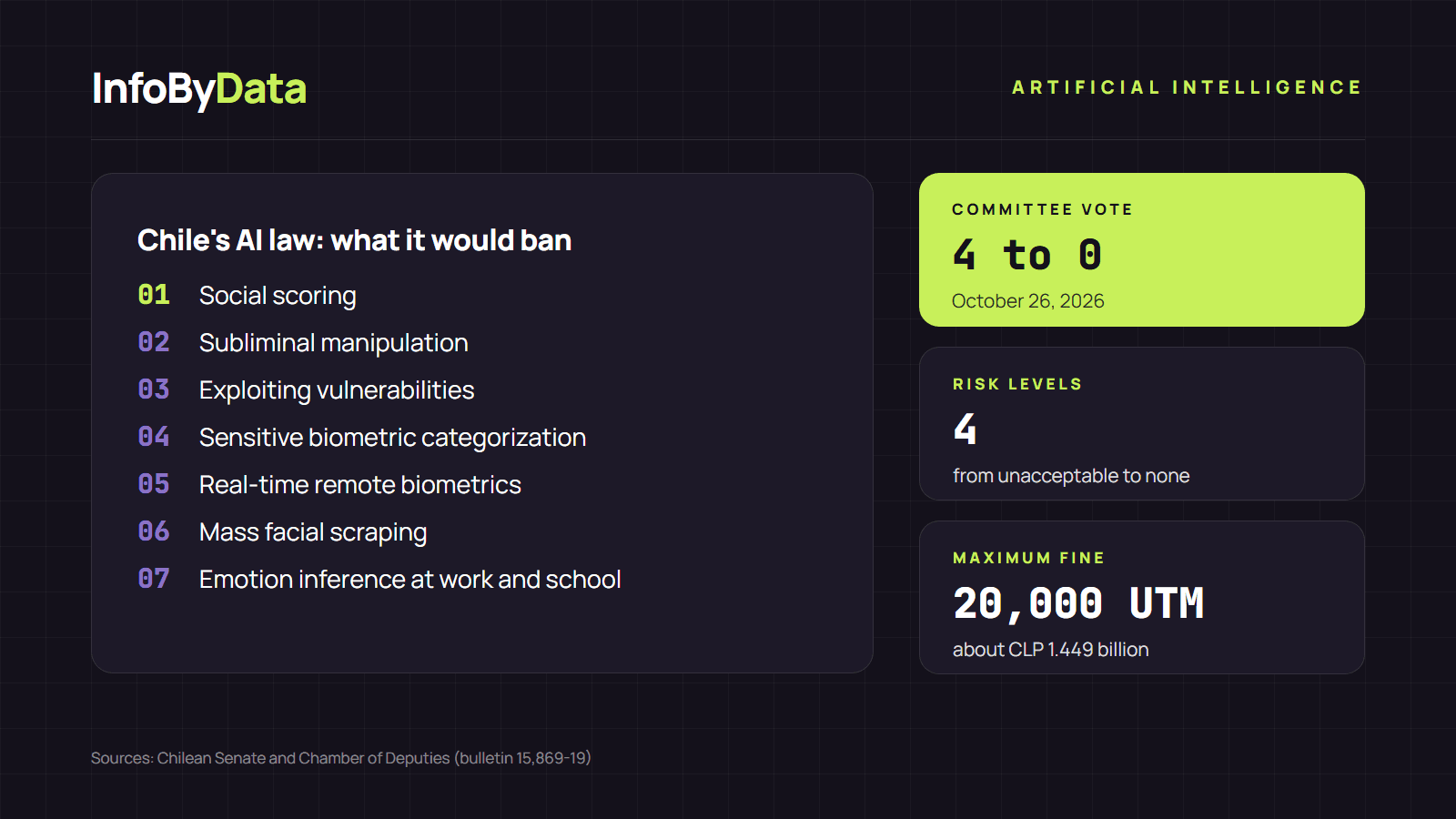
The artificial intelligence law in Chile took a key step: on October 26, 2026, the Senate's Future Challenges Committee approved the bill in general by 4 votes to none, and its first report was formally received on November 10, according to the Senate's legislative record. Approval "in general" means backing the idea of legislating: the text can still change and Chile does not yet have an AI law in force.
The bill (bulletins 15,869-19 and 16,821-19, merged) had already been passed by the Chamber of Deputies on October 13, 2025. This article summarizes, using the official text approved by the Chamber, which uses it would ban, what companies would have to do and how much fines could cost.
4
Risk categories
from unacceptable to no evident risk
7
Banned uses
including social scoring
20,000 UTM
Maximum fine
about CLP 1.449 billion as of November 2026
Source: Chamber of Deputies, official letter No. 20,843 with the approved text (Oct 13, 2025) · SII, UTM value
View the data as a table
| Risk categories | 4 | from unacceptable to no evident risk |
| Banned uses | 7 | including social scoring |
| Maximum fine | 20,000 UTM | about CLP 1.449 billion as of November 2026 |
What stage the artificial intelligence law in Chile is at
The bill began in April 2023 as a motion by lawmakers and was later merged with a bill sent by the Executive. This is its path according to official Congressional records:
| Date | Milestone |
|---|---|
| Apr 24, 2023 | The motion is filed in the Chamber of Deputies (bulletin 15,869-19) |
| Oct 13, 2025 | The Chamber passes the bill and sends it to the Senate |
| May 26, 2026 | Science Minister Ximena Lincolao presents the government's proposal to the Senate committee |
| Oct 26, 2026 | The Future Challenges Committee approves it in general (4 votes in favor) |
| Nov 10, 2026 | The committee's first report is formally received |
| Dec 4, 2026 | Proposed deadline for amendments |
Next comes the general vote on the Senate floor and then the article-by-article discussion, where changes can be added. The December 4 deadline was reported by Mala Espina Check. If passed, the Chamber's text says the law would take effect 12 months after its publication in the Official Gazette.
How it classifies AI: four risk levels
The bill does not regulate the technology itself but its uses, and ranks them by the risk they pose to people's rights, an approach inspired by the European Union's AI Act:
- Unacceptable risk: banned uses.
- High risk: uses that can significantly affect fundamental rights or consumer rights, copyright and related rights. They face strict rules.
- Limited risk: systems that interact with people and may cause minor deception or error, such as a chatbot. They must disclose that the person is talking to an AI.
- No evident risk: all other uses, with no special obligations.
In addition, anyone operating systems that generate synthetic content (audio, images, video or text) must ensure those outputs can be identified as artificially created or manipulated.
Which AI uses it would ban
Article 7 of the text passed by the Chamber defines seven unacceptable-risk uses:
- Subliminal manipulation that induces harmful decisions a person would not otherwise have made.
- Exploiting vulnerabilities such as age, economic situation or disability to alter behavior.
- Biometric categorization based on sensitive data that leads to arbitrary discrimination.
- Generic social scoring of people based on their behavior or socioeconomic status.
- Real-time remote biometric identification in publicly accessible spaces.
- Mass scraping of facial images from the internet or cameras, without consent, to build facial recognition databases.
- Emotion inference in workplaces, schools, border controls and criminal proceedings.
There are exceptions for therapeutic purposes with informed consent.
What obligations companies would face
Most companies that use AI for everyday tasks, such as drafting texts or summarizing documents, would fall into the lower-risk categories. The toughest requirements apply to high-risk uses, which would have to comply with six rules (Article 9):
- Risk management throughout the system's life cycle.
- Data governance if the system is trained on data.
- Technical documentation demonstrating compliance.
- Logs of events while the system is running.
- Human oversight by trained people.
- Accuracy, robustness and cybersecurity, aligned with Chile's Cybersecurity Framework Law.
If a high-risk system does not comply, the operator must deactivate, suspend or withdraw it from the market. The text also provides for standards that vary by company size and priority access for small businesses to regulatory sandboxes, where those who follow the guidelines are exempt from fines.
Fines: how much breaking the artificial intelligence law in Chile would cost
Enforcement would fall to Chile's Personal Data Protection Agency. Fines are set in UTM, a Chilean inflation-indexed unit; we converted them to pesos using the November 2026 UTM (CLP 72,440):
- Very serious: using AI for a banned purpose, or repeating a serious infraction within one year.
- Serious: breaching the high-risk rules.
- Minor: breaching the transparency obligations for limited-risk uses.
These are maximum amounts: the fine takes into account, among other factors, the company's size and sales, the harm caused, cooperation with the authorities and the benefit obtained.
Another bill: identity and traceability for AI agents
On October 28, 2026, a separate bill was filed in the Senate, bulletin 18,820-19, by senators Paulina Núñez, Paulina Vodanovic, Iván Flores, Manuel José Ossandón and Matías Walker. It amends the Cybersecurity Framework Law (Law 21,663) for private institutions that operate AI agents, meaning systems that can act on their own on networks, files or credentials.
Among other things, it proposes a verifiable identity for each agent, prior registration of its permissions, traceability of its actions, controls to suspend it and an internal log of "near-miss loss-of-control incidents." It would take effect 12 months after publication. It is at the first stage, with no urgency.
What the government proposes
The debate is not settled. In May 2026, Minister Lincolao presented a proposal based on six pillars focused on innovation, productivity and competitiveness, and suggested following models such as those of Japan and Singapore, according to the Senate. The committee chair, Senator Rojo Edwards, mentioned as an example replacing prior (ex ante) review with later (ex post) review.
At the time of the October vote, the substitute amendment announced by the Executive had not been filed, so the committee voted on the Chamber's text. That is why the final version of the artificial intelligence law in Chile may differ from what is described here. We will update this article as the bill moves forward.
To see how much Chilean companies use AI today, read our article on AI in business, and for the financial sector, the one on AI providers in Chile's financial industry.
What it means for you
- If you use AI tools in your daily life: the bill seeks to ensure you know when you are talking to an AI and that synthetic content, such as fake videos, can be identified.
- If you run a company: it makes sense to take stock of where you use AI and check whether any use could be high-risk, such as hiring or customer assessment. You have time: even if passed, the law would take effect one year after publication.
- If you work at an institution or make decisions: the uses the text bans and the high-risk rules already serve as a best-practice guide, and the debate on the regulatory model is open to proposals until the amendment deadline.
Sources
- Chilean Senate, legislative record for bulletin 15,869-19
- Chamber of Deputies, official letter No. 20,843 with the approved text (October 13, 2025)
- Chilean Senate, motion for bulletin 18,820-19 on AI agents (October 28, 2026)
- Chilean Senate, "Senators review the Executive's proposal for an AI framework law" (May 26, 2026)
- Mala Espina Check, "AI law advances in the Senate" (October 27, 2026)
- SII, 2026 UTM values
- artificial intelligence law in Chile
- AI regulation
- AI bill
- AI agents
- Chilean Senate