AI code generation: how much code AI writes in 2026 and what risks it poses for companies
More than 40% of pull requests on GitHub now start with an AI agent, according to Octoverse 2026, but 38% of AI-generated code still has vulnerabilities.
· 4 min read
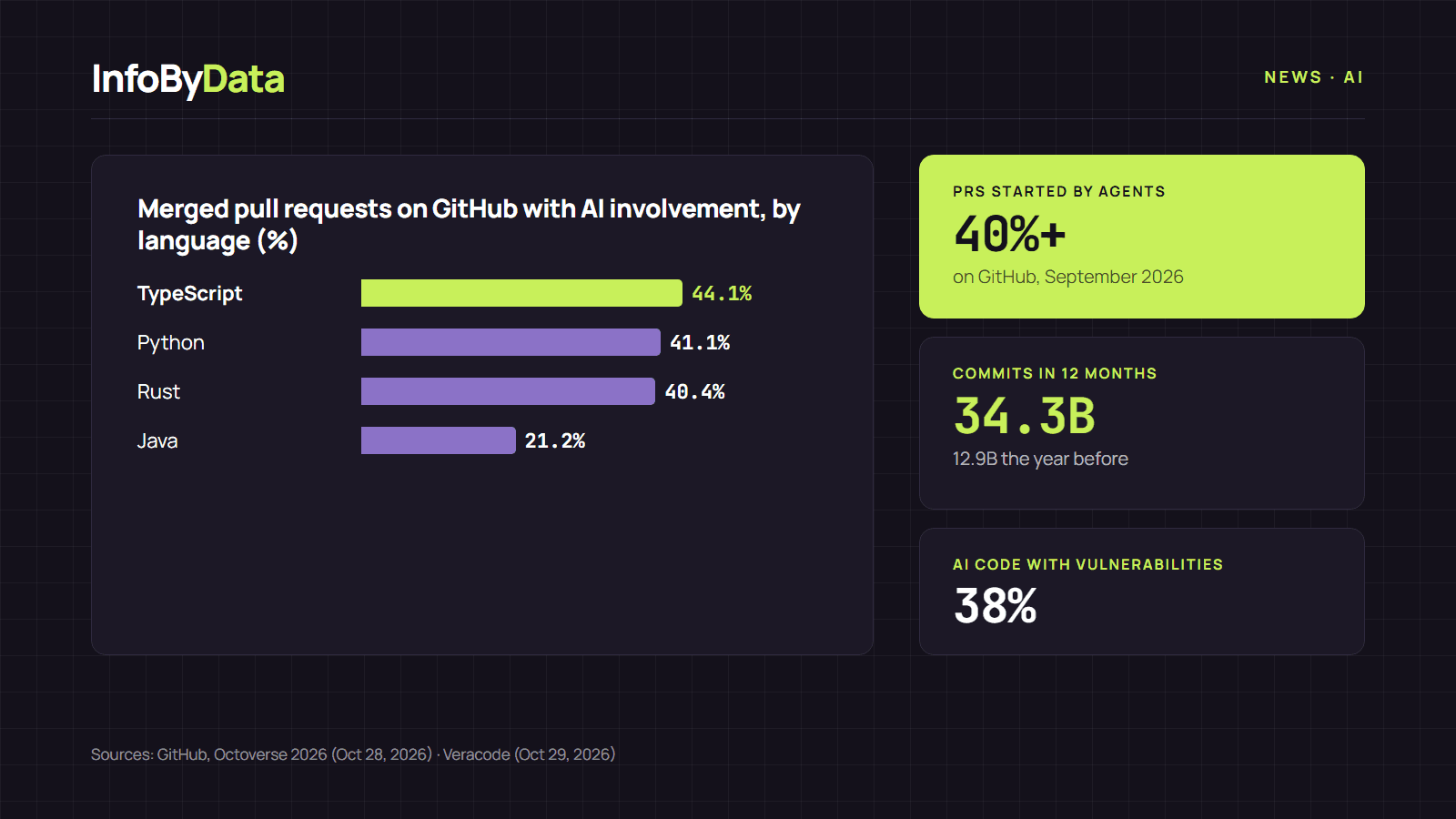
AI code generation is no longer an experiment: more than 40% of pull requests on GitHub started with a first draft written by an AI agent in September 2026, up from 17% in March, according to GitHub's Octoverse 2026 report, released on October 28.
Quality is not keeping pace. 38% of AI coding tasks introduced a security vulnerability in tests by Veracode, although that figure improved from 44% in July.
40%+
Pull requests started by agents
on GitHub, September 2026
73%
Developers using assistants daily
Stack Overflow survey
38%
AI code with vulnerabilities
Veracode tests, October
Source: GitHub, Octoverse 2026 · Stack Overflow, Developer Survey 2026 · Veracode (Oct 29, 2026)
View the data as a table
| Pull requests started by agents | 40%+ | on GitHub, September 2026 |
| Developers using assistants daily | 73% | Stack Overflow survey |
| AI code with vulnerabilities | 38% | Veracode tests, October |
What AI code generation is
AI code generation is the use of artificial intelligence models to write, complete, fix or review code from natural-language instructions. It started as autocomplete inside the editor and now works through agents: programs that take a task, change several files and propose the change ready for review.
We compare the main tools, such as Claude Code, GitHub Copilot, Codex and Cursor, in our article on AI tools for code generation. Here we focus on how much code AI produces and what it means for companies.
How much code AI writes in 2026
Activity on GitHub soared in the 12 months to September 2026. GitHub links the rise to the use of agents, although it notes that its data does not prove cause and effect.
Other figures from the report:
- 1.3 billion merged pull requests in the year, about 3.5 million a day, compared with 538 million in 2025.
- 110 million agent-started pull requests in September 2026 alone, about six times March's volume.
- 90% of agent-started pull requests were merged within two weeks in September, compared with about 86% of those with no detected agent involvement.
- 55% of GitHub Copilot monthly active users use its agent features, up from 35% a year earlier.
AI involvement varies by programming language:
GitHub warns that the 40% is a floor, because it does not detect all agent use, and that it measures pull requests, not lines of code: it does not mean AI writes 40% of all code.
How secure AI-generated code is
Veracode, a software security company, regularly tests the code generated by dozens of AI models. Its results show that the code almost always works, but it is not always secure: models write syntactically correct code almost 100% of the time, yet fail at basic defenses.
- The average pass rate rose from 56% to 62% between July and October 2026, the first meaningful improvement since 2025, according to Veracode.
- Failures cluster around certain attacks: in July, the code withstood SQL injection 83% of the time, but cross-site scripting (XSS) only 15% of the time and log injection only 12%.
- Java remains the weakest language, with a 31% pass rate.
"The answer should never be to use the most expensive model and hope for the best," said Chris Wysopal, Veracode's co-founder, in the release. Note that Veracode sells security testing tools.
What AI code generation means for companies
For companies, AI code generation promises more speed, but it shifts the work to review: if agents write more code, someone has to check that it is correct and secure. Developers know this: 48% trust AI when they can easily validate its answers, and only 16% trust it for most tasks that do not involve important decisions, according to Stack Overflow.
In Chile, adoption is still low overall: ILIA 2026 estimates that only 13.5% of companies use artificial intelligence. We analyze this in our article on AI in business in Chile, and in investment in artificial intelligence we show that 46.5% of companies say they lack specialized talent.
Some practices that follow from the data:
- Mandatory human review of every change proposed by an agent before it is merged.
- Automated security tests on every change, focusing on XSS and log injection, the most frequent failures according to Veracode.
- Small changes: agents touch several files at once (87% of their pull requests change more than one, according to GitHub), which makes them harder to review.
- Team training in the use of these tools, one of the gaps in artificial intelligence in business across the region.
AI code generation changes month by month. InfoByData will keep tracking these indicators and update this article when GitHub, Veracode or Stack Overflow publish new data. We have no commercial relationship with any of the companies mentioned.
What it means for you
- If you lead a development team: AI code generation can speed up the work, but decide who reviews the agents' code, and with which tests, before expanding its use.
- If you code: use AI for first drafts and check security yourself, especially in forms, logs and user-entered data.
- If you run a small business: AI coding can make small projects cheaper, but an experienced person should review what goes live.
Sources
- GitHub, "Octoverse: Commits, pushes, reach new highs in 2026 as developers build with agents" (October 28, 2026)
- Veracode, "2026 GenAI Code Security Report" (July 28, 2026)
- Veracode, "Veracode Finds First Meaningful Gain in AI Code Security Since 2025 as Average Pass Rate Hits 62%" (October 29, 2026)
- Stack Overflow, Developer Survey 2026: AI
- CENIA, ILIA 2026 (October 20, 2026)
- AI code generation
- AI coding
- GitHub Octoverse
- code security
- AI in business