How much does a data analyst earn in Chile in 2026: salaries by degree and employability
How much does a data analyst earn in Chile: per Mi Futuro, a computer engineering graduate earns CLP 2,683,432 gross a month four years after graduating.
· 4 min read
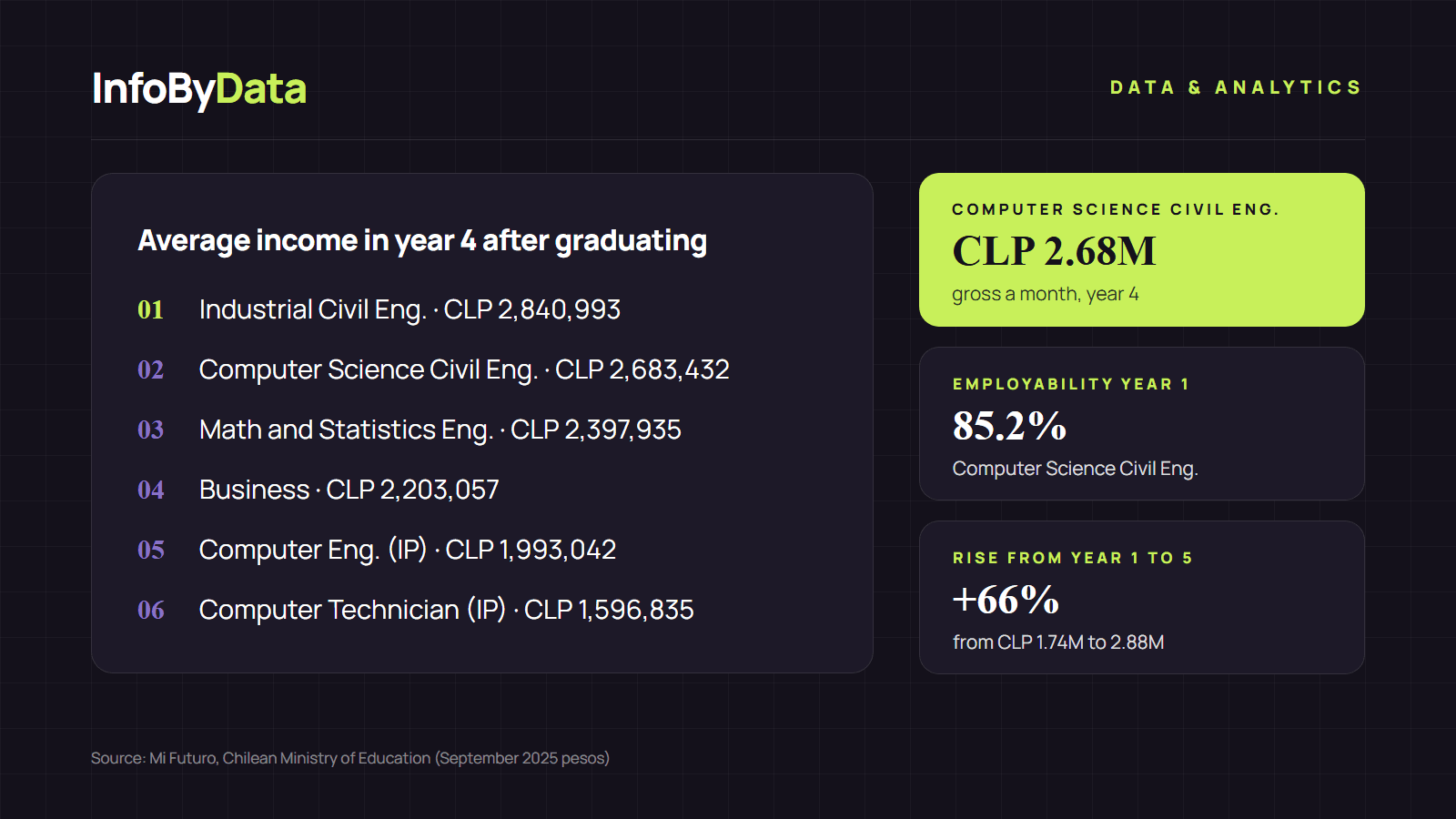
A graduate in Computer Science and Informatics Civil Engineering earns an average of CLP 2,683,432 gross a month four years after graduating, according to Mi Futuro, the Chilean Ministry of Education's portal. In the first year, the average is CLP 1,737,657. It is one of the degrees that produces the most data analysts in Chile.
There is no official statistic for the "data analyst" job title: people reach it from several degrees. So to answer how much a data analyst earns in Chile, we reviewed the income and employability of the degrees that most often lead to that job: computer science, statistics, industrial engineering and business.
CLP 2,683,432
Computer Science Civil Eng., year 4
average, universities
CLP 2,397,935
Mathematics and Statistics Eng., year 4
average, universities
CLP 1,993,042
Computer Eng. (IP), year 4
average, professional institutes
85.2%
Employability in year 1
Computer Science Civil Eng.
Source: Mi Futuro, Mineduc, gross monthly income in September 2025 Chilean pesos
View the data as a table
| Computer Science Civil Eng., year 4 | CLP 2,683,432 | average, universities |
| Mathematics and Statistics Eng., year 4 | CLP 2,397,935 | average, universities |
| Computer Eng. (IP), year 4 | CLP 1,993,042 | average, professional institutes |
| Employability in year 1 | 85.2% | Computer Science Civil Eng. |
How much does a data analyst earn in Chile by degree
Mi Futuro publishes the average gross monthly income of each degree, from the first to the fifth year after graduation. Figures are in September 2025 Chilean pesos, and income in year four covers the 2018, 2019 and 2020 graduating classes.
U: university. IP: professional institute. CFT: technical training center.
The gap between technical and university training is wide: a computer technician from a professional institute earns an average of CLP 1,596,835 in year four, versus CLP 2,683,432 for a computer science civil engineer. Even so, in data work, experience and the tools you master matter a lot, not just the degree.
How salary grows in the first five years
Salary rises fast in the early years. In Computer Science and Informatics Civil Engineering it goes from CLP 1,737,657 in year one to CLP 2,880,941 in year five: a 66% increase in four years.
| Degree | Year 1 | Year 4 | Year 5 |
|---|---|---|---|
| Computer Science and Informatics Civil Eng. (U) | 1,737,657 | 2,683,432 | 2,880,941 |
| Mathematics and Statistics Eng. (U) | 1,593,843 | 2,397,935 | 2,489,711 |
| Computer and Informatics Eng. (U) | 1,574,563 | 2,151,897 | 2,308,594 |
| Business (U) | 1,608,643 | 2,203,057 | 2,382,233 |
| Industrial Civil Eng. (U) | 2,100,771 | 2,840,993 | 3,126,885 |
| Computer and Informatics Eng. (IP) | 1,440,030 | 1,993,042 | 2,122,851 |
| Computer and Informatics Technician (IP) | 1,279,538 | 1,596,835 | 1,678,572 |
Gross monthly income in Chilean pesos.
Salaries vary widely within the same degree
The average hides large differences. Mi Futuro also publishes income brackets in year five. In Computer Science and Informatics Civil Engineering, the bottom 10% earns less than CLP 1,294,660, half earn more than CLP 2,601,025 and the top 10% exceeds CLP 4,680,338 a month.
Employability: how many graduates find work
Mi Futuro measures employability as the share of graduates earning more than the minimum wage in their first and second year. In data-related degrees it is high, according to the latest figures:
| Degree | Employability year 1 | Employability year 2 |
|---|---|---|
| Industrial Civil Eng. (U) | 88.7% | 92.9% |
| Computer Science and Informatics Civil Eng. (U) | 85.2% | 93.1% |
| Computer and Informatics Eng. (U) | 79.4% | 85.6% |
| Business (U) | 79.3% | 86.5% |
| Computer and Informatics Eng. (IP) | 76.5% | 87.2% |
| Computer and Informatics Technician (IP) | 70.2% | 78.6% |
That context matters: unemployment in Chile is high, and degrees with higher employability hold up better.
Demand: technical profiles that are hard to find
Chile has no official measure of data job vacancies, but Europe does. According to Eurostat, in 2024 9.55% of EU companies with 10 or more employees hired or tried to hire ICT specialists, and 5.49% had hard-to-fill vacancies. In other words, more than half of the companies looking for these profiles had trouble finding them.
Meanwhile, data use keeps spreading: 39.85% of European companies already analyze data, and in 33.02% their own staff do it, according to the same source. We cover this in detail in our 2026 data-driven study.
What it means for you
- The degree sets the starting point: by year four, a computer science civil engineer earns on average about CLP 1.1 million more a month than a computer technician. If you're choosing what to study, compare the degree and the institution on Mi Futuro, because income varies widely.
- The first years are key: salary rises by about two-thirds between year one and year five. Building experience with analytics tools, SQL or data visualization speeds up that jump.
- Use the data to negotiate: knowing how much a data analyst earns in Chile by background gives you a concrete basis to ask for a salary, or to set an offer if you're hiring.
Sources
- how much does a data analyst earn in Chile
- data analyst
- salaries
- employability
- Mi Futuro
- data science