AI in business by the numbers: Chile leads ILIA 2026, but only 13.5% of its companies use it
Chile tops the Latin American Artificial Intelligence Index for the fourth year running, but business adoption is still low, especially among small companies. We review data from ECLAC and Eurostat, and how to get started without a big investment.
By Paulina · SEO and digital strategy specialist
· 2 min read
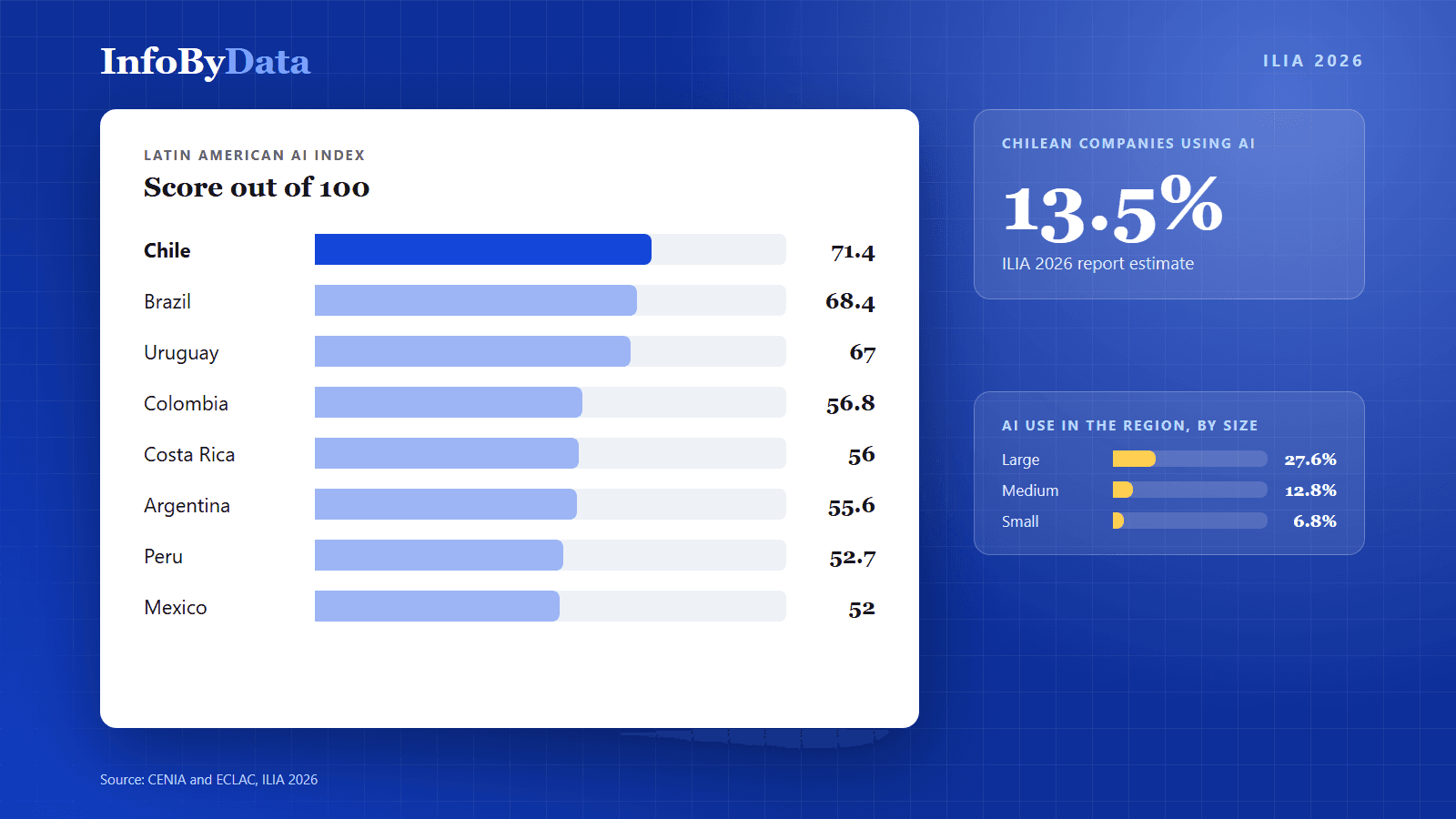
Chile scored 71.4 out of 100 on the 2026 Latin American Artificial Intelligence Index (ILIA) and led the region for the fourth year in a row, according to Chile's National Center for Artificial Intelligence (CENIA), which produces the index with ECLAC. However, the same report estimates that only 13.5% of Chilean companies use artificial intelligence.
The Latin American AI ranking
ILIA 2026 was published on October 20, 2026, and assesses 20 countries in Latin America and the Caribbean across three dimensions: enabling factors (such as talent and infrastructure), research, development and adoption, and governance.
Source: CENIA and ECLAC, ILIA 2026
View the data as a table
| Chile | 71.4 |
| Brazil | 68.4 |
| Uruguay | 67 |
| Colombia | 56.8 |
| Costa Rica | 56 |
| Argentina | 55.6 |
| Peru | 52.7 |
| Mexico | 52 |
| Ecuador | 51.8 |
| Dominican Republic | 45.1 |
The gap is in small businesses
Leading the index doesn't mean companies are already using AI at scale. ILIA 2026 compares adoption by company size in the region with five benchmark countries outside it (Germany, Spain, Estonia, Portugal and Singapore):
| Company size | Latin America and the Caribbean | Benchmark countries |
|---|---|---|
| Large | 27.6% | 66% |
| Medium | 12.8% | 41% |
| Small | 6.8% | 24% |
In the region, a large company is four times more likely to use AI than a small one.
How it compares with Europe
In the European Union, 19.95% of companies with 10 or more employees used AI in 2025, according to Eurostat. The size gap repeats: 17% of small companies, 30.36% of medium ones and 55.03% of large ones.
Why companies don't adopt it
Among European companies that considered using AI and didn't, the main reason was a lack of expertise, ahead of cost or usefulness:
Source: Eurostat, use of AI in enterprises 2025
View the data as a table
| Lack of expertise | 70.89% |
| Unclear legal consequences | 52.52% |
| Data protection concerns | 48.83% |
| Not seen as useful | 20.68% |
Only one in five companies that don't use AI think it wouldn't be useful to them. The main barrier is not knowing how to start.
How to start without a big investment
The most common uses of AI in European companies are text analysis (11.75% of companies), generating images, video or audio (9.55%) and generating text or speech (8.76%), according to Eurostat. These are tasks you can now test with low-cost tools.
- List the repetitive tasks for one week: answering similar emails, putting together reports, organizing spreadsheets or drafting posts.
- Pick a single low-risk task that's easy to check, such as email drafts or meeting summaries.
- Measure the time saved by comparing how long the task took before and after.
- Set clear rules: what information can be shared with AI tools, who reviews the results and which decisions are always made by a person. Legal and privacy concerns are the second and third most common barriers.
What it means for you
- The opportunity is in small businesses: with only 6.8% of small companies in the region using AI, adopting it well is still an edge over competitors.
- The barrier is knowledge, not budget: training one person on your team can unlock more than buying an expensive tool.
- Start with clear data rules: deciding from the outset what information gets shared avoids the legal and privacy concerns that hold back half of companies.
Sources
- AI in business
- AI in Chile
- ILIA 2026
- small business
- AI adoption