Requirements to apply for a mortgage in Chile: what the bank checks and what tips to follow
The requirements to apply for a mortgage in Chile according to the CMF: what the bank checks, what documents it asks for, how much you need down and 6 tips.
· 3 min read
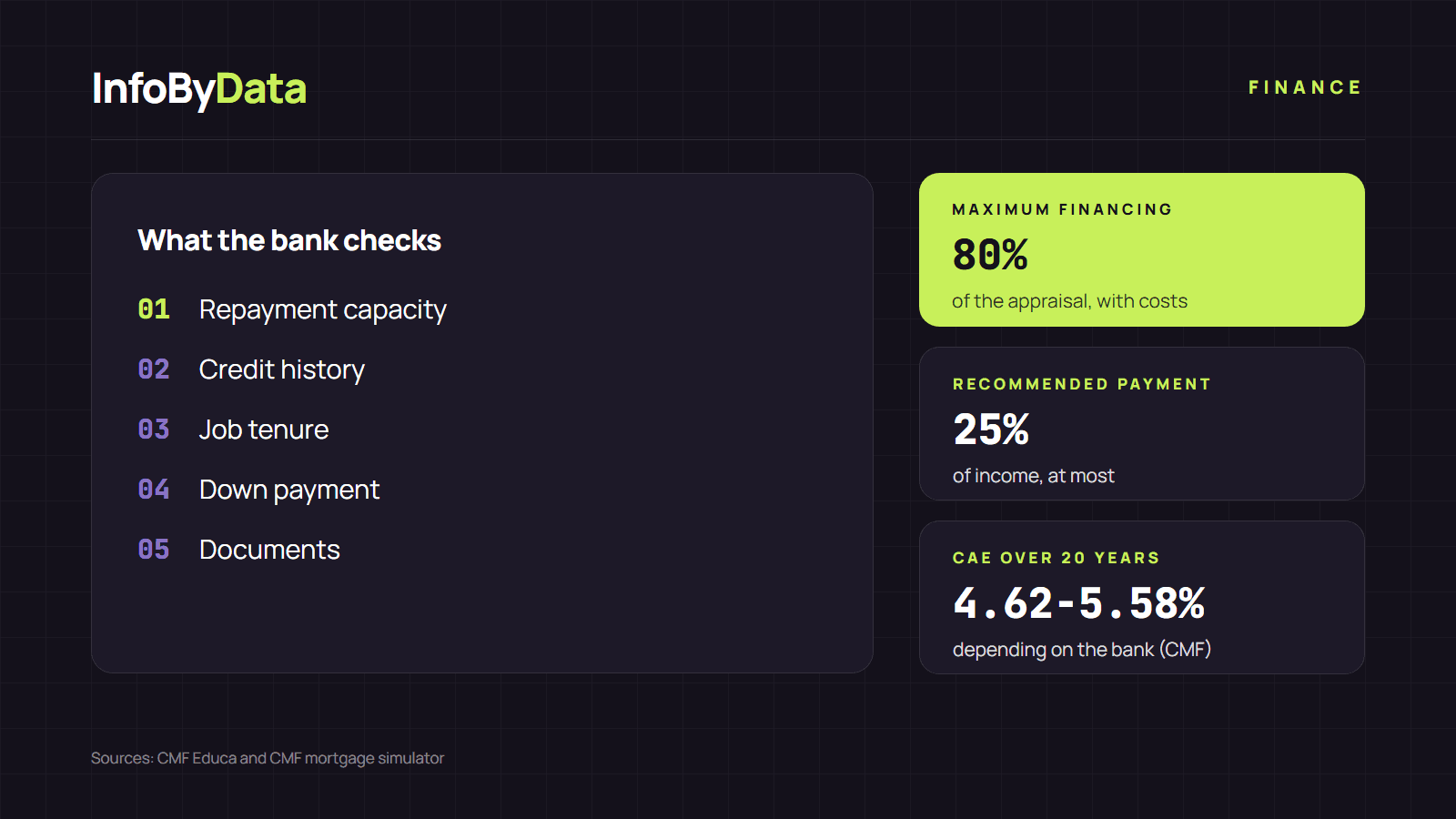
Knowing the requirements to apply for a mortgage before going to the bank saves you time and rejections. According to the CMF, Chile's financial regulator, you must pass an assessment in which the bank reviews your repayment capacity and your credit history. In addition, the bank finances at most 80% of the appraised value, closing costs included, so you cover the rest.
80%
Maximum financing
of the appraisal, with costs
25%
Recommended payment
of income, at most
10
Banks and credit unions in the CMF simulator
to compare offers
Source: CMF Educa and CMF mortgage simulator (November 6, 2026)
View the data as a table
| Maximum financing | 80% | of the appraisal, with costs |
| Recommended payment | 25% | of income, at most |
| Banks and credit unions in the CMF simulator | 10 | to compare offers |
What the bank checks: the requirements to apply for a mortgage
The law does not set a single list of requirements to apply for a mortgage. The CMF explains that each institution can set the conditions it considers appropriate, always within the law. In practice, the bank assesses four things:
- Your repayment capacity: how much you earn and how much you already owe in consumer loans, credit cards and installment purchases.
- Your credit history: whether you pay your debts on time.
- Your job tenure: if you are an employee, it is proven with your contract.
- The down payment you can make: the bank does not finance 100% of the home.
That assessment determines whether you get the loan and on what terms: the amount, the rate and the term.
What documents banks ask for
According to the CMF, these are the usual documents:
| Your situation | Documents |
|---|---|
| Employee | Latest pay slips and a copy of your contract, if applicable, to prove tenure |
| Self-employed | Income tax returns |
| Everyone | ID card and records of other assets (cars, property or stakes in companies) |
| If you combine incomes | The same documents from the other person |
The bank may ask for more documents depending on your case.
How much down payment you need and what costs to plan for
On top of the down payment, there are costs many people forget. According to CMF Educa, the borrower pays the stamp tax, the notary, the appraisal, the title search, the drafting of the deed and the registration with the Real Estate Registrar (Conservador de Bienes Raíces), which costs about 1% of the property's value. The borrower also pays mortgage life and fire insurance.
Costs other than insurance can be included in the loan, as long as the total does not exceed 80% of the appraised value. If the appraisal comes in below the sale price, the bank will lend less and you will need a larger down payment.
6 tips before applying for your mortgage
Meeting the requirements to apply for a mortgage is the first step. These tips help you get better terms:
- Estimate your monthly payment. The CMF notes that several institutions recommend that the payment be at most 25% of your total income. We explain how much you need to earn in our article on the income needed for a mortgage.
- Pay down your debts. Every consumer loan or credit card installment reduces the loan you can be approved for.
- Save for the down payment and costs. Add up the down payment, the purchase costs and a cushion for the unexpected.
- Get quotes from several banks. Compare offers by their CAE (annual equivalent cost), which adds up the rate, insurance and fees. For a UF 3,000 loan over 20 years, the CAE ranges from 4.62% to 5.58% depending on the bank, as shown in our mortgage comparison.
- Check the rate, the term and prepayment costs. A longer term lowers the payment but raises total interest.
- If you buy a new home, ask for the rate subsidy. It cuts the rate by up to 0.6 points on homes worth up to UF 6,000, under Law 21,836. If you are middle class, also check the housing subsidies for the middle class.
With your numbers ready, simulate the payment for each offer:
If you already meet the requirements to apply for a mortgage and want to see the full process, from getting quotes to signing the deed, read how to apply for a mortgage step by step.
What it means for you
- Get your papers ready before getting quotes. With your pay slips or tax returns at hand, the bank can assess you faster.
- Sort out your debts. Your repayment capacity is the first thing the bank checks, and every outstanding installment reduces it.
- Always compare by CAE. The differences between banks are large and you pay them for 20 or 30 years. Beware of scams: request quotes only through official channels. This article is for information only and is not financial advice.
Sources
- requirements to apply for a mortgage
- mortgage
- repayment capacity
- mortgage documents
- down payment
- CAE