How to apply for a mortgage in Chile, step by step: requirements, documents and costs
How to apply for a mortgage in 6 steps, from estimating your payment to signing the deed. What documents banks ask for and what costs to plan for, according to the CMF.
· 4 min read
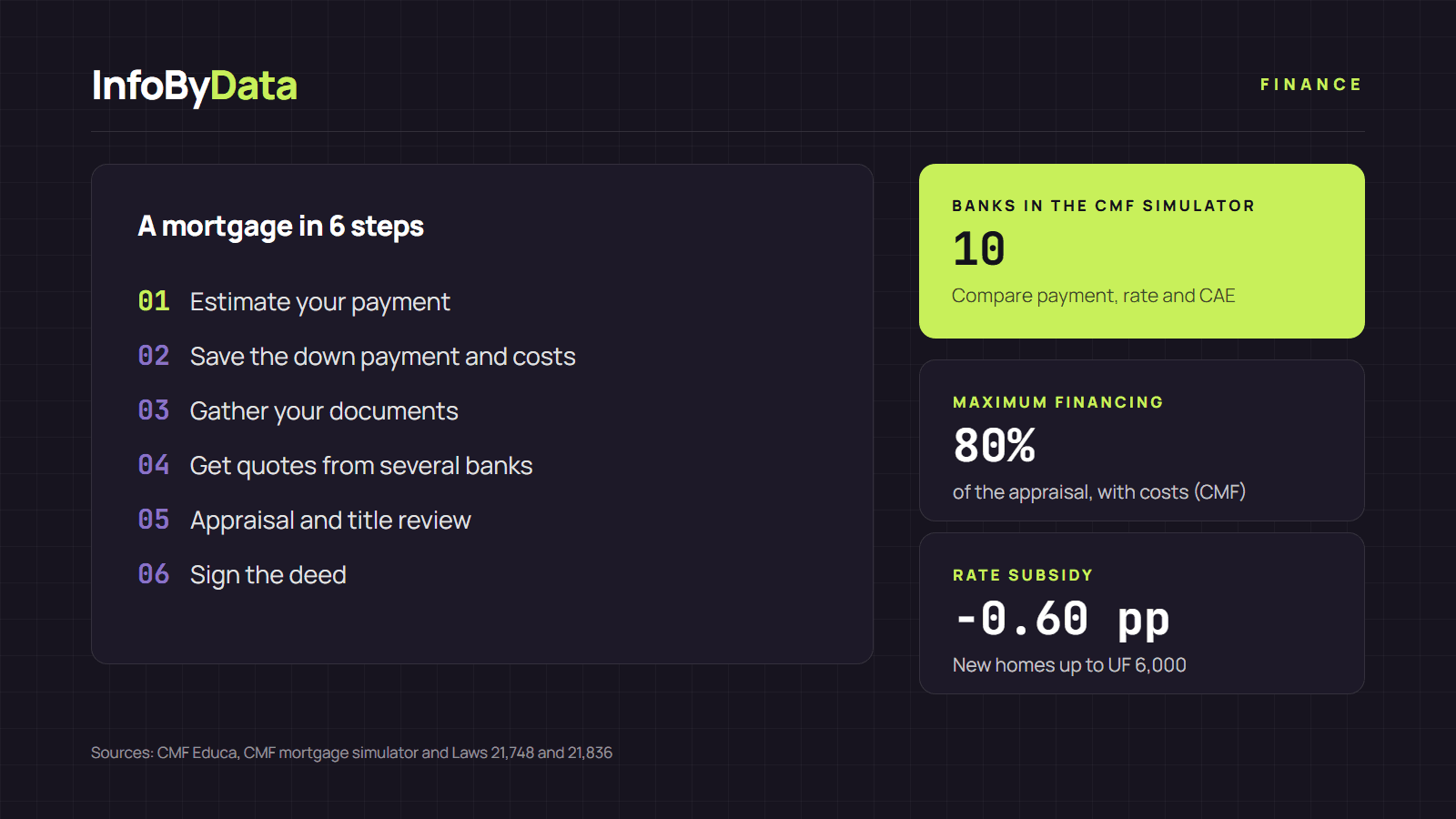
Knowing how to apply for a mortgage can save you a lot of money. The CMF compares the offers of 10 banks and credit unions in its simulator, and the gap between the cheapest and the most expensive is more than CLP 62,000 a month on a UF 3,000 loan over 20 years. These are the 6 steps to apply for a mortgage in Chile, with the documents and costs to keep in mind.
10
Institutions in the CMF simulator
banks and credit unions
80%
Maximum financing with costs
of the appraised value
−0.60 pp
Rate subsidy
new homes up to UF 6,000
Source: CMF, mortgage simulator (November 6, 2026), CMF Educa and Law 21,836
View the data as a table
| Institutions in the CMF simulator | 10 | banks and credit unions |
| Maximum financing with costs | 80% | of the appraised value |
| Rate subsidy | −0.60 pp | new homes up to UF 6,000 |
How to apply for a mortgage, step 1: work out what you can pay
Before looking at properties, decide how much you can pay each month without running out of room. The bank will review your ability to pay: your income and the debts you already have, such as consumer loans or credit cards.
With InfoByData's mortgage simulator you can try different property values, down payments, terms and rates, and see the payment in UF and in Chilean pesos. For example, a UF 3,200 loan over 25 years, at September's average rate (4.07%, according to the Central Bank), has a payment of UF 17.01, about CLP 702,000 a month without insurance.
Step 2: save the down payment and the costs
The bank does not finance 100% of the home. The difference is the down payment, which you pay yourself. There are also costs many people forget. According to CMF Educa, the borrower pays:
- stamp tax;
- notary fees;
- registration with the Property Registry (Conservador de Bienes Raíces), which costs about 1% of the property value;
- the property appraisal;
- the title review and drafting of the deed;
- life (desgravamen) and fire insurance.
The CMF explains that these costs, except insurance, can be included in the loan, as long as the total does not exceed 80% of the appraised value.
Step 3: gather your documents
To assess your ability to pay, banks ask for the following, according to the CMF:
- If you are an employee: your latest pay slips and, if needed, your employment contract to prove how long you have worked there.
- If you are self-employed: your income tax returns.
- In every case: your ID card and details of other assets, such as cars, properties or stakes in companies.
- If you combine income with another person: the same documents for that person.
Each bank may ask for more. The CMF notes that institutions are free to set their own conditions, always within the law.
Step 4: get quotes from several banks
If you are wondering how to apply for a mortgage that costs less, this is the key step. Ask several institutions for written quotes and compare them by their CAE (carga anual equivalente, the equivalent annual cost), which combines the rate, insurance and fees. In the CMF simulator, for a UF 3,000 loan over 20 years, the CAE ranges from 4.62% to 5.58%. We show the full table in our mortgage comparison.
Also look at:
- The type of rate: fixed, variable or mixed. A fixed rate keeps the UF payment the same for the whole loan.
- The term: a longer term lowers the payment but raises the total interest.
- The prepayment cost: what you are charged if you want to pay early.
You can enter up to 4 offers in the mortgage simulator and compare them side by side.
Step 5: appraisal and title review
Once the bank approves your loan, it reviews the property. The appraisal sets how much the home is worth to the bank, and the title review confirms that it can be put in your name and mortgaged in favor of the bank. If the appraisal comes in below the sale price, the bank will lend less and you will need a larger down payment.
Step 6: sign the deed and register the property
The last step is to sign the purchase deed and the mortgage loan at the notary, and register the property and the mortgage with the Property Registry. From then on the home is yours and you start paying the monthly installment.
If you are buying a new home, check the rate subsidy
Law 21,748 created a subsidy that lowers the rate by up to 60 basis points for people buying a new home in its first sale. Law 21,836, published in August 2026, raised the cap to homes worth up to UF 6,000, increased the number of subsidies to 80,000 and extended it until May 31, 2028. We explain who can use the subsidy.
What it means for you
- Start with the numbers. Before learning how to apply for a mortgage, work out what monthly payment you can afford and how much you need for the down payment and costs, which can add up to several million pesos.
- Always get quotes from more than one bank. CAE differences between institutions are large, and you pay them for 20 or 30 years.
- Watch out for scams. The CMF warns about fraud involving loan offers. Only request quotes through each bank's official channels. This article is for information only and is not financial advice.
Sources
- how to apply for a mortgage
- mortgage requirements
- mortgage documents
- closing costs
- appraisal
- CAE