What is VAT (IVA) and how is it calculated in Chile: rate, formula and examples
What is VAT (IVA) and how is it calculated in Chile, step by step with examples. The rate is 19%, and this tax brings in 42% of everything the country collects.
· 5 min read
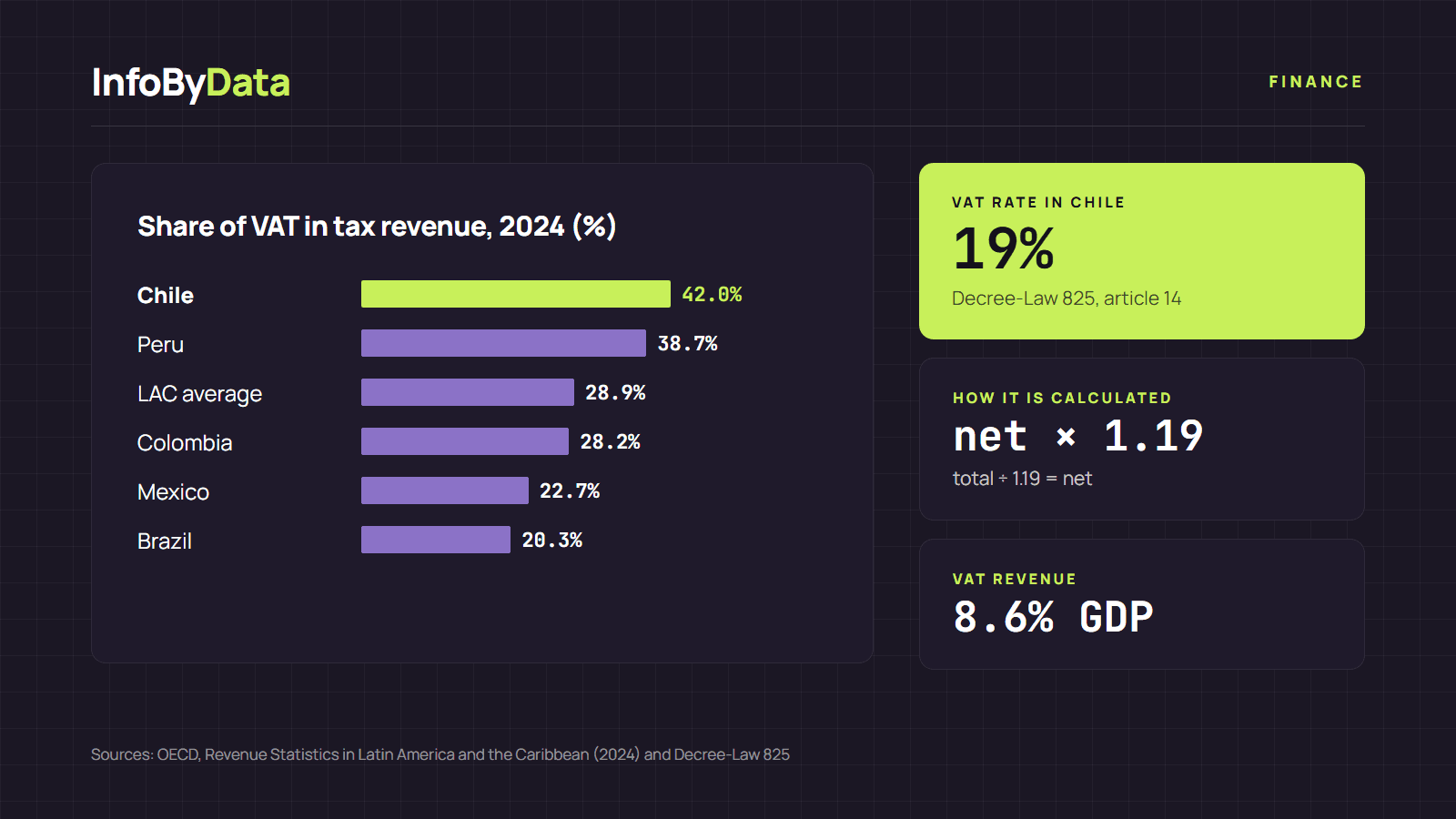
VAT is Chile's biggest source of tax revenue. In 2024 it brought in 42% of all the country's tax revenue, equal to 8.6% of GDP, according to the OECD Revenue Statistics in Latin America and the Caribbean. You pay it every time you buy something, even if you don't see it on the receipt. Here we explain what VAT is, how it works and how it is calculated, with examples.
19%
Standard rate
on the net amount
42%
Share of tax revenue
of all tax revenue
8.6%
Revenue
of GDP
Source: Decree-Law 825, art. 14 and OECD, 2024 data
View the data as a table
| Standard rate | 19% | on the net amount |
| Share of tax revenue | 42% | of all tax revenue |
| Revenue | 8.6% | of GDP |
What is VAT
VAT is the value added tax, known in Chile as IVA (Impuesto al Valor Agregado). It applies to sales of goods and services, and also to imports, under article 8 of Decree-Law 825, the Sales and Services Tax Law. Article 14 sets the rate: 19% of the taxable base, that is, of the price before tax.
In the end, the consumer pays the VAT: it is included in the price. Businesses charge it on every sale and pass it on to the treasury. That is why the prices you see in a store and the amounts on a receipt (boleta) already include VAT, while an invoice between businesses (factura) shows the net amount, the VAT and the total separately.
How VAT works: output VAT and input VAT
To understand what VAT is, you need to look at the whole chain. It is called "value added" because at each stage of the chain tax is only paid on the value that stage adds to the product. To achieve this, the law uses two concepts:
- Output VAT (débito fiscal): the total VAT a business charges on its sales in the month (article 20).
- Input VAT (crédito fiscal): the VAT the business paid on the invoices for its purchases in the same period (article 23).
The VAT a business pays each month is the difference: output VAT minus input VAT. An example with a bakery:
| Stage | Net price | VAT charged (output) | VAT paid on purchases (input) | VAT paid to the treasury |
|---|---|---|---|---|
| The mill sells flour to the bakery | CLP 100,000 | CLP 19,000 | CLP 0 | CLP 19,000 |
| The bakery sells the bread | CLP 250,000 | CLP 47,500 | CLP 19,000 | CLP 28,500 |
| Total received by the treasury | CLP 47,500 |
The treasury receives CLP 47,500 in total, exactly 19% of the final price before tax (CLP 250,000). And the person who pays it is the customer who buys the bread.
How VAT is calculated
To calculate VAT you only need to know whether you start from an amount before tax (net) or an amount including tax (total). These are the formulas:
| What you want to know | Formula | Example |
|---|---|---|
| The VAT on a net amount | net × 0.19 | CLP 100,000 × 0.19 = CLP 19,000 |
| The total with VAT | net × 1.19 | CLP 100,000 × 1.19 = CLP 119,000 |
| The net amount of a price with VAT | total ÷ 1.19 | CLP 119,000 ÷ 1.19 = CLP 100,000 |
| The VAT included in a price | total − net | CLP 119,000 − CLP 100,000 = CLP 19,000 |
If you don't want to do the math by hand, the InfoByData VAT calculator does it for you: enter the amount and it instantly shows the net amount, the VAT and the total.
The most common mistake when removing VAT
To find out how much VAT a price includes, many people take 19% of the total. That is a mistake: with a price of CLP 119,000, 19% gives CLP 22,610, but the real VAT is CLP 19,000. This happens because the 19% applies to the net amount, not to the total. The right way is to divide the total by 1.19, or use the "Remove VAT" tab of the free VAT calculator.
How VAT is rounded
In Chile amounts are expressed in whole pesos, with no decimals. If the calculation gives decimals, it is rounded to the nearest peso. For example, a price of CLP 1,000 including VAT has a net amount of CLP 840 (1,000 ÷ 1.19 = 840.34) and VAT of CLP 160.
Which sales and services are exempt from VAT
Not everything pays VAT. The law sets out exemptions in articles 12 and 13. Some examples:
- The sale of land, which under article 2 is not subject to the tax.
- Passenger transport by shipping, air and rail companies and by urban, intercity, interprovincial and rural transport companies.
- Educational institutions, for the income from their teaching activity.
- Some outpatient health services, along with the supplies used in them.
Exemptions come with specific conditions, so it is best to check the text of the law or ask the SII, Chile's tax authority, before applying them.
When VAT is filed and paid
Businesses file and pay VAT every month. Under article 64, the deadline is the 12th of each month, for the taxes of the previous month. There are special regimes, for example for small businesses that file online, with different deadlines, so check the SII calendar.
VAT in Chile compared with Latin America
Chile relies on VAT more than almost any other country in the region. According to the OECD, in 2024 VAT accounted for 42% of Chile's tax revenue: the second-highest share among 27 countries in Latin America and the Caribbean, behind only the Bahamas (44%). The regional average is 28.9%. Measured against the size of the economy, Chilean VAT brings in 8.6% of GDP, compared with 6.2% on average in the region.
This article is for information only and does not replace advice from an accountant.
What it means for you
- If you shop as a consumer: knowing what VAT is helps you read your receipts: the 19% VAT is already included in prices. Of every CLP 119 you pay, CLP 19 is tax.
- If you issue invoices: the VAT you charge is not yours. You subtract the VAT on your purchases (input VAT) and pay the difference by the 12th of the following month.
- If you need to remove or add VAT to an amount: divide or multiply by 1.19, or use the VAT calculator to avoid mistakes.
Sources
- what is VAT
- how VAT is calculated
- VAT in Chile
- VAT calculator
- output VAT
- input VAT