Google Cloud in Chile: why the country is its third-largest market in Latin America and what it means for businesses
Google Cloud in Chile is the company's third-largest market in Latin America, after Brazil and Mexico. Cloud figures, local infrastructure and the role of AI.
· 4 min read
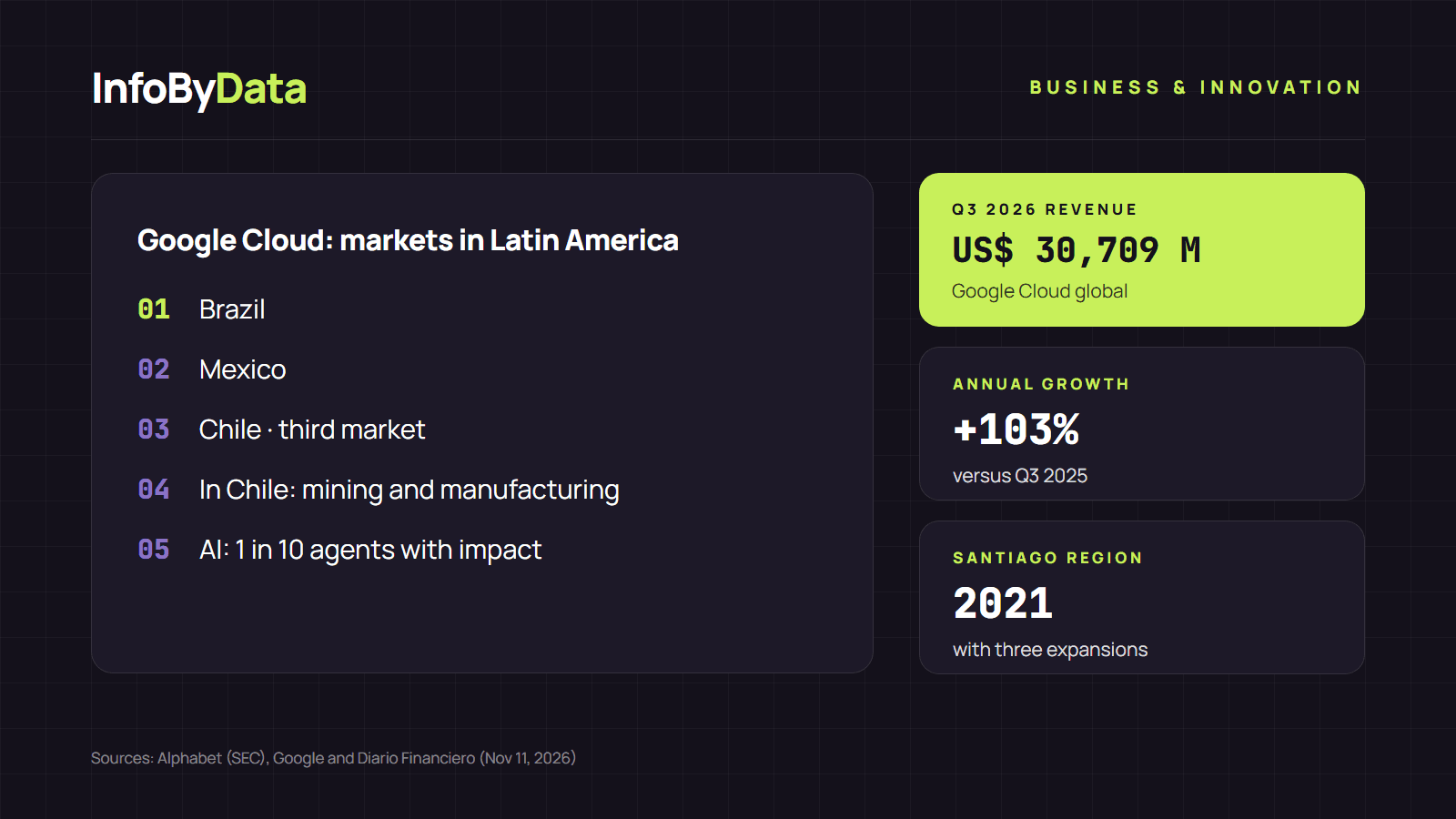
Google Cloud in Chile is the company's third most important market in Latin America, behind only Brazil and Mexico. That is what Eduardo López, Google's president for Latin America, said in an interview with Diario Financiero published on November 11, 2026, during the Google Cloud Summit in Santiago.
The company did not disclose sales by country. But public data from Google and its parent company, Alphabet, help explain why a country with a much smaller population than Brazil or Mexico makes the region's podium, and what that means for companies investing in technology.
3rd
Chile's rank in Latin America
after Brazil and Mexico
US$ 30,709 M
Global revenue in the quarter
July to September 2026
103%
Annual growth
versus the same quarter of 2025
2021
Cloud region in Santiago
with three expansions since then
Source: Alphabet, third quarter 2026 results (SEC) and Diario Financiero (Nov 11, 2026)
View the data as a table
| Chile's rank in Latin America | 3rd | after Brazil and Mexico |
| Global revenue in the quarter | US$ 30,709 M | July to September 2026 |
| Annual growth | 103% | versus the same quarter of 2025 |
| Cloud region in Santiago | 2021 | with three expansions since then |
Google Cloud in Chile: the region's third-largest market
According to López, the cloud business in Latin America follows the company's global growth trend, although he did not say what share of revenue comes from the region. The closest data point is Alphabet's: its revenue in "Other Americas," which combines Canada and Latin America, reached US$ 7,101 million in the third quarter of 2026, up 17% from a year earlier, according to its earnings release. That figure includes all of Google's businesses, not just the cloud.
Globally, the cloud is now Alphabet's growth engine:
- 2025
- 2026
Source: Alphabet, third quarter 2026 results (SEC)
View the data as a table
| 2025 | 2026 | |
|---|---|---|
| Revenue | 15,157 US$ M | 30,709 US$ M |
| Operating income | 3,594 US$ M | 11,121 US$ M |
Revenue doubled and operating income tripled in one year. Alphabet attributes this to "huge demand" for its AI infrastructure and AI solutions. To sustain that pace, the company invested US$ 51,355 million in the quarter, mainly in technical infrastructure for AI.
The infrastructure behind Google Cloud in Chile
Google Cloud in Chile did not reach third place because of market size, but because of infrastructure built up over more than a decade. These are the milestones, according to Google:
| Year | Milestone |
|---|---|
| 2012 | Google announces its first data center in South America, in Quilicura |
| 2019 | The Curie subsea cable, connecting Chile with California, lands in Valparaíso |
| 2021 | The Google Cloud region in Santiago opens |
| 2021-2026 | The region has three expansions, according to López |
| 2026 | The second phase of the Quilicura data center moves forward |
| Upcoming | Humboldt subsea cable, between Chile and Asia-Pacific |
Sources: Google, 15 years in Chile (May 27, 2026), Google, 10 facts about the Quilicura data center (Mar 31, 2026) and Diario Financiero.
Having a cloud region in the country means companies can store and process their data in Chile, with lower latency than if they relied on servers in Brazil or the United States. López explained that the company monitors the use of its infrastructure and anticipates demand: each expansion takes at least ten months, because of the time needed for equipment and its import. He did not disclose amounts or dates for new expansions.
The Quilicura data center also has its own figures. According to Google, in 2024 it ran on 92% carbon-free energy on an hourly basis, with a power usage effectiveness (PUE) of 1.09, and consumed 121.8 million gallons of water (about 461 million liters), supplied by Aguas Andinas. The company estimates that its digital infrastructure investments in Chile added about CLP 191.6 billion to GDP and supported around 5,520 jobs a year, on average between 2021 and 2023. Energy supply is key for this industry; we analyze it in our story on renewable energy in Chile.
Which industries drive the cloud in Chile
Across Latin America, the two sectors that use Google Cloud the most are financial services and retail. The third varies by country: in Colombia it is oil and gas, and in Chile it is manufacturing and mining. López anticipated that over the next two or three years the company will organize itself to better serve those three pillars, which "in theory, for Chile, will drive AI and Chile's GDP."
The challenge: making AI deliver results
For López, the main challenge for Latin American companies is no longer adopting artificial intelligence, but getting it to deliver concrete results. He gave an example: a large Brazilian company developed about 400 AI agents in one year, and only 40, one in ten, had an impact on the business. That is why, he said, companies now define the business case and the return on investment from the start.
It is the same logic as data-based decision making: measure before scaling. And it matches what local surveys show about investment in artificial intelligence by Chilean companies.
What it means for you
- If you run a company: Google Cloud's infrastructure in Chile makes it possible to keep data in the country and use AI with lower latency. Before launching AI projects, define which indicator each one should improve; the example of the 400 agents shows that quantity does not guarantee results.
- If you work in technology or data: the expansion of the cloud and the focus on mining, manufacturing, banking and retail increase demand for profiles that combine data, AI and knowledge of those industries. Check how much a data analyst earns in Chile.
- If you make public or investment decisions: Chile being the region's third-largest market with a much smaller population than Brazil or Mexico shows the weight of connectivity, energy and stability in attracting digital infrastructure.
Sources
- Diario Financiero, "Google Cloud sitúa a Chile como su tercer mercado más importante en América Latina" (November 11, 2026)
- Alphabet, third quarter 2026 results, Form 8-K filed with the SEC (October 28, 2026)
- Google, "15 años en Chile: construyendo el futuro digital del país" (May 27, 2026)
- Google, "10 datos sobre el centro de datos de Google en Quilicura" (March 31, 2026)
- Google Cloud in Chile
- cloud computing
- data centers
- artificial intelligence
- digital transformation
- Latin America