Electromobility in Chile: how many electric cars are sold and where they can be charged
Electromobility in Chile sped up in 2026: sales of electric and plug-in cars grew 144.6% through September. What is being sold and where cars are charged.
· 3 min read
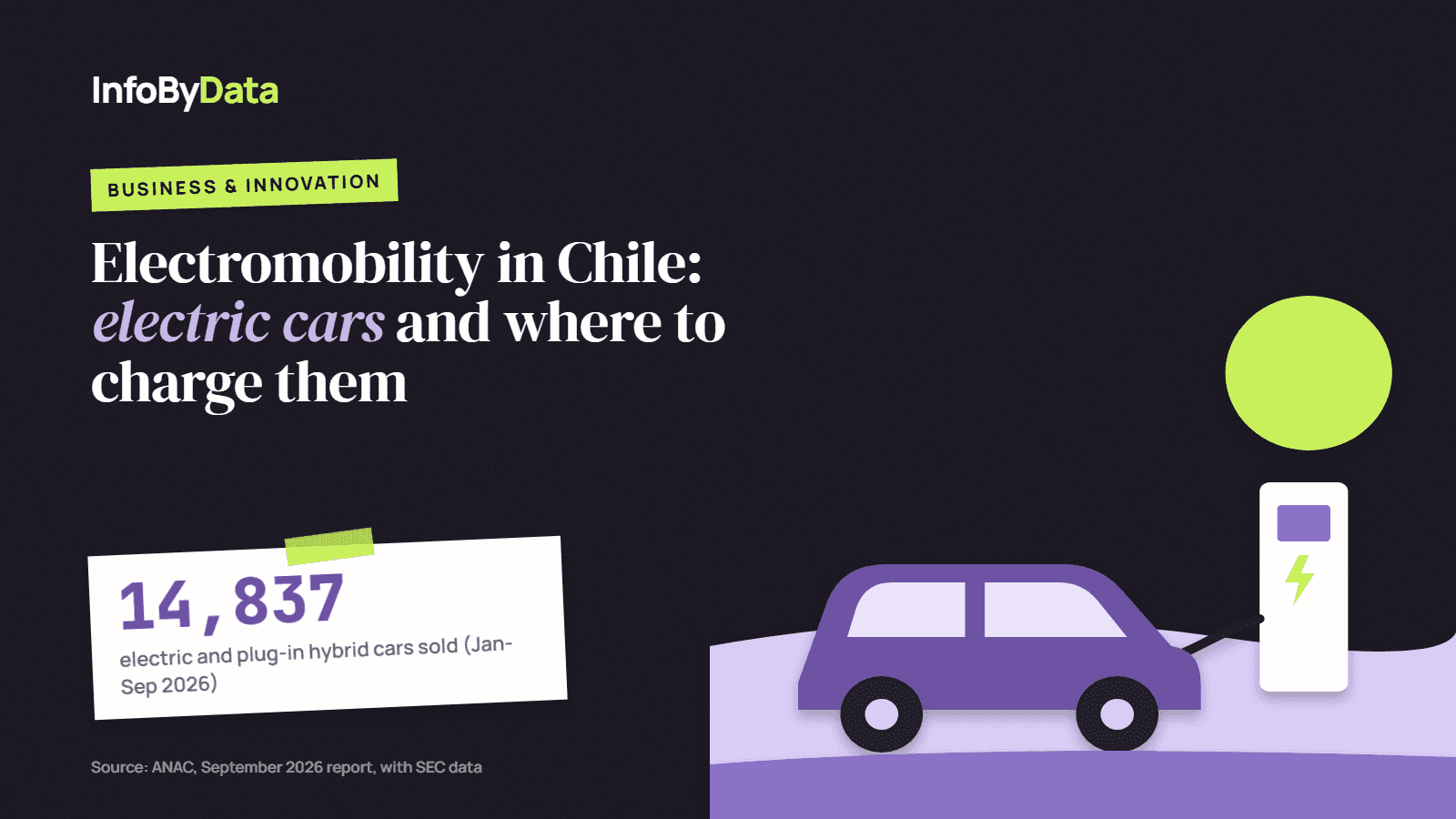
Electromobility in Chile had its best year. Between January and September 2026, 14,837 electric and plug-in hybrid cars were sold, 144.6% more than in the same period of 2025, according to the September report from ANAC, the association of car brands. They now account for 6.3% of new light and medium vehicles sold in the country.
14,837
Plug-ins sold
electric and plug-in hybrids
+144.6%
Annual growth
versus January-September 2025
1,853
Public charging points
connected as of September 15
Source: ANAC, zero and low emission vehicles report, September 2026, with SEC data
View the data as a table
| Plug-ins sold | 14,837 | electric and plug-in hybrids |
| Annual growth | +144.6% | versus January-September 2025 |
| Public charging points | 1,853 | connected as of September 15 |
How many electric cars are sold in Chile
ANAC splits "new energy" vehicles into four groups. The best sellers are still mild hybrids, which have a small support battery but run on gasoline. Fully electric cars total 8,209 units so far this year:
The fastest growth comes from cars that plug in. Plug-in hybrids rose 202.1% and fully electric cars 112.0%:
In September alone, 2,135 plug-in vehicles were sold, 152.1% more than a year earlier. ANAC attributes much of the jump to higher fuel prices, which according to the association have meant 30% more spending on average for families since March.
Where electric cars can be charged
As of September 15, the SEC interoperability platform listed 1,853 public charging points connected. Most are slow chargers:
Source: ANAC, September 2026, with SEC data
View the data as a table
| Slow charging | 1,155 |
| Fast charging | 496 |
| Ultra-fast charging | 202 |
But the public network is growing more slowly than sales. Between January and September, 209 public charging points were added, 52.4% fewer than in the same period of 2025. Almost all of them (183) are direct current, which allows faster charging.
Charging is shifting to private locations. In the same period, 1,581 new chargers were registered: 1,260 private (in homes, buildings and companies), 210 for public transport and 111 public. Installed capacity reached 61.0 MW, 12.8% more than a year earlier.
Electric buses: the other engine of electromobility in Chile
The most visible face of electromobility in Chile is public transport. According to the Government, the Santiago Metropolitan Region reached 4,088 electric buses, 62% of the Red Movilidad fleet, and expected to reach 4,400 (68%) in March 2026. Outside Santiago, another 271 electric buses run in 11 regions. The Government estimates an 80% reduction in fine particulate emissions and up to 64% less noise along the Alameda.
This year, however, electric bus sales fell: 445 were sold between January and September, 69.2% fewer than in 2025. ANAC explains this by the lack of new Red Movilidad tenders, which account for most of these purchases. Electric trucks remain a niche: 62 units this year.
The goal: 2035
The National Electromobility Strategy, published in 2022, sets that by 2035 100% of sales of light and medium vehicles, and of buses, taxis and shared taxis, will be zero emission. With 6.3% of the market today, there is a long way to go, but plug-in sales are doubling every year.
Electromobility and renewable energy
An electric car is only as clean as the electricity used to charge it, and Chile has an advantage there: in 2025, sun and wind generated about 38% of the electricity and two thirds is already renewable, as we explain in our article on renewable energy in Chile. At midday, when solar power covers most of the demand, charging an electric car uses almost entirely renewable electricity. Find more data on business and sustainability in the Business & innovation section.
What it means for you
- If you are thinking of buying a car: plug-ins are no longer a rarity. Compare the total cost (price, energy and maintenance) and check whether you can charge at home or at work, because the public network is growing more slowly than sales.
- If you run a company or a building: private charging is growing fastest. Installing chargers in customer or employee parking is an opportunity.
- If you make public policy decisions: the 2035 goal depends on the charging network and bus tenders keeping pace with sales, which today move at different speeds.
Sources
- electromobility in Chile
- electric cars
- charging points
- electric buses
- renewable energy
- sustainability