Mortgage loans in Chile: banks ease their lending standards and demand picks up
30% of banks in Chile eased their standards for mortgage loans in the third quarter and 40% saw stronger demand, according to the Central Bank of Chile.
· 4 min read
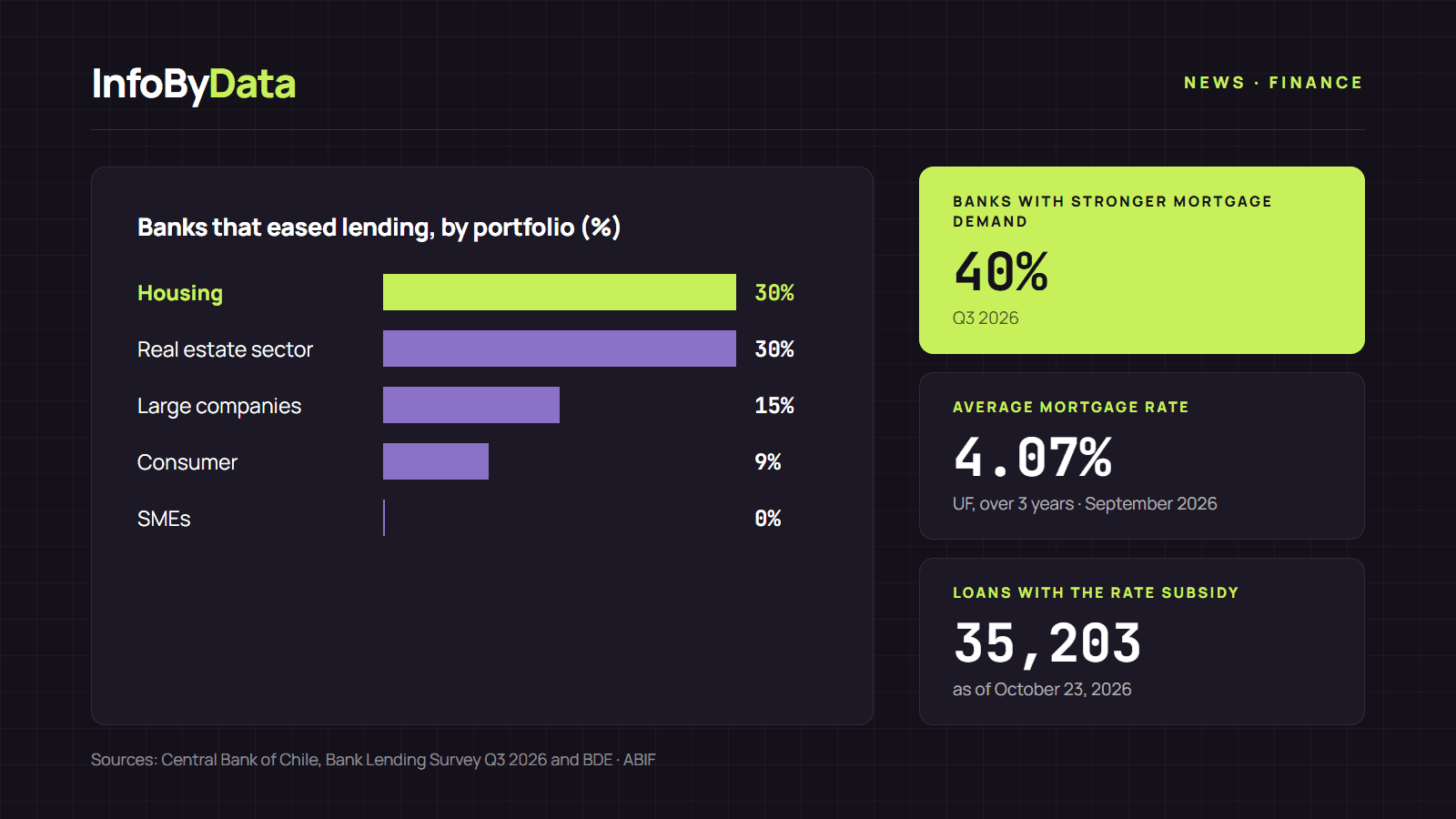
Chilean banks are opening the door to mortgage loans again. According to the Bank Lending Survey for the third quarter of 2026 by the Central Bank of Chile, 30% of institutions reported easier standards for housing loans compared with the previous quarter, and 40% saw demand pick up, linked to better rates. The survey was carried out between September 14 and 28 among bank credit officers, and its results were released on October 14, as reported by Diario Financiero and CNN Chile.
30%
Banks that eased housing loans
Q3 2026
40%
Banks with stronger mortgage demand
Q3 2026
4.07%
Average mortgage rate
UF, over 3 years, September 2026
Source: Central Bank of Chile, Bank Lending Survey Q3 2026 and Statistics Database
View the data as a table
| Banks that eased housing loans | 30% | Q3 2026 |
| Banks with stronger mortgage demand | 40% | Q3 2026 |
| Average mortgage rate | 4.07% | UF, over 3 years, September 2026 |
What changed for mortgage loans, according to the Central Bank
Every quarter, the Bank Lending Survey asks banks whether they tightened, kept or eased their standards for approving loans (requirements, down payment, terms or amounts), and whether they see more or fewer applications. In the third quarter, easing was concentrated in two portfolios: housing and the real estate sector, with 30% of banks in each.
Other portfolios look more cautious. For SMEs, no institution changed its standards. In construction, 90% kept theirs unchanged. For large companies, 15% eased and 8% tightened.
Demand for mortgage loans picks up with better rates
On the household side, banks see more interest in buying a home. The share of institutions that saw weaker demand for mortgage loans fell from 20% to 10% in one quarter. In consumer credit, that group dropped from 36% to 9%, and for large companies, from 31% to 8%.
- Q2 2026
- Q3 2026
Source: Central Bank of Chile, Bank Lending Survey Q3 2026, via La Tercera
View the data as a table
| Q2 2026 | Q3 2026 | |
|---|---|---|
| Housing | 20% | 10% |
| Consumer | 36% | 9% |
| Large companies | 31% | 8% |
Rates explain part of the shift. According to the Central Bank's Statistics Database, the average rate on housing loans in UF for more than three years was 4.07% in September 2026, 0.14 points lower than a year earlier (4.21%). The low point of the year was May, at 3.96%, and it has edged up since then.
Source: Central Bank of Chile, Statistics Database (updated October 7, 2026)
View the data as a table
| Sep 25 | 4.21% |
| Oct 25 | 4.16% |
| Nov 25 | 4.13% |
| Dec 25 | 4.14% |
| Jan 26 | 4.12% |
| Feb 26 | 4.11% |
| Mar 26 | 4.06% |
| Apr 26 | 3.98% |
| May 26 | 3.96% |
| Jun 26 | 3.97% |
| Jul 26 | 4% |
| Aug 26 | 4.04% |
| Sep 26 | 4.07% |
Consumer credit remains tight, though demand improves
Easing did not reach every type of household loan. For consumer loans, 18% of banks tightened their standards and only 9% eased them, the same shares as in the previous survey. Even so, demand improved: banks seeing more consumer loan applications rose from 9% to 18%.
| Portfolio | Eased | Tightened | Stronger demand |
|---|---|---|---|
| Housing | 30% | — | 40% |
| Consumer | 9% | 18% | 18% |
| Large companies | 15% | 8% | 8% |
| SMEs | 0% | 0% | 10% |
| Real estate sector | 30% | — | 40% |
— : the figure does not appear in the published summaries of the survey.
The rate subsidy is boosting mortgage loans
Another factor is the interest rate subsidy for new homes, which lowers the loan rate and comes with a state guarantee (Fogaes). Law 21,836, published in Chile's Official Gazette on August 17, 2026, expanded the program: it raised the maximum home value from 4,000 to 6,000 UF, increased the cap from 50,000 to 80,000 loans and extended it until May 31, 2028.
As of October 23, the program had 35,203 mortgage loans granted with the subsidy, 44% of the cap, according to figures from Chile's banking association (ABIF) reported by La Tercera. There were also 123,309 eligible applications.
Total lending is starting to move as well. According to Chile's Financial Market Commission (CMF), bank loans grew 0.93% in real terms over twelve months through September, after two weaker months, driven by commercial loans (1.57%) and, to a lesser extent, housing.
To follow the value of the UF, the inflation-indexed unit in which most of these loans are set, you can use our currency converter. This article is for information only and is not financial or home-buying advice.
What it means for you
- If you are looking for a mortgage loan: with 30% of banks easing and the rate at 4.07%, it is a good time to get quotes from several lenders. Compare the total cost of the loan (CAE), not just the rate.
- If you are buying a new home worth up to 6,000 UF: check whether you qualify for the rate subsidy. The bank handles it, and the program has a cap: 44% has already been used.
- If you are considering a consumer loan: banks are still stricter in that portfolio (18% tightened), so it pays to tidy up your credit history and debt level before applying.
Sources
- Central Bank of Chile, Bank Lending Survey
- Central Bank of Chile, Statistics Database: housing loan rate in UF over 3 years
- CMF, performance of banks and cooperatives as of September 2026 (October 29, 2026)
- Official Gazette of Chile, Law 21,836 (August 17, 2026)
- Diario Financiero, Banks ease mortgage lending standards (October 14, 2026)
- La Tercera, Banks ease mortgages and real estate loans
- La Tercera, Mortgage rate subsidy tops 35,000 loans granted
- CNN Chile, Banks ease lending standards for housing and real estate
- mortgage loans
- Bank Lending Survey
- mortgage rate
- mortgage rate subsidy
- Central Bank of Chile