Exchange rates for holidays abroad: the Argentine peso and the euro rose the least for Chileans
With the dollar at CLP 994.29, travel costs more. Exchange rates for holidays show the Argentine peso (+4.3%) and the euro (+6.1%) rose the least for Chileans.
· 4 min read
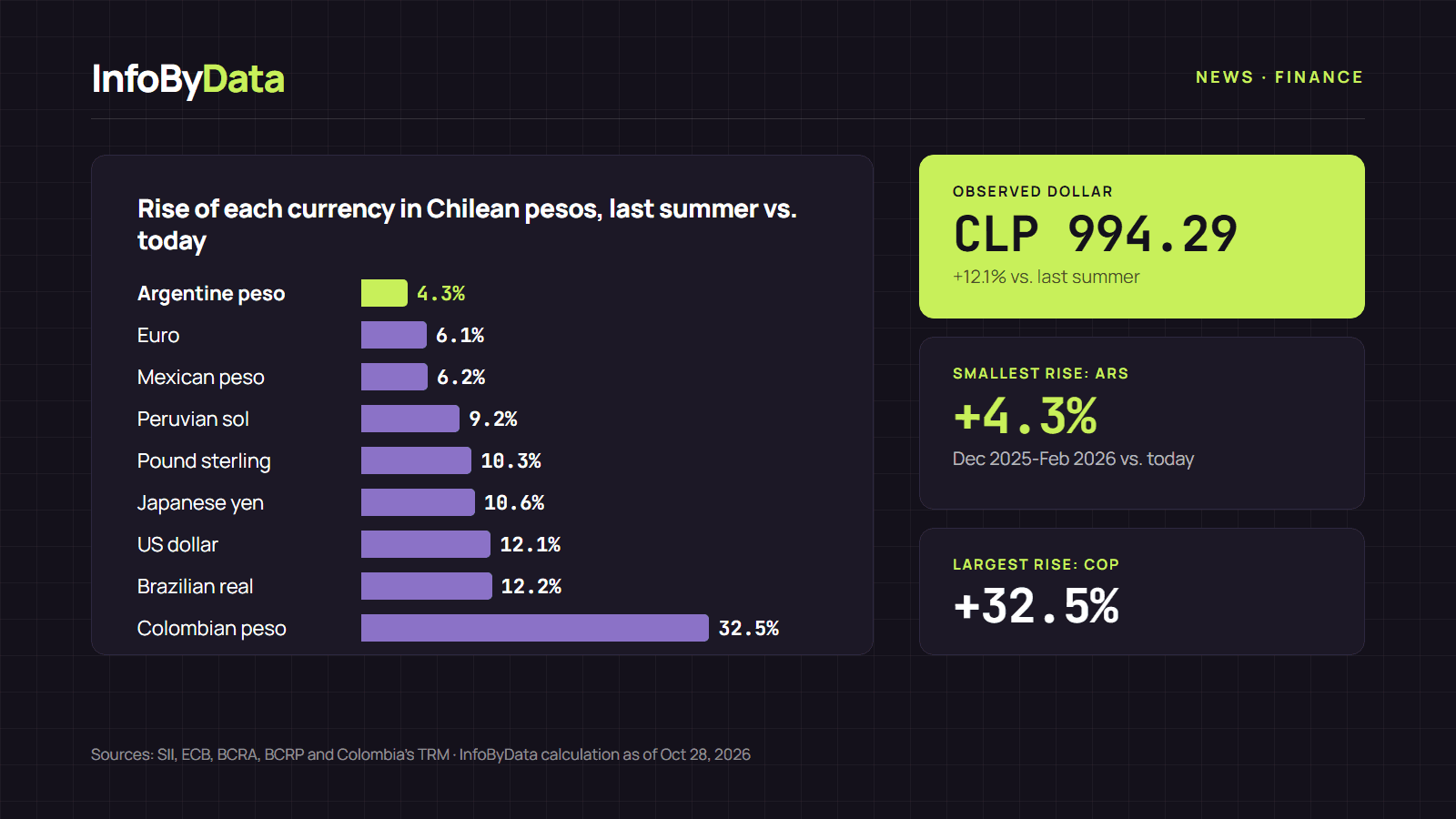
Exchange rates for holidays reach this summer season with broadly bad news for Chileans: almost every currency at popular travel destinations costs more pesos than last summer. The main reason is the dollar, which hit CLP 994.29 on October 27, its highest level in almost two years according to the SII.
But the rise is uneven. We compared today's value of ten currencies with their average from last summer (December 2025 to February 2026), and the increases range from +4.3% to +32.5%.
CLP 994.29
Observed dollar
+12.1% vs. last summer
+4.3%
Smallest rise
Argentine peso
+32.5%
Largest rise
Colombian peso
Source: SII, ECB and BCRA; InfoByData calculation
View the data as a table
| Observed dollar | CLP 994.29 | +12.1% vs. last summer |
| Smallest rise | +4.3% | Argentine peso |
| Largest rise | +32.5% | Colombian peso |
Ranking of exchange rates for holidays: how much each currency rose
The chart shows how much more each currency costs in Chilean pesos today compared with its average last summer. The shorter the bar, the less that destination became more expensive because of the exchange rate.
The only currency we found cheaper than last summer is the Turkish lira (−2.9%), a less common destination for Chileans.
How many more pesos the same budget costs
In money terms: this table shows how many Chilean pesos it took to buy the same amount in each currency last summer and how many it takes today.
| Budget | Last summer | Today | Difference |
|---|---|---|---|
| US$1,000 (United States) | CLP 887,327 | CLP 994,290 | +CLP 106,963 |
| €1,000 (Europe) | CLP 1,043,177 | CLP 1,106,943 | +CLP 63,766 |
| £1,000 (United Kingdom) | CLP 1,197,408 | CLP 1,321,171 | +CLP 123,762 |
| R$1,000 (Brazil) | CLP 166,408 | CLP 186,646 | +CLP 20,238 |
| S/1,000 (Peru) | CLP 263,707 | CLP 288,033 | +CLP 24,326 |
| MX$10,000 (Mexico) | CLP 502,421 | CLP 533,683 | +CLP 31,262 |
| AR$1,000,000 (Argentina) | CLP 618,374 | CLP 644,805 | +CLP 26,432 |
| COP 1,000,000 (Colombia) | CLP 238,358 | CLP 315,846 | +CLP 77,488 |
You can run your own numbers with InfoByData's currency converter, which is updated with the same official sources.
Why the euro and the Argentine peso rose less
The Chilean peso lost value against the dollar: last summer's average was CLP 887.33 and today it is CLP 994.29. That is why currencies that also weakened against the dollar offset part of that rise:
- Euro: last summer one euro was worth US$1.18 on average; today it is worth US$1.11, according to the European Central Bank (ECB).
- Argentine peso: it went from 1,435 to 1,542 pesos per dollar, according to the Central Bank of Argentina (BCRA).
- Colombian peso: it did the opposite. It strengthened from 3,722 to 3,148 pesos per dollar, according to the TRM of the Financial Superintendence, which is why it is the currency that became most expensive for Chileans.
Keep in mind: exchange rates for holidays do not measure what things cost in each country. In Argentina, for example, prices rose 17.9% between January and August, so a "cheap" Argentine peso does not mean a cheap trip. We look at this in travelling to Argentina or Brazil this summer. And if you are choosing between long-haul destinations, see travelling to Europe or the United States.
How we calculated these figures
- Today: SII observed dollar (CLP 994.29, published on October 27) and rates as of October 28, 2026 (Peruvian sol as of October 27).
- Last summer: average of business days between December 1, 2025 and February 28, 2026.
- Cross rates: the SII only publishes the dollar. The other currencies are calculated through the dollar, using official rates from the ECB (euro, pound, yen, real, Mexican peso and Turkish lira), the BCRA, the Central Reserve Bank of Peru (BCRP) and Colombia's TRM.
- These are reference rates, not the exchange rates for holidays offered by each exchange house. Exchange houses and cards charge an additional margin that varies by provider.
Exchange rates can change from day to day. At InfoByData we will keep evaluating and analyzing them throughout the summer season, and we will update these figures when there are relevant changes.
This article is for information only and is not a recommendation to buy currency or invest.
What it means for you
- If you are heading to Argentina, Europe or Mexico: their currencies rose the least because of the exchange rate (between 4.3% and 6.2%), but also check local inflation before setting your budget.
- If you are travelling to the United States, Brazil or Colombia: the same budget costs between 12% and 32% more pesos than last summer; recalculate your spending with today's rate, not last year's.
- If you pay by card: the charge uses the exchange rate on the day the purchase is processed, which may differ from today's. The SII observed dollar is a useful benchmark.
Sources
- exchange rates for holidays
- travel abroad
- observed dollar
- euro
- Argentine peso
- Brazilian real