Loans for unbanked small businesses: how AgendaPro’s model, repaid out of sales, works
AgendaPro is moving into fintech with loans for unbanked small businesses of CLP 1.5 to 4 million, repaid as a share of sales. How it works and why it matters.
· 4 min read
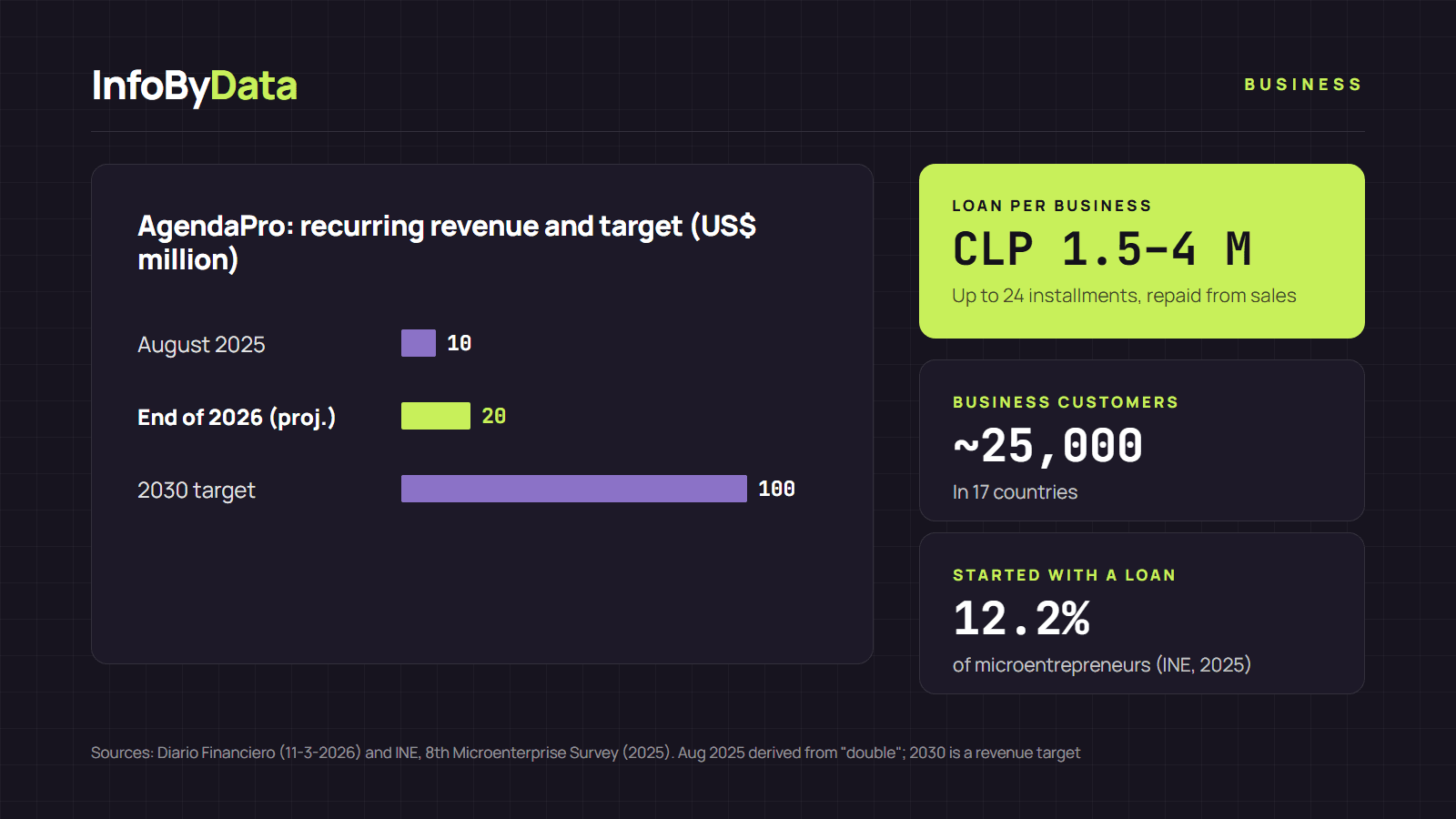
Chilean startup AgendaPro, known for its booking software for hair salons, beauty centers and health practices, has started offering loans for unbanked small businesses. The loans range from CLP 1.5 million to CLP 4 million, in up to 24 installments, and are repaid as a percentage of what the business sells: if it sells nothing in a month, it pays nothing, CEO and co-founder Julio Guzmán told Diario Financiero. The product is called AgendaPro Propay. It has been in a pilot phase this year, with a formal launch planned for 2027.
CLP 1.5–4 M
Loan amount
Chilean pesos
24 installments
Maximum term
repaid as a % of sales
~25,000
Business customers
in 17 countries
Source: Diario Financiero, November 3, 2026
View the data as a table
| Loan amount | CLP 1.5–4 M | Chilean pesos |
| Maximum term | 24 installments | repaid as a % of sales |
| Business customers | ~25,000 | in 17 countries |
How AgendaPro’s loans for unbanked small businesses work
The model relies on what AgendaPro already knows about its customers. Because businesses use its software to book appointments and take payments, the company can see how much each one sells and how steadily. It assesses the loan with that information instead of asking for financial statements or a banking history.
These are the terms Guzmán described:
- Amount: between CLP 1.5 million and CLP 4 million.
- Term: up to 24 installments.
- Repayment: a percentage of sales. If the business does not sell, nothing is collected.
- Rate: a market rate, which could fall as volume grows.
- Requirement: using AgendaPro’s payment terminal. The company wants at least 60% of its businesses to have one.
- Defaults: according to the company, there have been none during the pilot.
Guzmán explained that these businesses are left "out even of factoring," because they do not issue invoices that can be sold. His summary of the model: "If the business wins, we win."
Why loans for unbanked small businesses are scarce
The problem AgendaPro is trying to solve shows up in official data. According to the 8th Microenterprise Survey by Chile’s National Statistics Institute (INE), published in December 2025, Chile has 1,998,178 microentrepreneurs. Of them, 54.2% work informally, and only 12.2% used a loan or credit as their main source of funding to get started. Most, 60.4%, started with their own money.
A beauty salon or a small practice can sell well every month and still not qualify for a bank loan, because it has no invoices, collateral or formal track record. Loans for unbanked small businesses like AgendaPro’s rely on a different signal: the daily sales that run through its system.
The business behind it: from booking software to fintech
The idea came up in 2021, when AgendaPro went through the US accelerator Y Combinator. Its mentors pointed out that in the United States this kind of software had already added financial services, and that the way in was the payment terminal, because about 80% of beauty transactions happen in person, Guzmán recalled.
The plan has three stages:
- Business loans, which it currently funds with its own money. To grow, it is looking for a partner to buy the loans AgendaPro assesses and originates. AgendaPro would put in part of the money and the returns would be split 30% for the startup and 70% for the funder.
- Interest-free installments for end customers paying for expensive treatments.
- A checking account with a card for professionals, by 2028, through a partnership with a bank.
As long as it only originates loans and does not keep them on its balance sheet, Guzmán believes the company does not need regulatory approval. That would change if the loans stayed on its books. "My dream is to be a bank. I don’t know if I’ll make it, because it takes a lot of scale," he said.
The company expects to end 2026 with US$20 million in annual recurring revenue, double its level in August 2025, when it announced a US$35 million Series B round led by Riverwood. It has raised US$43 million in total and is aiming for 100,000 customers and US$100 million in revenue by 2030.
If you are interested in how young companies grow in the region, see entrepreneurship in Latin America in numbers.
What it means for you
- If you run a small business without access to banks: loans for unbanked small businesses that are repaid out of sales adjust the payment to what you sell. Before signing, compare the total rate and the share of sales that will be deducted, not just the amount.
- If you run a software company: this case shows a common fintech path, using the sales data you already process to offer financing. It is a more regulated business, so check with lawyers when you would need approval.
- If you follow the market: AgendaPro is betting that sales data can replace the invoice as collateral. The result will show up in default rates once the product leaves its pilot phase in 2027.
Sources
- loans for unbanked small businesses
- AgendaPro
- fintech
- small business financing
- microenterprise
- Chilean startups