What people ask AI: advice, information and writing make up almost 8 in 10 conversations
What people ask AI: practical guidance, seeking information and writing add up to 77% of ChatGPT messages. Here is what the studies from the US and Chile show.
· 5 min read
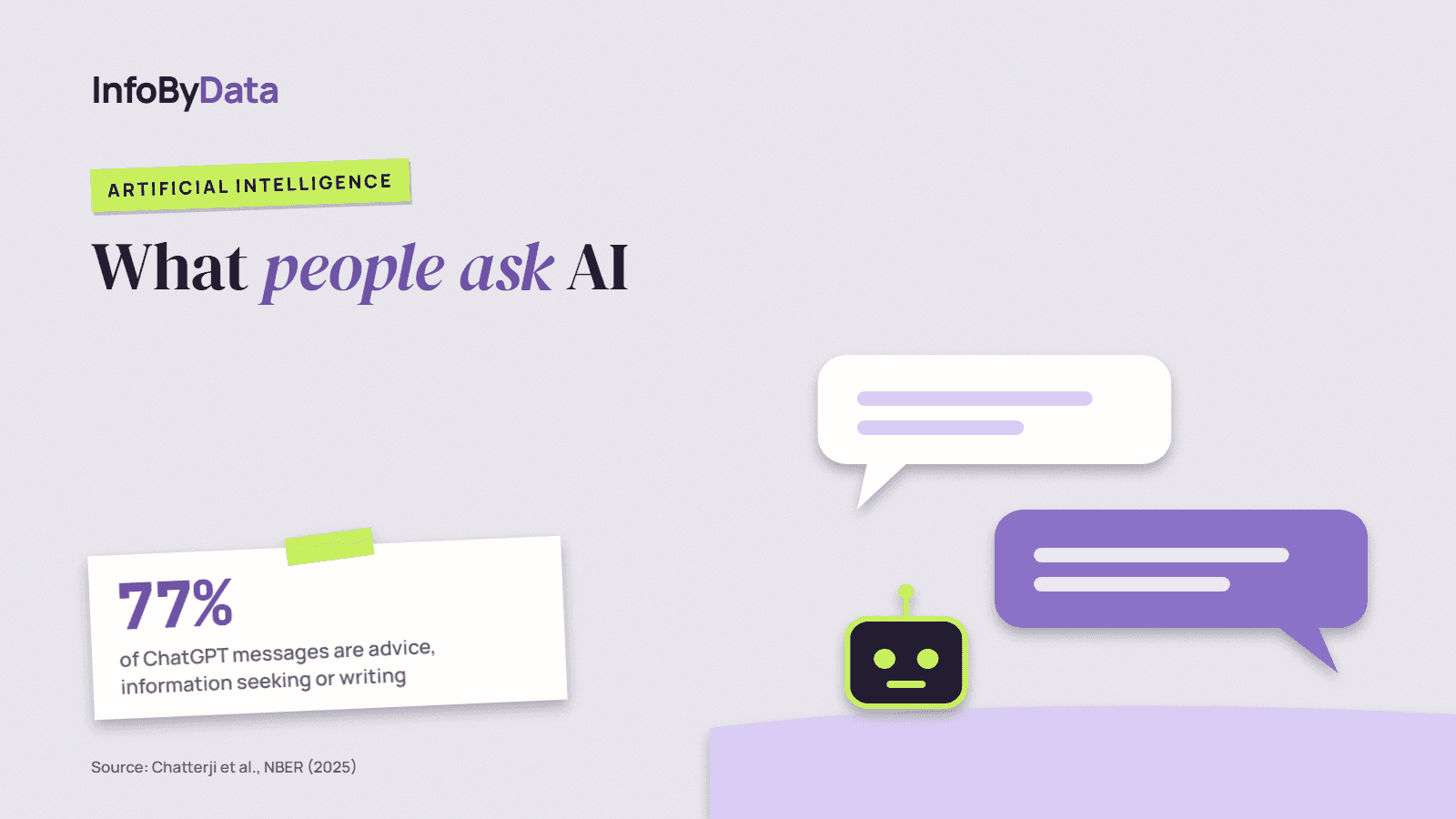
To understand what people ask AI, there is one source no survey can match: the conversations themselves. The largest study published so far, by OpenAI researchers and Harvard economist David Deming, classified 1.5 million ChatGPT conversations without anyone reading the messages. The result: practical guidance, seeking information and writing account for about 77% of everything people ask for, according to the working paper published by the NBER.
Programming and emotional companionship, two uses that often make headlines, are minor. Below are the data from the OpenAI study, a Pew Research Center survey in the United States and three studies conducted in Chile.
77%
Advice, information and writing
of ChatGPT messages
70%
Outside work
of messages are personal use
4.2%
Programming
of messages
71%
Chileans who asked for personal advice
at least once
Source: Chatterji et al., "How People Use ChatGPT", NBER (2025) and Universidad Autónoma, cited by CNN Chile (2026)
View the data as a table
| Advice, information and writing | 77% | of ChatGPT messages |
| Outside work | 70% | of messages are personal use |
| Programming | 4.2% | of messages |
| Chileans who asked for personal advice | 71% | at least once |
What people ask AI, by topic
The study grouped messages from ChatGPT consumer accounts into seven topics. Three account for almost all use:
- Practical guidance (29%): how to do something, tutoring and explanations, creative ideas, health, fitness and self-care. It is the most stable category over time.
- Seeking information (24%): facts about people, current events, products and recipes. It grew the most: it was 14% in July 2024.
- Writing (24%): writing, editing, translating and summarizing texts. It fell from 36% a year earlier.
- Jul-2024
- 2025
Source: Chatterji et al., "How People Use ChatGPT", NBER Working Paper 34255 (2025)
View the data as a table
| Jul-2024 | 2025 | |
|---|---|---|
| Practical guidance | 29% | 29% |
| Seeking information | 14% | 24% |
| Writing | 36% | 24% |
| Multimedia (images) | 2% | 7% |
| Technical help | 12% | 5% |
Two details show how AI is really used. Two thirds of writing requests do not aim to create a text from scratch, but to modify one the person already wrote: edit it, translate it or summarize it. And education weighs heavily: 10.2% of all messages are requests for tutoring or teaching.
At the other end, the most talked-about uses are small:
Programming has a low share within ChatGPT because much of that work happens in other tools, such as coding assistants and direct access to the models (API), as we explain in AI tools for code generation.
Asking, doing or expressing
The study also classified the intent of each message. Asking (requesting information or advice to make a decision) is growing fastest. Doing means requesting a concrete output, such as a text, a plan or code. Expressing covers personal conversation, reflection and play.
In July 2024, asking and doing were evenly split and expressing was below 8%. By late June 2025, asking was already more than half. For companies, that is the key figure: AI is increasingly used as an advisor before a decision, and that answer mentions brands, products and sites.
Another figure reinforces it: about 70% of messages are not related to work. In work conversations, by contrast, writing dominates, with about 40%.
What people ask AI in the United States
Surveys ask people directly what they use chatbots for. In the Pew Research Center survey of 5,119 U.S. adults in February 2026, searching for information is the most common use:
Pew also found that about a quarter of adults use chatbots every day, and that half do not use them at all.
What people ask AI in Chile
There is no conversation data for Chile, but three recent studies show concrete uses:
- Personal advice. The IV Survey on Social Perception of AI by Universidad Autónoma (1,216 people in all 16 regions) found that 71% have asked an AI for advice on personal problems at least once, about friendship, relationships or family. 7% always do so and 16% frequently. Among 18 to 34 year olds, the figure rises to 80%.
- Health. The study "WIP Chile 5.0: Google versus Doctor", by the UC School of Communications, indicates that 32.9% of adults use generative AI to answer health questions, according to BioBioChile.
- Shopping. According to Cadem, when AI is used for consumption, the most frequent uses are quoting or comparing prices (43%), evaluating the quality of a product or service (42%) and understanding what each alternative offers (42%).
These studies use different questions and samples, so the figures should not be added up or compared as if they were one survey. What they do show is a common pattern: people ask AI before deciding, whether what to buy, how to take care of themselves or how to solve a problem.
Why it matters for brands
If seeking information and advice already make up half of use, more and more decisions start with a question to an assistant. Those answers include companies, products and websites, and those that do not appear are left out of consideration. We review which Chilean brands appear in our article on visibility in AI search engines, and which assistant sends the most visits in which AI people use most in Chile.
To find out whether your site provides the information assistants need to cite it, you can check it with our free AI Checker.
What it means for you
- If you run a business: the questions people ask AI resemble those they would ask an expert salesperson. Answer your customers' real questions clearly on your site: prices, differences between products and how to choose.
- If you work in education or health: AI is already a frequent source of advice. It is worth guiding people on how to verify its answers, because none of these tools replaces a professional.
- If you use AI daily: the data shows its greatest value lies in advising and explaining, not just writing. Asking for context and sources improves the quality of the answers.
Sources
- Chatterji, Cunningham, Deming, Hitzig, Ong, Shan and Wadman, "How People Use ChatGPT", NBER Working Paper 34255 (September 2025)
- OpenAI, "How people are using ChatGPT" (September 2025)
- Pew Research Center, "Americans and AI 2026: Chatbots, Smart Devices and Views on Impact" (June 17, 2026)
- CNN Chile, IV Survey on Social Perception of AI in Chile 2026, Universidad Autónoma (November 2026)
- BioBioChile, "WIP Chile 5.0: Google versus Doctor" study, UC School of Communications (October 14, 2026)
- The Clinic, Cadem study on generative AI and consumption (September 3, 2026)
- what people ask AI
- ChatGPT uses
- generative artificial intelligence
- digital behavior
- AI visibility