Brand mentions in AI: which Chilean brands ChatGPT and Gemini name and where they get their information
Brand mentions in AI: ChatGPT names 2.3 brands per answer and Gemini 2.8. Two Chilean studies show which companies appear and which sources assistants rely on.
· 5 min read
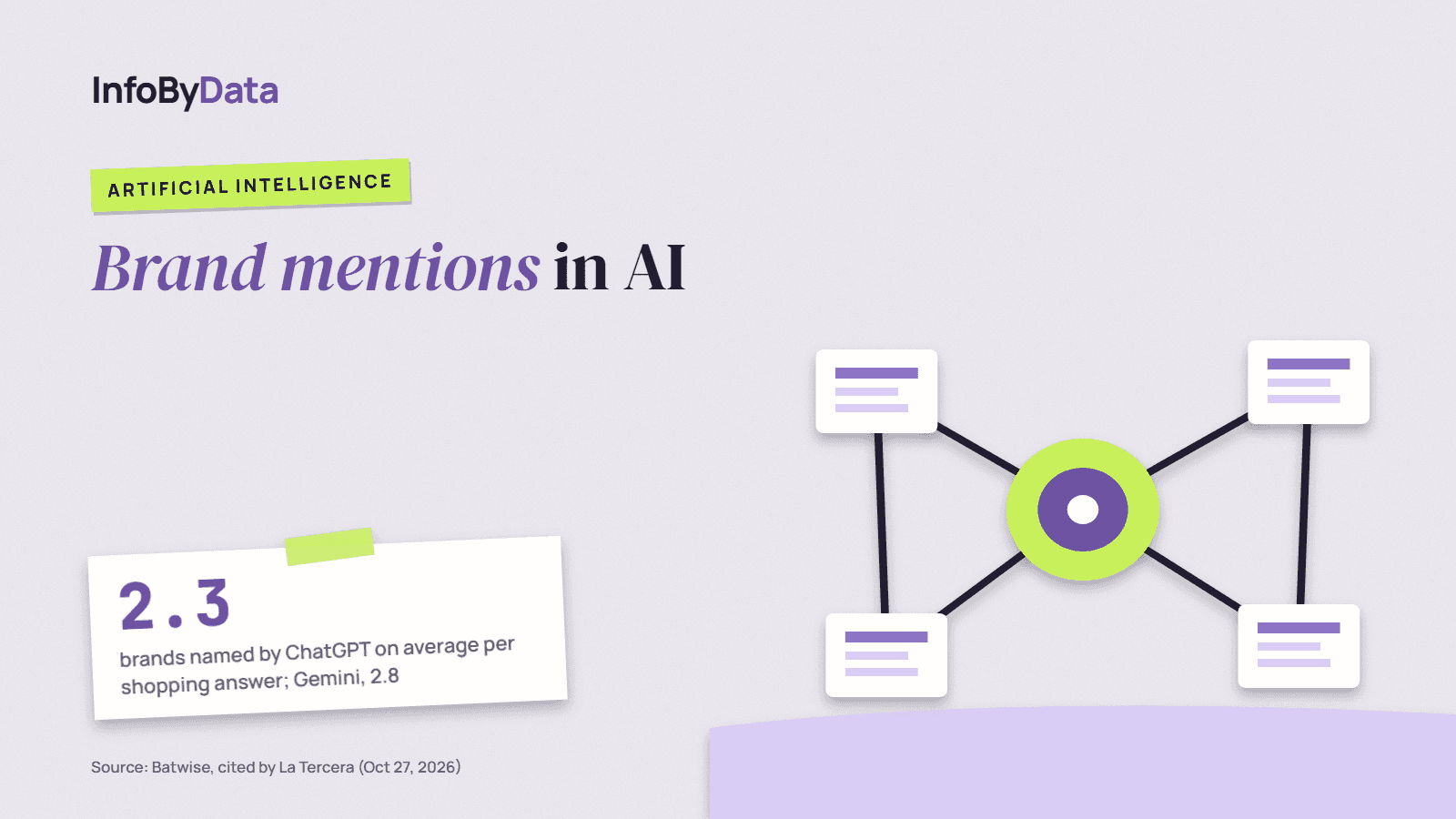
Brand mentions in AI work differently from a Google ranking. When someone asks ChatGPT which product to buy, they get an average of 2.3 brands; in Gemini, 2.8, according to the "Ranking IA Chile 2026" by Chilean startup Batwise, published by La Tercera. There is no second page: the brand is either in the answer or it is not.
Two studies carried out in Chile in 2026 show which brands assistants mention, how they describe them and, above all, where they get their information. Their results complement each other and, on one key point, contradict each other.
2.3
Brands per answer in ChatGPT
and 2.8 in Gemini
548
Brands evaluated by Batwise
in 35 categories
32 of 35
Categories with the same winner
in ChatGPT and Gemini
56.7
Average AI reputation score
out of 100, across 200 brands (UBIK)
Source: Batwise, cited by La Tercera (Oct 27, 2026) and UBIK, cited by The Clinic (Aug 27, 2026)
View the data as a table
| Brands per answer in ChatGPT | 2.3 | and 2.8 in Gemini |
| Brands evaluated by Batwise | 548 | in 35 categories |
| Categories with the same winner | 32 of 35 | in ChatGPT and Gemini |
| Average AI reputation score | 56.7 | out of 100, across 200 brands (UBIK) |
Which Chilean brands get the most brand mentions in AI
Batwise asked shopping questions "the way a buyer would, without naming brands", with location set to Chile and in anonymous browsing, between September 20 and October 2, 2026. It evaluated 548 brands in 35 consumer, retail, services and finance categories.
Some of the most recommended brands by category were:
| Category | Brand most recommended by AI |
|---|---|
| Airlines | Latam Airlines |
| Delivery apps | PedidosYa |
| Banks | Santander |
| Clinics | Clínica Alemana |
| Fuel | Copec |
| Home appliances | LG |
| Pharmacies | Cruz Verde |
| Car brands | Toyota |
| Marketplaces | MercadoLibre |
| Supermarkets | Lider |
| Mobile and home internet | Entel |
| Department stores | Falabella |
The most striking figure is the agreement between assistants: in 32 of the 35 categories, ChatGPT and Gemini chose the same winner. The highest mention rates were for Lider, MercadoLibre, Copec and AFP Capital.
Brand mentions in AI don't always match what consumers think
Batwise compared its results with three survey-based brand perception studies. It matched Cadem Marcas Ciudadanas in 10 of 15 categories, Criteria Total Brands in 9 of 15, and Chile 3D in 1 of 3.
The differences are the most revealing:
- Cars: Tesla was the top brand in the Cadem survey, but got just 1% of mentions in AI answers. Toyota led there.
- Pharmacies: Dr. Simi led in Cadem and came fourth in AI, where Cruz Verde won.
- Banks: BancoEstado was first in Cadem and third in AI, which chose Santander.
As the study itself puts it, brands that are very strong among consumers do not always have the same presence in ChatGPT or Gemini. Reputation built on the street does not automatically carry over to an assistant's answer.
How AI describes brands: the reputation study
The second study, "IA_Rep" by Chilean company UBIK, presented together with Cadem and published by The Clinic, does not measure whether a brand appears, but how ChatGPT, Gemini, Claude and Perplexity describe it. It analyzed 200 brands in 33 categories using four criteria: narrative assessment, visibility, consistency across platforms and controversy risk.
The average was 56.7 points out of 100, ranging from 27.5 to 80.7. Clínica Alemana (80.7), Colún (75.6) and Metro (74.3) led.
Two findings matter for any company:
- The visibility paradox. The brands most visible to AI also show more controversy risk in its answers: appearing more also means more problems get told.
- Each assistant has a tone. According to the study, ChatGPT is the most lenient in presenting controversies, Gemini uses a positive tone with moderate-risk brands, Perplexity is the most balanced and Claude the most demanding and critical.
Where they get their information: the point where the studies disagree
Here is the key difference. Both studies looked at which sources assistants cite, and reached opposite results:
- Shopping questions (Batwise)
- Brand reputation (UBIK)
Source: Batwise, cited by La Tercera (Oct 2026) and UBIK, cited by The Clinic (Aug 2026)
View the data as a table
| Shopping questions (Batwise) | Brand reputation (UBIK) | |
|---|---|---|
| Company websites | 58% | 9% |
| News media | 16% | 49% |
The most likely explanation lies in the type of question. When someone asks what to buy, AI looks for product pages, prices and features, and finds them on company websites (58% of sources in the Batwise study). When the question is about a company's reputation, AI relies on the press (49%) and on regulators and public bodies (19%), according to UBIK.
For a brand, this means it needs two different things: a clear and complete website of its own to appear in shopping recommendations, and presence in media and independent sources so that it is described well.
A Pew Research Center study of Google's AI summaries in the United States adds another clue: Wikipedia, YouTube and Reddit made up 15% of the sources cited, and government sites (6%) appeared more often than in traditional results (2%).
How to improve brand mentions in AI
With this data, there are concrete actions:
- Check what assistants say about your brand. Ask ChatGPT, Gemini and Perplexity the way a customer would, without naming your brand, and note who appears.
- Complete your website. Prices, features, comparisons and FAQs in text. It is the main source for shopping questions.
- Work on press and independent sources. They are the basis of how AI describes your reputation.
- Keep it consistent. If your information differs on your site, on marketplaces and in the media, each assistant may tell a different story.
To find out whether your site is technically ready for assistants to read and cite it, you can check it with our free AI Checker. You can also see which regional companies appear in answers in our article on visibility in AI search engines.
Both studies were conducted by companies that sell AI positioning services, and their full methodologies are not public. Their figures serve as a reference for the phenomenon, not as an official measurement.
What it means for you
- If you manage a brand: brand mentions in AI are concentrated on two or three names per category. Being well known is not enough; the information has to be available where assistants look for it.
- If you work in communications: the press is still the main source AI uses to describe a company's reputation. Media relations are gaining value, not losing it.
- If you run a small business: in many categories no brand dominates. A website with complete, verifiable information is a concrete opportunity to appear.
Sources
- La Tercera, "Estudio revela las principales marcas que se posicionan ante consultas de consumo con IA en plataformas ChatGPT y Gemini" (October 27, 2026)
- The Clinic, "Estudio mide la reputación de las marcas chilenas en la inteligencia artificial: Clínica Alemana, Colún y Metro lideran ranking" (August 27, 2026)
- Pew Research Center, "Google users are less likely to click on links when an AI summary appears in the results" (July 22, 2025)
- brand mentions in AI
- brand reputation
- ChatGPT
- Gemini
- GEO
- AI visibility
- marketing in Chile