AI for product search: how Chileans use it to compare prices and how much it influences purchases
26% of Chileans already use AI for product search before buying, mainly to compare prices. But only 3% buy directly after asking it. Here is the data.
· 4 min read
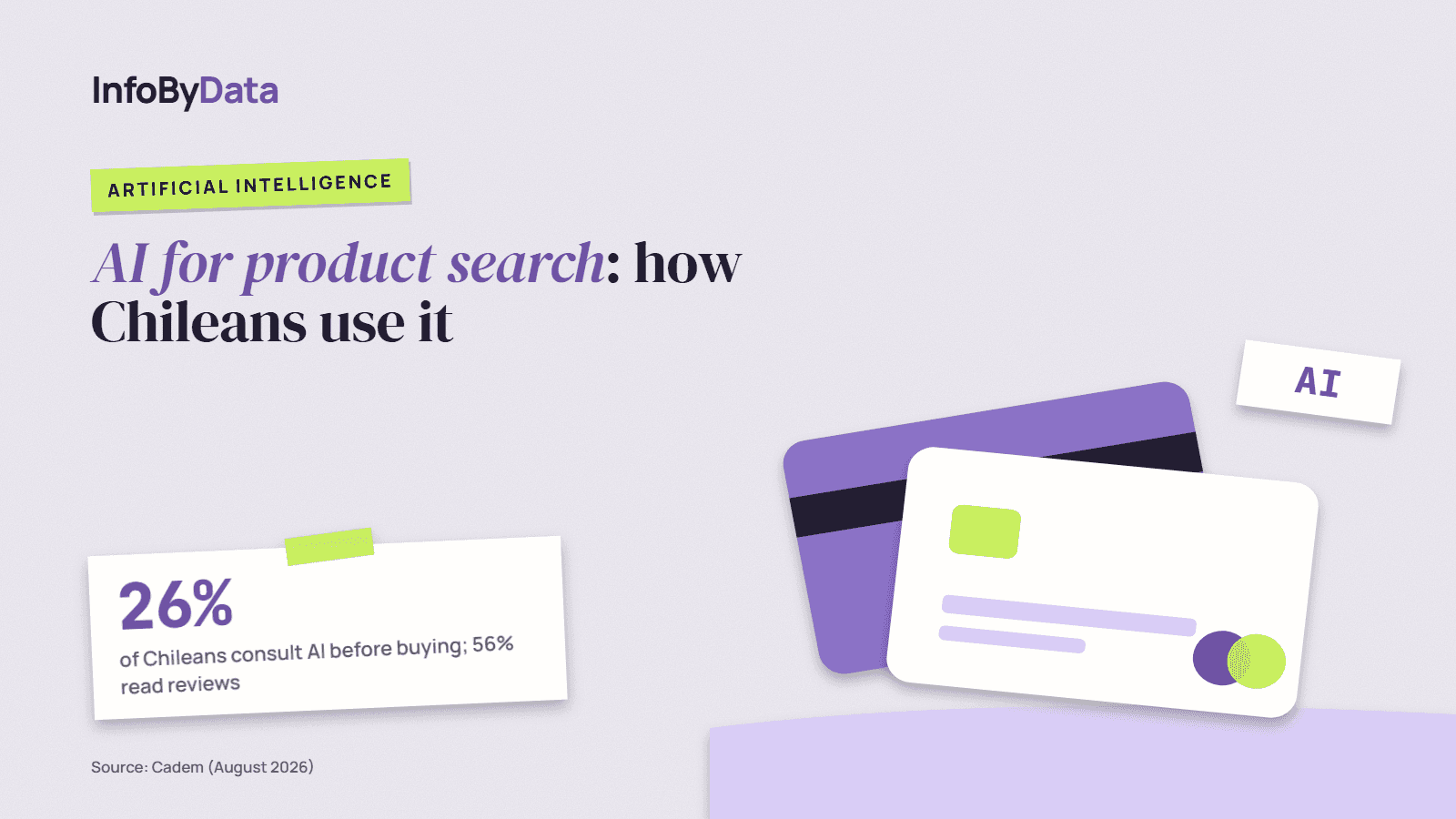
AI for product search is already part of the shopping journey in Chile, but it has not yet replaced Google or reviews. 26% of Chileans use artificial intelligence as a source of information before buying, compared with 56% who check other users' reviews and another 56% who use search engines, according to an August 2026 study by Cadem, based on 1,000 web surveys of people over 18.
Where AI does carry weight is before choosing: 48% say it made them discover or consider a new brand, product or store. This article gathers what is known about how AI is used for shopping in Chile and the United States, just as Black Friday 2026 begins.
26%
Consult it before buying
vs 56% who read reviews
48%
Discovered a new brand with AI
or a product or sales channel
31%
Trust AI more than advertising
about what is said of a brand
3%
Buy directly after asking it
most keep researching
Source: Cadem, cited by The Clinic (August 2026)
View the data as a table
| Consult it before buying | 26% | vs 56% who read reviews |
| Discovered a new brand with AI | 48% | or a product or sales channel |
| Trust AI more than advertising | 31% | about what is said of a brand |
| Buy directly after asking it | 3% | most keep researching |
What Chileans use AI for product search for
When someone uses AI for product search, they rarely ask it to buy for them. They use it to organize information. According to Cadem, the most frequent uses are quoting or comparing prices, evaluating quality and understanding what each alternative offers:
52% of respondents believe AI helps them better understand differences between products and brands, and 46% say it saves them time when looking for information. Use is highest in electronics and technology (20%) and lowest in restaurants and delivery (5% each): AI shows up when the product is expensive, technical or hard to compare.
A different measurement, carried out by Chilean startup Batwise on shopping questions in ChatGPT and Gemini and published by La Tercera, points in the same direction: between 30% and 60% of queries seek a recommendation, and only between 10% and 17% express a direct intention to buy.
AI for product search vs Google and reviews
AI is still the fourth source of information before a purchase in Chile. People still trust other buyers, search engines and brands' official sites first:
Even so, AI has an effect the other sources do not show as strongly: 27% say they changed their opinion of or trust in a company after consulting it, and 31% trust what AI says about a brand more than its advertising. In other words, AI does not close the sale, but it does influence which brands make the shortlist.
Which AI people use most for product search
There is no Chilean survey asking which assistant people use to shop. The best available indicator is which chatbot visits to websites come from. In October 2026, Gemini generated 54.4% of those visits in Chile and ChatGPT 33.7%, according to StatCounter, although Gemini's jump in a single month means the figure should be read with caution. We explain it in which AI people use most in Chile.
For retail, this matters because each assistant answers differently. In the Batwise study, ChatGPT named an average of 2.3 brands per answer and Gemini 2.8: unlike a Google results page, the shopper sees two or three options, not ten.
What is happening in the United States: AI traffic to stores is multiplying
The United States shows where behavior may be heading. According to Adobe, which measures more than one trillion visits to retail sites, visits to online stores from generative AI tools grew 693.4% in the 2025 holiday season compared with the previous year. Use was highest in video games, toys, appliances, electronics and personal care.
For the 2026 season, Adobe projects that this traffic will more than double again:
Adobe notes that the user base is still modest and that the figure measures clicks to stores, not sales. In an Adobe survey of 5,000 consumers, 77% of those who used AI to shop online say they feel more confident in their purchase and 69% say they are less likely to return the product.
How to prepare a store for AI for product search
If people use AI to compare prices, quality and alternatives, assistants need to find that information on your site, clearly written:
- Complete product pages. Price, dimensions, materials, warranty and compatibility in text, not just in images. What is not stated cannot be compared; we saw it in our Black Friday comparisons.
- Answers to real questions. A FAQ section that says who each product is for and how it differs from the alternatives.
- Visible reviews. Reviews are still shoppers' first source and also a signal for assistants.
- Presence beyond your site. Assistants also cite media, comparison sites and marketplaces; your brand needs to appear in those sources.
To find out whether your site provides the information ChatGPT, Gemini or Perplexity need to recommend it, you can check it with our free AI Checker. If you run a store, our guide to integrating AI into your online store may also help.
What it means for you
- If you sell online: AI for product search influences people before the click. An incomplete product page can leave you out of a recommendation you will never even see in your analytics.
- If you work in marketing: AI is already a brand discovery channel (48%), but it does not replace reviews or Google. It pays to work on all three fronts at once.
- If you are shopping this Black Friday: use AI to compare features, but check the price at the store. Assistants can show outdated prices, and during sales events prices change the same day.
Sources
- The Clinic, "Estudio de Cadem: el 78% de los chilenos ha usado IA generativa y casi la mitad descubre nuevas marcas con ella" (September 3, 2026)
- La Tercera, "Estudio revela las principales marcas que se posicionan ante consultas de consumo con IA en plataformas ChatGPT y Gemini" (October 27, 2026)
- Adobe, "Holiday Shopping Season Drove a Record $257.8 Billion Online with Consumers Embracing Generative AI Tools" (January 2026)
- Adobe Digital Insights, 2026 U.S. holiday season forecast (September 2026)
- StatCounter Global Stats, AI Chatbot Market Share Chile (October 2026)
- AI for product search
- AI shopping
- ChatGPT
- Gemini
- e-commerce
- Black Friday 2026
- AI visibility