User behavior in AI: how much people trust it, when they click and how often they use it
User behavior in AI is changing how people search: with an AI summary, only 8% click on a result, compared with 15% without one. Here are the key figures.
· 5 min read
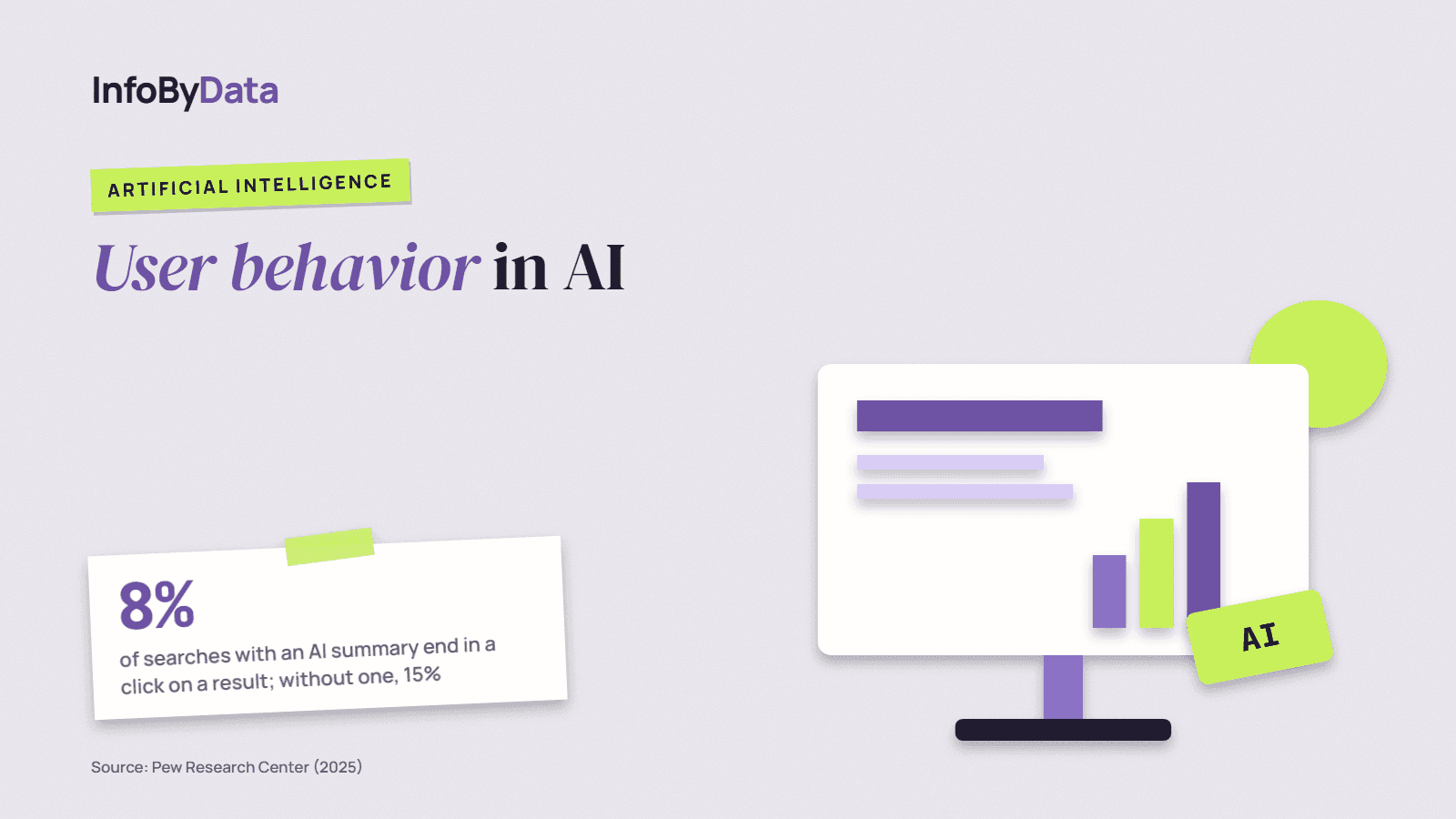
User behavior in AI can be measured with three questions: how often people use it, how much they trust it and what they do after reading an answer. The third is the one that affects companies most. When Google shows an AI summary, users click on a traditional result in 8% of visits, almost half as often as when there is no summary (15%), according to a Pew Research Center study that tracked the actual browsing of 900 adults in the United States.
Below is what studies by Pew, OpenAI, Cadem and Universidad Autónoma show about how people behave with artificial intelligence.
8%
Clicks with an AI summary
vs 15% without a summary
1%
Clicks on a link in the summary
of visits with a summary
58%
Chileans who use AI every week
several times a week or more
60%
Read AI summaries
of U.S. adults
Source: Pew Research Center (2025 and 2026), Cadem (August 2026)
View the data as a table
| Clicks with an AI summary | 8% | vs 15% without a summary |
| Clicks on a link in the summary | 1% | of visits with a summary |
| Chileans who use AI every week | 58% | several times a week or more |
| Read AI summaries | 60% | of U.S. adults |
How often people use AI
In Chile, use is already widespread and frequent. According to Cadem, 78% of adults surveyed have used tools such as ChatGPT, Gemini or Copilot at some point, and 58% use them several times a week or more often. Among 18 to 34 year olds, ever-use reaches 93%.
In the United States, the Pew Research Center survey of February 2026 shows a country split in half: about a quarter use chatbots daily, another quarter use them several times a week or less, and half do not use them.
Age makes the biggest difference. In the United States, adults under 50 are twice as likely to use ChatGPT as those 50 and older (57% vs 28%). The gender gap, by contrast, has almost disappeared: on ChatGPT, the share of users with typically feminine names rose from 37% in January 2024 to 52% in July 2025, according to OpenAI.
What people do after reading an answer: user behavior in AI and clicks
Pew's study of Google's AI summaries is the best measure of what people do after reading an answer, because it does not ask: it observes the actual browsing of 900 adults during March 2025.
- With AI summary
- Without AI summary
Source: Pew Research Center, browsing analysis of 900 U.S. adults (March 2025)
View the data as a table
| With AI summary | Without AI summary | |
|---|---|---|
| Clicks a traditional result | 8% | 15% |
| Ends their browsing session | 26% | 16% |
Three behaviors stand out:
- They click less. With an AI summary, clicks on a traditional result fall by almost half.
- They hardly use the links in the summary. In only 1% of visits with a summary did the person click on one of the cited sources.
- They stay with the answer. On 26% of pages with a summary, the person ended their browsing there, compared with 16% without a summary.
The type of question also matters. Only 8% of one- or two-word searches showed an AI summary, but the figure rose to 53% for searches of 10 words or more, and to 60% for those starting with words such as "who", "what" or "why". The more a search resembles a conversation, the more likely AI is to answer it. We analyze the impact on traffic in how much traffic the first Google result loses when an AI summary appears.
In 2026, 60% of U.S. adults say they read search engines' AI summaries, 30% say they do not and 10% are not sure, according to Pew.
How much people trust AI
Trust is high for getting informed, but low for delegating decisions. In Chile, the Cadem study shows that 31% trust what AI says about a brand more than its advertising, but only 3% buy directly after consulting it.
The IV Survey on Social Perception of AI by Universidad Autónoma, with 1,216 people from all 16 regions, shows an ambivalent relationship:
The perception of threat rose from 23.3% to 28% in one year. The risks of greatest concern today are false or hard-to-distinguish information (25.4%) and the use of personal data (19.5%). Looking ahead, the main fear is losing the ability to think and learn (27.6%).
In other words, people use AI more and more, ask it for advice and consult it before buying, but they do not hand it the final decision: they verify, compare and keep consulting other sources.
What people ask for: more and more advice, fewer tasks
The deepest behavioral change is in intent. On ChatGPT, messages in which the person asks for information or advice to make a decision reached 51.6% in June 2025, compared with 34.6% for requests for concrete tasks, such as writing a text or code, according to the NBER study. We detail the topics in what people ask AI.
Why it matters for your site
If user behavior in AI means reading the answer without clicking, the visit is no longer the only way to measure visibility. What matters is whether your brand or site appears inside the answer, as a source or as a recommendation. We review which Chilean brands manage to appear in brand mentions in AI.
To find out whether your site is ready for ChatGPT, Gemini or Perplexity to read and cite it, you can check it with our free AI Checker.
What it means for you
- If you have a website: fewer clicks does not mean less influence. Also measure whether you are cited in AI answers, not just how much traffic you get from Google.
- If you work in marketing or content: long, question-style searches are the ones that trigger AI summaries most. Answer those questions directly and verifiably on your site.
- If you use AI daily: most people still verify before deciding, and it is good practice. Check the sources the answer cites, especially on health, money and shopping.
Sources
- Pew Research Center, "Google users are less likely to click on links when an AI summary appears in the results" (July 22, 2025)
- Pew Research Center, "Americans and AI 2026: Chatbots, Smart Devices and Views on Impact" (June 17, 2026)
- Chatterji et al., "How People Use ChatGPT", NBER Working Paper 34255 (September 2025)
- OpenAI, "How people are using ChatGPT" (September 2025)
- The Clinic, Cadem study on generative AI and consumption (September 3, 2026)
- CNN Chile, IV Survey on Social Perception of AI in Chile 2026, Universidad Autónoma (November 2026)
- user behavior in AI
- AI summaries
- trust in AI
- ChatGPT
- Google AI Overviews
- AI visibility