Trusted wallets for storing crypto in Chile: how to choose between custody, hot wallets and cold wallets (2026)
There were 158,000 thefts from personal crypto wallets in 2025. Where to find trusted wallets in Chile, hot vs. cold wallets, and what to ask a custodian.
· 4 min read
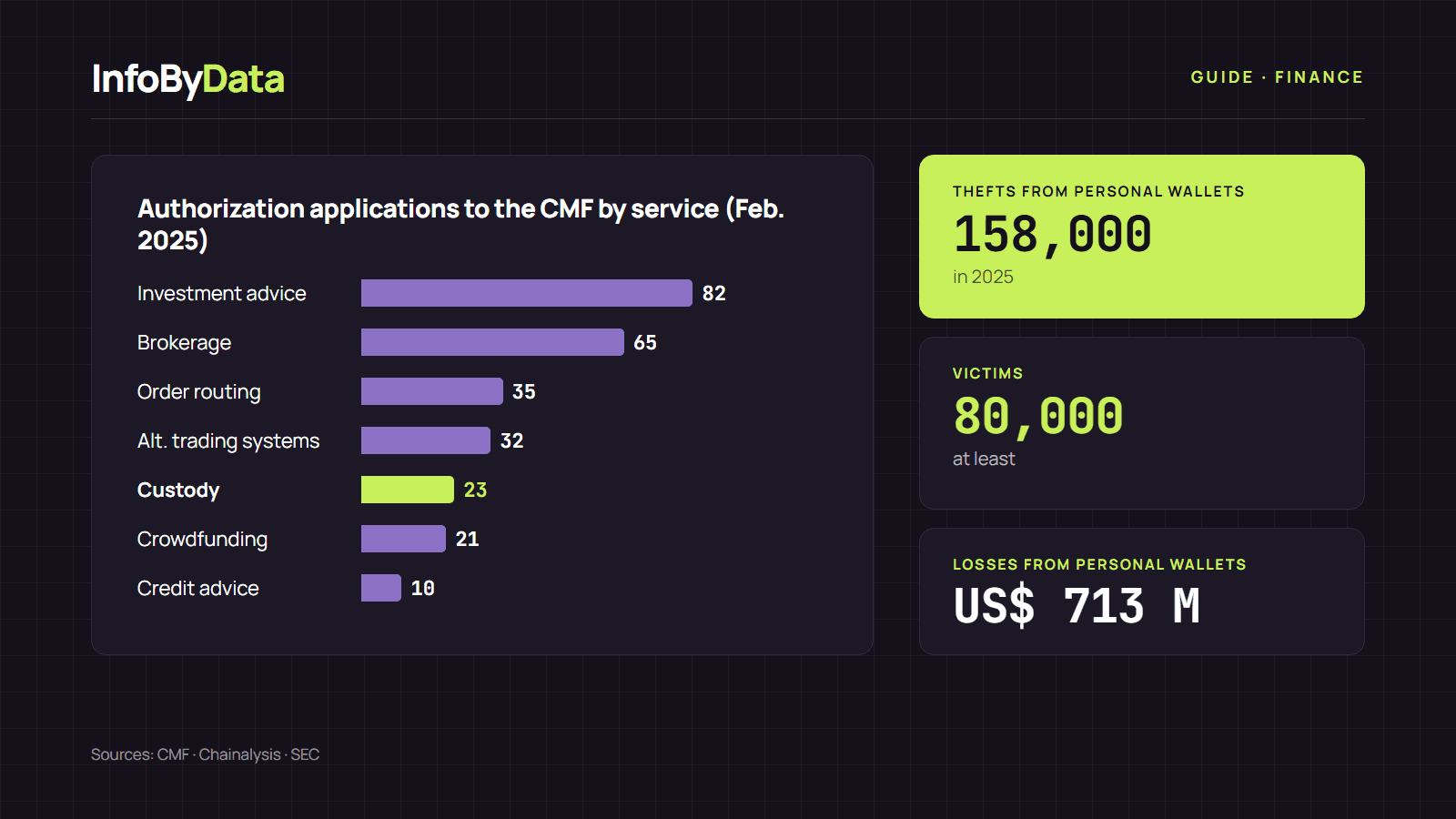
In 2025 there were 158,000 thefts from personal cryptocurrency wallets, affecting at least 80,000 victims, according to Chainalysis. Losses from those wallets totaled US$ 713 million. Choosing trusted wallets and understanding how they work matters as much as deciding what to buy.
In this guide we explain the types of wallets as described by the U.S. Securities and Exchange Commission (SEC), and where to check crypto custodians in Chile. We don't recommend any brand or platform.
158,000
Thefts from personal wallets
incidents in 2025
80,000
Victims
unique people or entities, at least
US$ 713 M
Losses from personal wallets
versus US$ 1,500 M in 2024
US$ 3,400 M
Total crypto stolen
includes the US$ 1,500 M Bybit hack
Source: Chainalysis, December 18, 2025
View the data as a table
| Thefts from personal wallets | 158,000 | incidents in 2025 |
| Victims | 80,000 | unique people or entities, at least |
| Losses from personal wallets | US$ 713 M | versus US$ 1,500 M in 2024 |
| Total crypto stolen | US$ 3,400 M | includes the US$ 1,500 M Bybit hack |
What a crypto wallet is
A wallet doesn't hold the cryptocurrency itself: it holds the private keys that let you use it. According to the SEC, a private key "is like a password to your crypto wallet", with two important differences: it can't be changed or replaced, and if you lose it, you permanently lose access to your crypto assets.
Many wallets also provide a seed phrase: a sequence of words that lets you restore the wallet if you lose the key or the device. The SEC recommends keeping it in a secure place and not sharing it with anyone.
Hot wallet or cold wallet: the differences
| Hot wallet | Cold wallet | |
|---|---|---|
| What it is | A wallet connected to the internet (app, program or web) | A device not connected to the internet, such as a USB drive or even paper |
| Convenience | More convenient for transactions | Less convenient for transactions |
| Main risk | More exposed to cyberattacks | Can be lost, damaged or stolen |
| Cost | May be free at first | Usually has to be purchased |
Source: SEC, Crypto Asset Custody Basics for Retail Investors (December 12, 2025).
According to the SEC, cold wallets are generally more secure from cyberthreats, but if they're lost or damaged without a backup, the loss can be permanent.
Third-party custody or self-custody
The other big decision is who holds the keys:
- Third-party custody: a platform or custodian manages the keys for you. The SEC warns that if the custodian is hacked, shuts down or goes bankrupt, you may lose access to your crypto assets.
- Self-custody: you control the private keys and are solely responsible for protecting them. If you lose them or they're stolen, no one can restore your access.
Chainalysis figures show attackers target both. In 2025, the largest theft hit a centralized service (Bybit, US$ 1.5 billion), while thefts from personal wallets rose in number even as they fell in value:
Chainalysis reads the decline this way: attackers are reaching more people but taking less from each one.
Where to find trusted wallets in Chile
If you choose third-party custody: check the CMF registry
In Chile, the Fintech Law (Law 21,521) recognizes crypto assets as financial instruments, and custody of financial instruments is one of the services that require registration in the CMF Registry of Financial Service Providers. When the transition period ended in February 2025, the Financial Market Commission (CMF) had received 23 authorization applications for that service.
Before leaving your crypto assets on a platform, look up its name in that registry and in the CMF citizen alerts. If it isn't registered, the CMF can't supervise or sanction it.
If you choose self-custody: download and buy only from the source
- App or software wallets: download them only from the developer's official site or your phone's official app store, and check that the developer's name matches. Scammers publish fake copies.
- Hardware wallets: buy them from the manufacturer or an authorized reseller, never second-hand, and set them up yourself from scratch.
- Seed phrase: write it down offline, keep it somewhere safe and never type it into a website, chat or email.
Questions the SEC recommends asking a custodian
- Where and how does it store and safeguard my crypto assets?
- Does it store them in its own facilities or subcontract to another company?
- Does it use hot wallets, cold wallets or other methods?
- Does it have insurance against loss or theft, and what are its terms?
- What fees does it charge?
Checklist for choosing trusted wallets
- The platform is listed in the CMF registry and doesn't appear in its alerts.
- The app or device comes from the official site or the manufacturer.
- Your seed phrase is stored offline, in a safe place.
- You turned on two-step verification.
- You keep money for frequent use, in a hot wallet, separate from what you hold long term.
This article is for information only and is not a recommendation to invest or to use any wallet or platform.
If you're just starting out, see how to invest in crypto with little money from Chile, the security measures to protect your crypto assets and the market overview in crypto in numbers.
What it means for you
- Your wallet holds keys, not coins: if you lose the private key or the seed phrase, you can lose your crypto assets forever.
- Each option carries a different risk: third-party custody depends on the platform; self-custody depends on you.
- In Chile, the CMF registry is the starting point: check any custodian before trusting it with your crypto assets.
Sources
- Chainalysis: "2025 Crypto Theft Reaches $3.4 Billion" (December 18, 2025)
- SEC (Investor.gov): Crypto Asset Custody Basics for Retail Investors (December 12, 2025)
- CMF: Registry of Financial Service Providers
- CMF: review of the Fintech Law transition period (February 4, 2025)
- CMF: citizen alerts
- Library of the National Congress of Chile: Law 21,521 (Fintech Law)
- trusted wallets
- crypto wallet Chile
- cryptocurrency wallet
- cold wallet
- crypto asset custody