Crypto asset security: 9 measures to protect your crypto from theft and scams (2026)
Crypto scams reported to the FBI caused over US$ 11 billion in losses in 2025. Here are 9 security measures from official sources to protect your crypto.
· 4 min read
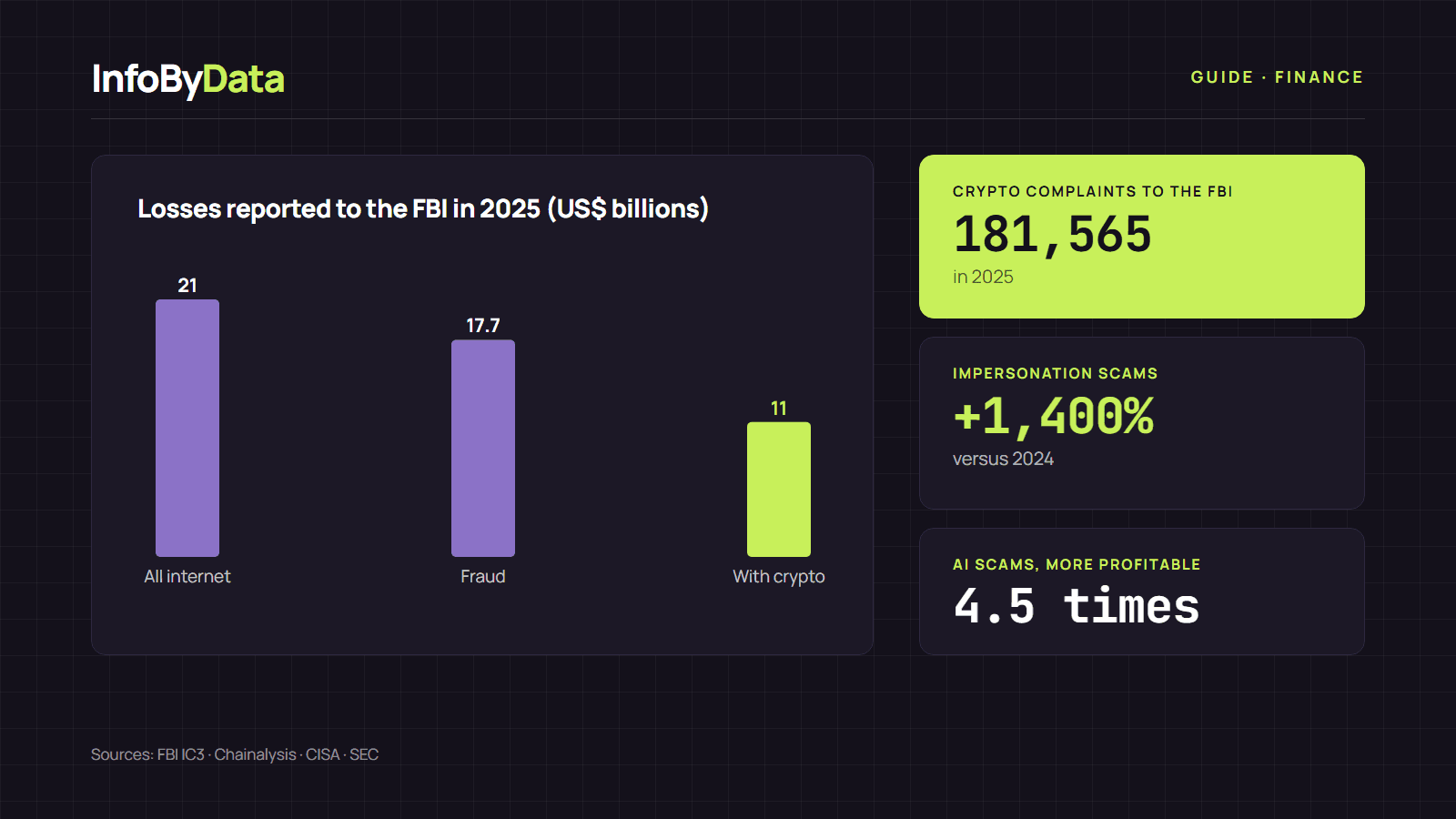
People who reported cryptocurrency fraud to the FBI in 2025 reported the highest losses of any internet crime: 181,565 complaints totaling more than US$ 11 billion, according to the annual report of the Internet Crime Complaint Center (IC3). Globally, Chainalysis estimates crypto scams took about US$ 17 billion that year. Crypto asset security depends as much on habits as on technology.
These are 9 measures to protect your crypto assets, based on recommendations from official bodies in Chile and the United States.
181,565
Crypto-related complaints to the FBI
losses of more than US$ 11 billion in 2025
US$ 17,000 M
Crypto scams worldwide
Chainalysis estimate for 2025
+1,400%
Impersonation scams
growth versus 2024
4.5 times
AI scams versus traditional ones
more profitable for scammers
Source: FBI, 2025 IC3 report; Chainalysis, 2026
View the data as a table
| Crypto-related complaints to the FBI | 181,565 | losses of more than US$ 11 billion in 2025 |
| Crypto scams worldwide | US$ 17,000 M | Chainalysis estimate for 2025 |
| Impersonation scams | +1,400% | growth versus 2024 |
| AI scams versus traditional ones | 4.5 times | more profitable for scammers |
How crypto assets get stolen
The most common attacks don't break the technology: they deceive people. According to Chainalysis, impersonation scams, where the criminal poses as a company, a bank or a government agency, grew more than 1,400% in 2025. The FBI warns that scammers use fake social profiles, voice clones, fake identification documents and believable videos of public figures or loved ones.
There are also direct thefts from wallets: 158,000 thefts from personal wallets were recorded in 2025, according to Chainalysis, and in the first half of 2026 the same firm documented 46 violent attacks on crypto holders worldwide.
9 measures to protect your crypto assets
1. Never share your seed phrase or private key
The private key works like your wallet's password and can't be changed. The SEC recommends keeping your seed phrase in a secure place and not sharing it with anyone. No legitimate platform or support service will ask you for it.
2. Use phishing-resistant authentication
The U.S. cybersecurity agency, CISA, ranks two-step verification methods from strongest to weakest: first physical security keys (FIDO/WebAuthn), then authenticator apps and, last, SMS or voice codes, which it recommends using only as a last resort.
3. Keep long-term holdings offline
According to the SEC, cold wallets, which aren't connected to the internet, are generally more secure from cyberattacks than hot wallets. We explain this in our guide to trusted wallets for storing crypto in Chile.
4. Check the platform with the CMF
In Chile, anyone who holds or brokers crypto assets must be listed in the CMF Registry of Financial Service Providers. Also check the citizen alerts, where the Financial Market Commission lists entities that aren't authorized.
5. Distrust guaranteed returns
The CMF asks people to be skeptical of promises of very high returns, including on social media and from influencers. The U.S. Federal Trade Commission (FTC) is blunt: only scammers guarantee profits.
6. No legitimate party demands payment in crypto
According to the FTC, "only scammers demand payment in cryptocurrency". If someone asks you for crypto to release a prize, a job, a procedure or to "protect" your money, it's a scam.
7. Always go to the official address
Don't open links in unexpected messages, emails or ads. Type the platform's address yourself or use its official app. Impersonation scams copy the look of real companies.
8. Take a moment before acting
The FBI asks people to "Take a Beat": resist pressure to act quickly and assess the situation before handing over money or personal information. With voice cloning and fake AI videos, an urgent call from a supposed relative or executive may be fake.
9. Be discreet about what you hold
Chainalysis recommends not publicly disclosing your crypto holdings, on social media or at events, and being careful about linking your wallets to your real identity. In the first half of 2026 it documented physical attacks or threats that, including attempts, involved US$ 107 million.
What to do if you're robbed or scammed
- Cut off contact with the scammer and don't send more money: crypto transactions generally can't be reversed.
- Notify the platform you used so it can try to freeze the funds.
- Report the incident to Chile's National CSIRT at 1510, and file a complaint with the police or the Prosecutor's Office.
- If the entity offered financial services without authorization, report it to the CMF.
- Distrust anyone offering to "recover" your funds for a fee: it's another type of scam.
This article is for information only and is not a recommendation to invest or to use any platform.
If you're just starting out, read how to invest in crypto with little money from Chile and see where the market stands in crypto in numbers.
What it means for you
- Most thefts start with deception: no legitimate party will ask for your seed phrase, your private key or payment in crypto.
- Not all two-step verification is equal: a physical security key is safer than an SMS code.
- Verify, distrust and be discreet: check the platform with the CMF, distrust guaranteed returns and don't publicize what you hold.
Sources
- FBI: "Cryptocurrency and AI Scams Bilk Americans of Billions", 2025 IC3 report (April 6, 2026)
- Chainalysis: "2026 Crypto Crime Report: Scams" (January 13, 2026)
- Chainalysis: "2025 Crypto Theft Reaches $3.4 Billion" (December 18, 2025)
- Chainalysis: violent attacks on crypto holders (August 6, 2026)
- SEC (Investor.gov): Crypto Asset Custody Basics for Retail Investors
- CISA: Implementing Phishing-Resistant MFA
- FTC: What To Know About Cryptocurrency and Scams
- CMF Educa: crypto assets
- CMF: Registry of Financial Service Providers
- CMF: citizen alerts
- National CSIRT of Chile: report an incident
- crypto asset security
- protect crypto assets
- crypto scams
- seed phrase
- two-factor authentication