What stablecoins are and how they are used in Latin America: the digital dollar that grows while bitcoin falls
What stablecoins are: cryptocurrencies pegged to the dollar, now worth US$279.6 billion and moving 32% of cross-border crypto transfers in Latin America.
· 5 min read
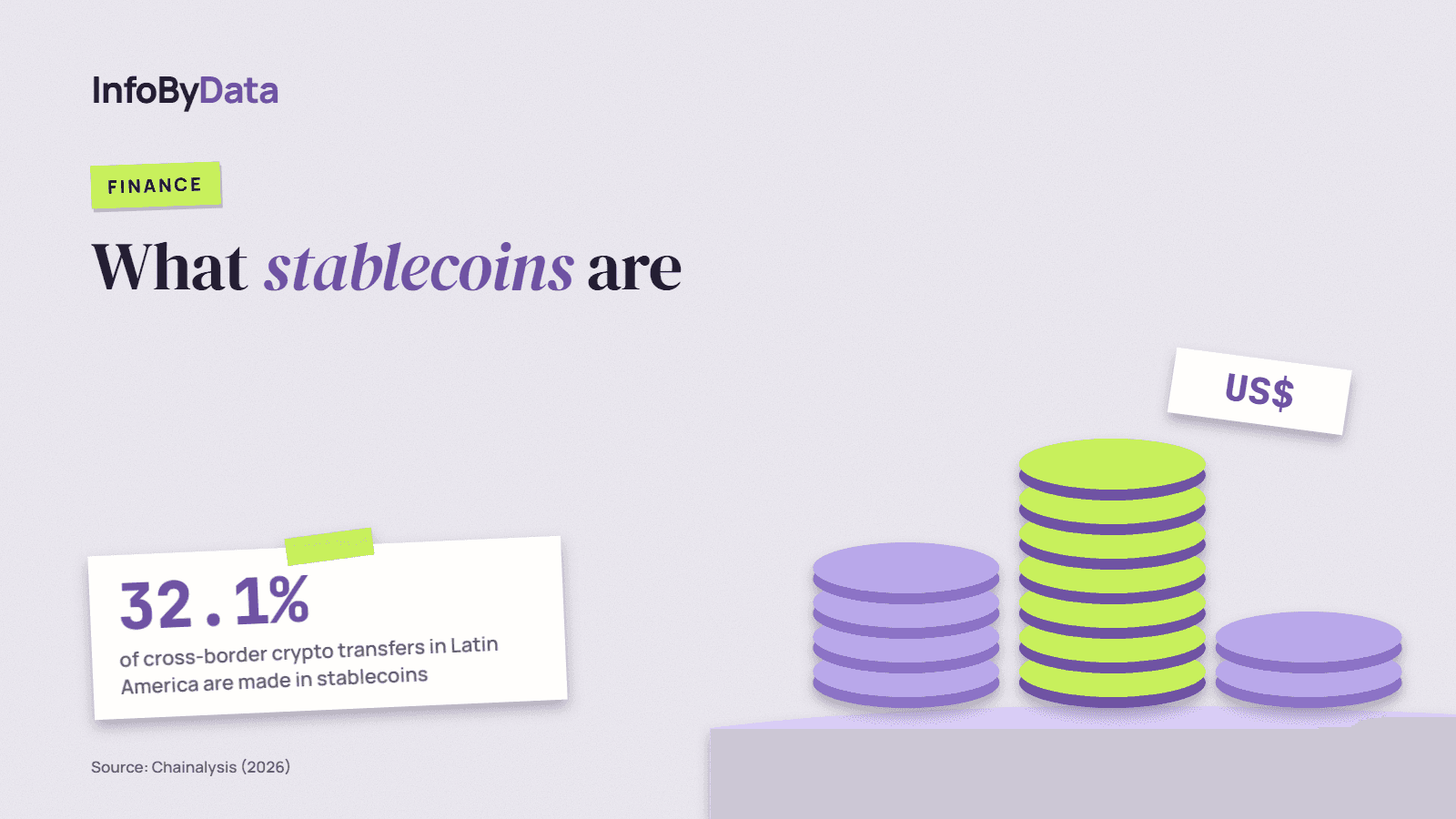
While the bitcoin price has fallen more than 30% in 2026, one type of cryptocurrency stays at around one dollar: stablecoins. Understanding what stablecoins are helps explain one of the biggest changes in the crypto world in Latin America: they now account for 32.1% of the crypto value sent between countries in the region, according to Chainalysis's 2026 report.
Worldwide, stablecoins already total US$279.6 billion, according to CoinGecko. This article explains what they are, which are the largest, how they are used in the region and what risks they carry.
US$279.6 billion
Total value of stablecoins
worldwide
62%
Tether (USDT) share
of all stablecoins
32.1%
Cross-border crypto transfers in Latin America
made in stablecoins
+47%
Chilean wallets with US$10,000 or more in stablecoins
since July 2024
Source: CoinGecko (Nov 27, 2026) and Chainalysis (2026)
View the data as a table
| Total value of stablecoins | US$279.6 billion | worldwide |
| Tether (USDT) share | 62% | of all stablecoins |
| Cross-border crypto transfers in Latin America | 32.1% | made in stablecoins |
| Chilean wallets with US$10,000 or more in stablecoins | +47% | since July 2024 |
What stablecoins are
A stablecoin is a cryptocurrency designed to keep a fixed price, almost always one U.S. dollar. Unlike bitcoin, whose price rises and falls with supply and demand, a stablecoin aims to always be worth the same.
To achieve this, most have an issuer that holds equivalent reserves: for every stablecoin in circulation, it keeps one dollar in cash, deposits or short-term Treasury bills. This is the case for Tether (USDT), USD Coin (USDC) and PayPal USD (PYUSD). Others are backed by other cryptocurrencies or more complex financial mechanisms, such as Dai or Ethena USDe.
In practice, a stablecoin works like a digital dollar that moves over a cryptocurrency network: it can be sent to another country in minutes, stored in a digital wallet or exchanged for other cryptocurrencies, without going through a bank.
Which stablecoins are the largest
The market is highly concentrated. Tether and USDC account for 87% of the value of all stablecoins:
Stablecoins represent about 13% of the total value of the crypto market, which is around US$2.09 trillion according to CoinGecko. Their weight tends to grow when other cryptocurrencies fall, because many users take refuge in them without leaving the crypto world.
How stablecoins are used in Latin America
Chainalysis's report shows that in the region stablecoins are increasingly used to move and store money, not just to speculate. As of June 2026, their weight in Latin America's crypto activity was:
Uses vary by country:
- Payments and remittances in Mexico. Quarterly stablecoin inflows to Mexican platforms reached US$8.4 billion in the second quarter of 2026, more than eight times their 2021 level.
- Business in Brazil. Brazil's stablecoin economy grew 495% over the period, compared with 89.4% in the rest of the region. According to local players cited by Chainalysis, they are used mainly between companies there, because Pix, the Central Bank of Brazil's payment system, already covers everyday payments.
- Protection against inflation in Argentina and Venezuela. Chainalysis describes stablecoins as an alternative way to access dollars when the local currency loses value. Venezuela's crypto economy grew 107.2% over the period.
- Saving in dollars. While self-custodied bitcoin fell 78% in value, stablecoins in those wallets rose 66%.
In Chile, Chainalysis does not publish the size of the market, but it does provide one indicator: wallets with at least US$10,000 in stablecoins grew 47% since July 2024, less than in Brazil, Mexico or Argentina.
Specialized media such as CriptoNoticias and The Block have highlighted the same pattern: the region's crypto activity held up despite falling prices, largely thanks to stablecoins. Latin America's crypto economy moved US$593.8 billion in the 12 months to June 2026, 9.8% more than the previous year.
What risks stablecoins carry
Understanding what stablecoins are also means knowing their risks. Being called "stable" does not mean they are risk-free:
- Issuer risk. Their value depends on the issuer actually holding the reserves it claims and being able to return the dollars when asked.
- Losing the peg. In stressful moments, a stablecoin can trade below one dollar for a while.
- Platform risk. If you keep stablecoins on a platform that goes bankrupt or is hacked, you can lose them. We explain this in our article on trustworthy wallets to store crypto in Chile.
- Not legal money in Chile. For Chile's SII, cryptocurrencies are neither legal tender nor foreign currency, and they do not carry the guarantee of a bank deposit.
Regulation is advancing. In the United States, the GENIUS Act, signed on July 18, 2025, requires payment stablecoins to hold 100% reserves in liquid assets, such as dollars or short-term Treasury bills, and prohibits presenting them as backed or insured by the government. According to the Congressional Research Service, its licensing requirements take effect 18 months after enactment or 120 days after final rules are issued, whichever comes first.
Stablecoins and taxes in Chile
Knowing what stablecoins are also matters for your taxes. Exchanging a cryptocurrency for a stablecoin, for example selling bitcoin to move into USDT, also counts as a sale for the SII: if there was a gain, it must be declared. We explain it in how to declare cryptocurrencies to the SII. To see how the rest of the market has fallen, check the bitcoin price in 2026 and our article on cryptocurrencies in figures.
What it means for you
- If you send or receive money from abroad: stablecoins are an increasingly used alternative in the region, but compare fees, exchange rates and the platform's security before using them.
- If you want to protect savings: a stablecoin tracks the dollar, does not generate returns on its own and depends on its issuer. It does not have the protection of a bank deposit.
- If you run a company with customers or suppliers abroad: in Brazil and Mexico they are already used for business payments. It is worth following how regulation evolves in Chile and in the countries you work with.
This article is for information only and is not investment advice. Cryptocurrencies, including stablecoins, carry risks.
Sources
- Chainalysis: "Latin America crypto adoption 2026"
- CoinGecko: stablecoins category
- CoinGecko: total crypto market capitalization
- CriptoNoticias: "5 países que lideran el mercado de criptomonedas en Latinoamérica, según Chainalysis"
- The Block: "Crypto economy fell just 1.6% in 12 months despite $2.1 trillion market cap rout, Chainalysis says" (September 23, 2026)
- White House: GENIUS Act fact sheet (July 2025)
- Congressional Research Service: "Stablecoin Legislation: An Overview of the GENIUS Act of 2025"
- SII: Ruling No. 963 of 2018
- what stablecoins are
- stablecoins
- USDT
- USDC
- cryptocurrencies in Latin America
- digital dollar